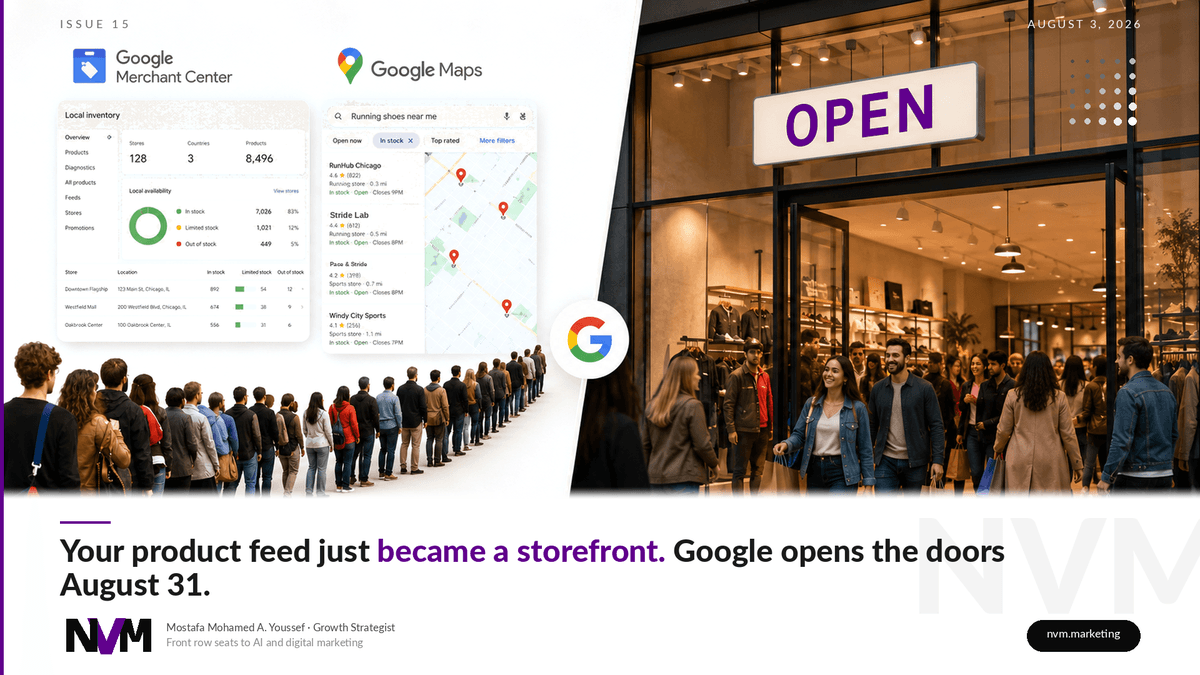
Google Turns On Local Inventory Ads on Aug 31
On August 31 the enable_local setting stops accepting no, and AI Max starts writing product titles from your feed. The Merchant Center feed is now the ad.
Welcome back to the front row. This week the least glamorous file in your account, the one you handed to a developer in 2023 and never opened again, quietly became the most valuable thing you own. On August 31 Google starts reading it out loud, and it will read whatever is in there.
Two announcements landed eleven days apart and the trade press filed them under separate beats. One was a developer note about a setting that stops accepting the answer "no." The other was a feature sighting inside Standard Shopping campaigns. Everyone treated them as two stories. They are one, and the version you have been told (Google is taking control away) is the wrong half of it.
The Feed Stopped Being a File
You have spent years treating the Merchant Center feed as plumbing. Something you open when disapprovals spike and ignore the other fifty-one weeks. The creative work happened in the ad copy, the strategy in the campaign structure, and the feed sat underneath both like a water pipe.
The feed is not plumbing. The feed is the ad.
What it costs you to keep believing otherwise
On August 31, Google enables Local Inventory Ads by default on every Shopping campaign, aligning them with how Performance Max for Retail already behaves. The developer blog says it plainly: the Campaign.ShoppingSetting.enable_local field will no longer have any effect on Shopping campaigns, because the backend overrides it to true.
Whether that is good news or nothing at all comes down to one file. If your store locations and local availability sit in Merchant Center, a second surface opens on your existing budget. If they do not, August 31 arrives and nothing happens. Same reach, same spend, and a competitor who did the boring data work shows up on a query you both wanted.
Google puts a number on that gap. Retailers running local inventory ads alongside Shopping ads see a 21% increase in store visits and a 9% increase in online conversions for products available in store. Read the fine print before the number: Google Data, Global, July 2023 to July 2024, Google's own retailers, no published methodology. I will not launder that into a law of physics. It is good for direction, and the direction says the online lift is the smaller prize. The main event is the store visit, the thing you could never sell to a client with a mall unit.
The mechanism, in order
Start with the API. From v25.1 forward, setting enable_local to false throws ContextError.OPERATION_NOT_PERMITTED_FOR_CONTEXT. Your script does not get a warning. It gets an error.
Two documented workarounds. CampaignCriterionService with a listing scope where product_channel = ONLINE. Or the Inventory filter in campaign settings, Channel set to Online or Local, which is what keeps budgets separable.
Scope matters. Shopping campaigns only. enable_local still behaves normally in Performance Max and Demand Gen.
Google told manager accounts the same thing in plainer language: review your Shopping campaigns before 08/31/2026 and set the Inventory filter if you want online and local budgets kept apart. Full email here. An email and a boolean that stopped answering. Four weeks. The rollout is clumsy and I will say so.
Now the other half. Google's AI Max for Shopping documentation describes text customization that "can dynamically update your product titles to align with customer search queries," and the line underneath matters more: the system treats your feed "as a deep product database rather than a static list," pulling attributes like "waterproof" and "available for store pickup" into titles that serve in AI Overviews and AI Mode. Google's stated result is "+5% more conversions / conversion value at a similar CPA/ROAS." Same honesty tax: internal data, 2026, retail advertisers, no methodology published. Run a test, do not build a deck.
And since July 23 those features have been widely spotted rolling out inside Standard Shopping campaigns, corroborated here. Rolling out in beta.
The pattern nobody named
Back in Issue #1 we said the landing page had stopped being a destination and become your targeting layer. In Issue #2 we said the auction had turned into a beauty contest judged on your inputs. The feed has now collected all three jobs at once. It targets. It writes the copy. And from August 31, it decides which channels you appear on.
Every field you never filled in is now a place you do not show up.
Where you actually stand
You already know which account this exposes. The retail client with eleven branches, whose feed has four attributes and a title that reads like a SKU. You have been meaning to fix it since spring.
That is the MENA problem in one line. GCC and Egyptian retail is overwhelmingly omni-channel. The customer researches on Google and buys in a mall, and connecting those two required an opt-in almost no SMB account ever touched. On August 31 Google connects it.
Local inventory ads run across Egypt, Saudi Arabia, the UAE, Kuwait, Bahrain, Oman, Jordan, Lebanon, Morocco, Tunisia and Algeria. Free local listings, only in Saudi Arabia and the UAE. So in KSA and UAE a clean feed earns two layers on one budget, and everywhere else August 31 is a FREE upgrade to spend you already committed.
One condition: the store and availability data has to be in Merchant Center. Do not wait for the Local Inventory app, because POS auto-upload is limited to the UK, Ireland, US and Canada.
Do this before August 31
List every client with a physical location. That list is your August.
Open each Shopping campaign. Settings, Inventory filter. Channel = Local, Channel = Online, or open. Open only if one budget should serve both.
Check Merchant Center for store data and local inventory. No store data, nothing local serves. That is not a Google problem. That is a Tuesday afternoon.
Running scripts on API v25.1 or later? Stop sending enable_local = false. Use a listing scope through CampaignCriterionService, product_channel = ONLINE.
Pull your top 50 products by spend. Fill the descriptive attributes. AI Max reads attributes, not your headline.
Turn on AI Max text customization in one campaign. Not all of them. Keep a control.
Log a baseline the week of August 24. After September 1 you will want a before.
Four weeks to fill in fields. Then Google fills them in for you, and it guesses from what is already there.
Go write the feed.
PROMPT OF THE WEEK
Paste this with one product's current feed row and let the model do the attribute archaeology you have been avoiding.
You are a Google Merchant Center feed specialist working on a retail account in the MENA region. I will paste one product's current feed data. Do five things. 1) Rewrite the product title as a plain, attribute-dense title. No marketing adjectives, no brand slogans. Use only information present in the data I gave you. 2) List every Merchant Center attribute that is missing or empty, ranked by how likely it is to be used as a matching signal for a search query. For each one, say in a few words why it matters. 3) For each missing attribute, write the exact question I should ask the client to get the value, in one sentence, in plain language a shop owner will understand. 4) Flag any field that would block this product from serving as a local inventory ad if my store data were connected. Name the field and what a valid value looks like. 5) Give me a one-line verdict: is this product ready for AI Max text customization to build a title from, or not yet, and what is the single highest-value field to fill first. Rules: do not invent attribute values. If something is unknown, write "unknown". Do not rewrite the brand name. Output items 1 and 5 as plain text, items 2 to 4 as one table with columns Attribute, Why it matters, Question for client, Blocks LIA (yes/no). Product data: [PASTE FEED ROW]
What this gives you: a client-ready gap list instead of a vague intention to "improve the feed," and it scales to your top 50 SKUs in one afternoon.
THIS WEEK
Search Console platform properties went live globally on July 29. Verify your Instagram, TikTok, X and YouTube accounts and see which search queries pull people to your social content in Google Search, Discover and News. For every MENA SMB whose real storefront is an Instagram profile, this is the first time you can attribute Google search demand to content you do not host, and it is free.
Google Ads shipped Lead Journey Mapping. Drag-and-drop mapping of your end-to-end sales stages inside Google Ads, attaching conversion actions, conversion delays and deal values per stage, and feeding that back into bidding. If you have been explaining "our sales cycle is 45 days" to a bidding strategy that cannot hear you, this is the microphone.
ChatGPT Ads is testing an "Agent" campaign type. The click does not go to your site. It drops the user into a Business Agent chat conversation instead. Issue #2 argued your landing page was being judged before the click. This asks whether there is a click at all.
Target CPA and Target ROAS are standalone bidding strategies again. Rolled out July 29, back in the drop-down instead of buried as optional targets under Maximize Conversions and Maximize Conversion Value. Small change, real consequence: the junior on your team will now find the setting they have been silently not using.
THE DISCOURSE
Arpan Banerjee posted Google's raw LIA email around July 16 and added the one line everybody needed: "this notice applies to manager accounts with Shopping campaigns linked to a Merchant Center account that has the local inventory ads add-on enabled."
No outrage, no thread of doom. He told people exactly who it hits, and the replies asked "does this affect me" instead of "how dare they." That is the correct first question.
@AnthonyHigman, July 28: "Here Is A New One For An Ad Platform!!! I Turn Ad Group Off, Ad Group Immediately Turns Itself Back On......"Fun!!!!""
I laughed, because that is the week's mood exactly: settings you switched off keep switching themselves back on. Look at the reflex underneath the joke, though. We reach for the off switch to defend a control, and half the time the control left the building a year ago and the switch was decoration. The better question is not "how do I turn this off." It is "what does the default hand me, and can I use it before the slow crowd notices it moved." Sometimes the answer is no and you scope it out properly. Sometimes it is free reach you would never have opted into.
TOOL OF THE WEEK
Find your path to local inventory ads and free local listings. Google Merchant Center's interactive troubleshooter. No login, no seat cost, no call.
Six questions: do you have physical stores, a Business Profile, a Merchant Center account, are you sending product data, do you offer ship-to-store or per-store stock, do you have a live inventory feed. It outputs the exact LIA implementation route for your specific setup, and it names Saudi Arabia and the UAE in the supported pickup features.
Use it this week as a sorting machine. Run every retail client with a physical location through it and drop them into three buckets. (a) Already feeding local data: verify the Inventory filter so Online and Local budgets stay separable. (b) Has stores, no local feed: this is the free-reach bucket, take the lightest route the wizard gives you and start now. (c) Pure ecom, no stores: nothing will serve, but scope to product_channel = ONLINE so your API tooling does not break on v25.1.
Three buckets, four weeks, one afternoon of clicking.
MY TAKE
Say you have a Merchant Center tab open right now for a client with nine stores in Cairo, and the feed has five populated attributes. Five. That account has been running Shopping for two years buying online conversions only, while nine physical locations sat there generating footfall Google was never told about.
The marketers who spend August writing threads about consent are the same ones who spent 2025 fighting broad match. They will show up in October asking why their impression share moved.
Meanwhile the retailer with a boring, complete, attribute-heavy feed is about to get paid twice on one budget.
Feeds are not glamorous work. They are the work.
That's Issue #15 of NVM. If this gave you one thing to act on this week, share it with someone who needs it. Reply to this if you have a question. I read every one. See you next week. — Mostafa
NVM · Front row seats to AI and digital marketing
- Subscribe → nvm.marketing/newsletter
- Join the community → nvm.marketing/community
- Write for NVM (pitch a blog post) → nvm.marketing/blog
Get the next issue first
Weekly intelligence on AI, search, and performance marketing, straight to your inbox. No noise.
Prefer to discuss on LinkedIn? Join the conversation on the original post.
Join the discussion on LinkedInComments
Sign in to join the conversation
Sign in