Advanced SEO: Dominating the Middle Eastern Search Landscape
Most brands entering MENA treat Arabic SEO as a translation project — and rank nowhere. Here's what bilingual search markets actually demand.
Ranking on the first page of Google in the Middle East requires more than high-volume keywords and quality backlinks. It requires understanding a search landscape that operates in two languages simultaneously, serves a mobile-dominant audience, and rewards technical precision in ways that Western SEO rarely demands.
Most international brands entering the MENA market treat Arabic SEO as a translation project: take the English content, run it through a localization service, publish it on a subdirectory, and wait for rankings. This approach fails consistently because it misunderstands the fundamental nature of bilingual search markets.
The Bilingual Search Paradox
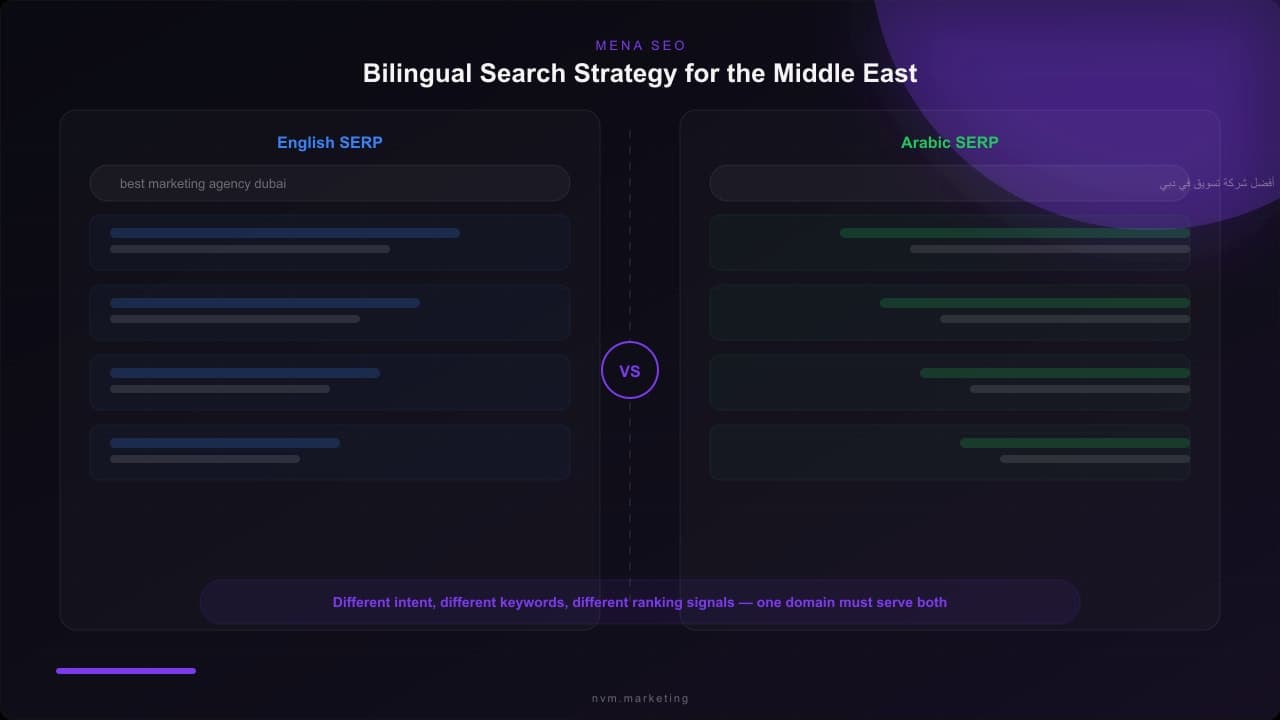
In cities like Dubai, Doha, and Riyadh, users search in both English and Arabic — often for the same intent. A business owner looking for accounting software might search "best accounting software UAE" in English and "أفضل برنامج محاسبة الإمارات" in Arabic during the same research session. These are two separate search environments with different competition levels, different ranking factors, and different user expectations.
Why This Creates Opportunity
Most competitors optimize for one language or the other. They either build an English-first site with minimal Arabic content or an Arabic-first site with limited English reach. A bilingual SEO strategy that treats both languages as primary captures traffic that monolingual competitors cannot.
The data supports this. In the UAE, approximately 45 percent of commercial searches happen in Arabic, but the competition for Arabic keywords is significantly lower than for their English equivalents. A keyword that costs 15 AED per click in English Google Ads might cost 4 AED in Arabic. The same volume differential exists in organic search — ranking for Arabic commercial terms requires less domain authority and fewer backlinks than the English equivalents.
Cross-Lingual Authority Building
The most advanced bilingual SEO strategy builds authority between your Arabic and English content rather than treating them as separate silos. This means:
Internal cross-linking: Your English service page should link to the Arabic equivalent with contextual anchor text, and vice versa. This signals to Google that both versions are authoritative and creates a link equity flow between language versions.
Bilingual content hubs: Rather than duplicating every page in both languages, create content hubs where some pages exist only in English (technical deep-dives that appeal to an international audience) and others exist only in Arabic (locally-focused guides that address region-specific questions). The hub links to both, creating a richer topical cluster than either language alone.
Cross-language backlink strategy: Build Arabic backlinks for your Arabic content and English backlinks for your English content. A common mistake is building only English backlinks for a site that has Arabic content — Google evaluates language-specific authority independently.
Hreflang Implementation: Getting It Right
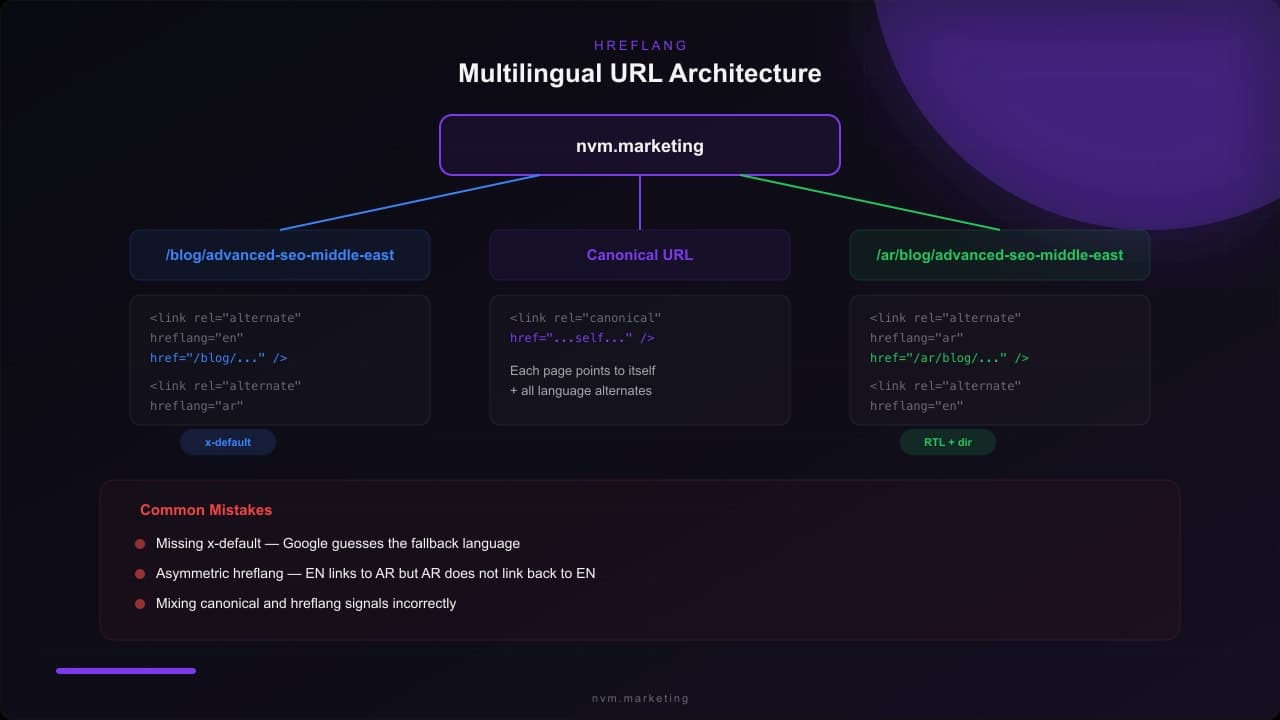
Hreflang tags tell Google which language and regional version of a page to show to which users. They are technically simple but operationally complex, and implementation errors are the single most common technical SEO problem in bilingual MENA sites.
Common Hreflang Mistakes
Missing self-referencing tags: Every page must include a hreflang tag pointing to itself. An English page needs both hreflang="en" pointing to itself and hreflang="ar" pointing to the Arabic equivalent.
Inconsistent URL patterns: If your English pages live at /en/services/seo and your Arabic pages at /ar/services/seo, this structure must be consistent across every page pair. A single broken pair can cascade errors across your entire hreflang implementation.
Missing x-default: The x-default hreflang value tells Google which version to show users whose language and location do not match any specified hreflang. For most MENA businesses, this should point to the English version, as it serves as the default for international visitors.
Conflicting canonicals: Your canonical tags and hreflang tags must agree. If the canonical for an Arabic page points to the English version, Google receives contradictory signals and may ignore the hreflang entirely.
Implementation Best Practices
For Next.js and similar modern frameworks, implement hreflang through the metadata API rather than manual HTML tags. This ensures consistency and reduces human error:
- Generate hreflang values programmatically from your routing structure
- Validate every page pair with a automated crawler that checks for bidirectional references
- Monitor Google Search Console for hreflang errors weekly — they appear under the "International Targeting" report
- Test with Google's URL Inspection tool after any structural changes
Semantic Arabic SEO
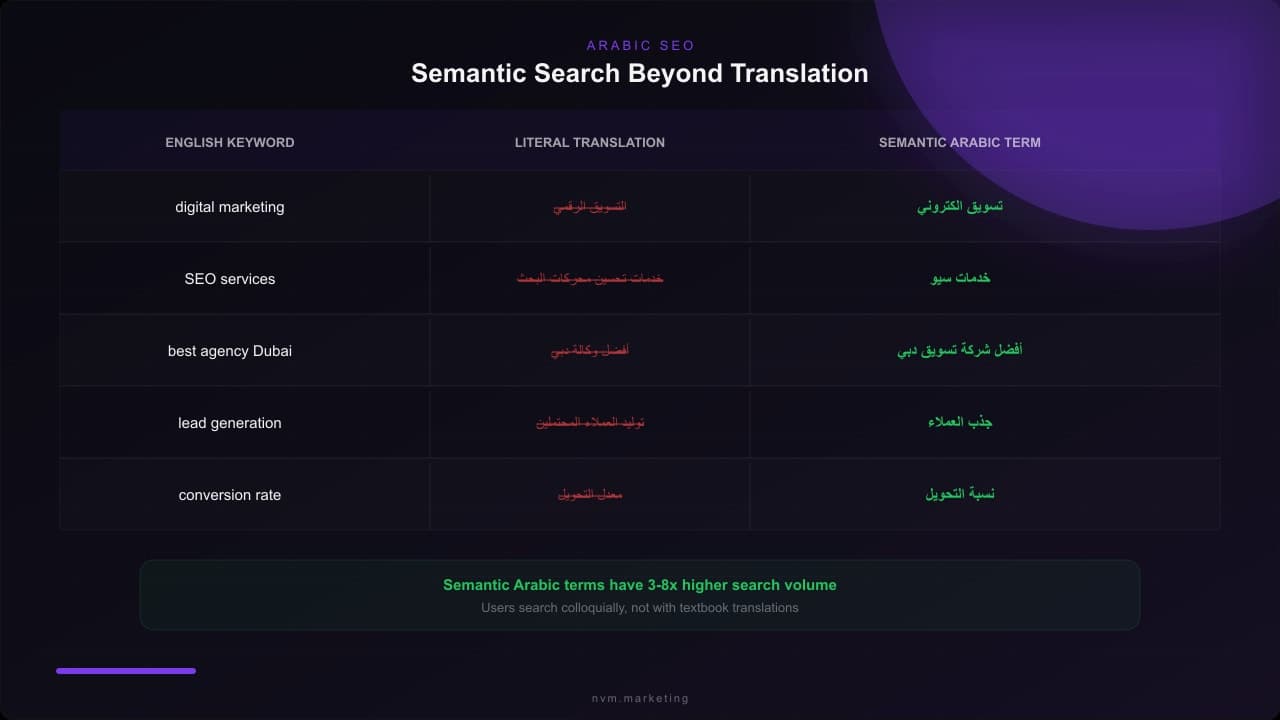
Arabic search optimization is fundamentally different from English SEO. The language has characteristics that affect keyword research, content structure, and on-page optimization in ways that direct translation cannot address.
Root-Based Morphology
Arabic is a root-based language where most words derive from three-letter roots. The root ك-ت-ب (k-t-b, related to writing) produces كتاب (book), كاتب (writer), مكتبة (library), and مكتوب (written). Google's Arabic language models understand these morphological relationships, which means:
- You do not need to separately target every morphological variant of a keyword. Optimizing for the primary form often captures traffic from related variants.
- Your content should naturally include morphological variants rather than unnaturally repeating a single form. This signals topical depth to Google's language model.
- Long-tail Arabic keywords often perform differently than their English equivalents because Arabic morphology compresses multiple English words into single Arabic terms.
Dialect vs. Modern Standard Arabic
Users search differently depending on their dialect and context. A user in Saudi Arabia might search using Gulf Arabic colloquialisms while a user in Egypt uses Egyptian Arabic variants. Meanwhile, formal content tends to use Modern Standard Arabic (MSA, or Fusha).
The effective strategy is to write primary content in MSA for broad reach while naturally incorporating Gulf Arabic terms where they match common search patterns. For example, a page targeting "digital marketing" should include both التسويق الرقمي (MSA) and variations that GCC users commonly search, which might differ from how the same concept is expressed in Levantine or North African Arabic.
Arabic Content Structure
Arabic readers scan pages differently than English readers. Right-to-left text changes the visual hierarchy and the natural eye movement pattern. SEO-optimized Arabic content should:
- Place key information and keywords at the beginning of sentences and paragraphs, but adjust for Arabic sentence structure where the verb often comes first
- Use shorter paragraphs than English equivalents — Arabic text is visually denser and needs more whitespace to maintain readability
- Structure headings with Arabic-appropriate keyword placement, recognizing that Arabic prepositional phrases and definite articles affect how keywords appear naturally in headings
Technical Foundations for MENA SEO
Server Proximity and CDN Configuration
While CDNs distribute content globally, the origin server location still affects Time to First Byte (TTFB), which Google uses as a ranking signal. For MENA-focused sites, hosting on infrastructure with regional points of presence — AWS Bahrain, Google Cloud Doha or Riyadh, or Azure UAE — provides measurable TTFB improvements of 50 to 150 milliseconds compared to US or European hosting.
These gains are small individually but compound across Core Web Vitals metrics. When your competition is tight and ranking positions are separated by marginal technical differences, regional hosting provides a consistent advantage.
Mobile-First Is Mobile-Only
Over 90 percent of search traffic in the GCC comes from mobile devices. Google indexes your mobile version first and foremost. If your site has any differences between mobile and desktop — hidden content, different navigation, truncated text — the mobile version is what Google evaluates.
This makes mobile performance a ranking factor with outsized importance in the MENA market. Specific technical requirements:
- Largest Contentful Paint under 1.5 seconds on mid-range Android devices over 4G connections — this is the real benchmark, not synthetic lab scores
- No layout shifts caused by lazy-loaded images without dimensions, late-loading fonts, or dynamically injected content
- Touch targets minimum 48x48 pixels with adequate spacing — fat-finger errors increase bounce rates which indirectly affect rankings
- Arabic font loading optimization — Arabic web fonts are typically larger than Latin fonts and can significantly delay rendering if not optimized with font-display: swap and preloading
Core Web Vitals for Bilingual Sites
Bilingual sites face a specific Core Web Vitals challenge: the same page template often performs differently in Arabic and English because Arabic fonts render differently, RTL layouts calculate differently, and Arabic text blocks have different dimensions. Test both language versions independently and optimize each — a passing English score does not guarantee the Arabic equivalent passes.
Content Strategy for MENA Search
Intent-Aligned Content
Stop writing content for search engines and start writing for the decisions your audience is trying to make. The highest-converting SEO content answers specific questions that indicate commercial intent:
High-intent queries: "Best property investment areas in Dubai 2026" — the user is comparing options before a purchase decision. Content should compare areas with specific data points: average yield, price per square foot, upcoming infrastructure projects.
High-value informational queries: "How to register a business in Saudi Arabia" — the user needs a process guide and will likely need services related to that process. Content should provide a complete, step-by-step guide while naturally positioning relevant services.
Comparison queries: "Shopify vs custom e-commerce Dubai" — the user is evaluating solutions. Content should provide an honest comparison with local market context rather than pushing one solution.
Topical Authority Building
Google increasingly rewards sites that demonstrate comprehensive expertise in a topic rather than sites that publish thin content across many topics. In the MENA context, this means:
- Build deep content clusters around your core topics. If you are an SEO agency, create 15 to 20 interconnected pages covering every aspect of SEO in the Middle East rather than 5 shallow pages that touch on each topic superficially.
- Include local data, local case studies, and local market references. Content that references UAE-specific regulations, Saudi-specific market data, or GCC-specific consumer behaviors signals local expertise that generic content cannot match.
- Update content regularly. A comprehensive guide published in 2024 that has not been updated loses authority to a less comprehensive guide published last month.
Link Building in the MENA Region
Local Backlink Sources
Backlinks from regional sources carry disproportionate weight for MENA rankings. Priority sources include:
- Regional industry publications and trade associations
- UAE and Saudi government directories and business registries
- Local university research collaborations
- Regional event sponsorships and speaking engagements
- Arabic-language press releases distributed through regional wire services
Digital PR for the Gulf Market
Digital PR in the GCC operates differently from Western markets. Relationship-driven outreach is more effective than cold pitching. Building relationships with journalists and editors at publications like Arabian Business, Gulf News, and regional trade publications requires sustained engagement, not transactional link requests.
The most effective approach is creating original research, market data, or surveys specific to the GCC market. Publications are eager for locally-relevant data they can cite, and these citations generate high-authority backlinks naturally.
SEO Is a Marathon
Search visibility in the Middle East rewards patience and consistency. The businesses that dominate MENA search results are not the ones that ran an aggressive campaign for three months — they are the ones that have been publishing quality content, building technical foundations, and earning authoritative backlinks for years.
The starting point is a technically sound, bilingual website with structured data, correct hreflang implementation, and fast mobile performance. From there, it is a discipline: publish deeply researched content that serves your audience's actual questions, build topical authority through comprehensive coverage, and earn backlinks through genuine expertise.
The competition for MENA search positions is intensifying every quarter. The cost of waiting is not standing still — it is falling behind as competitors who started earlier compound their authority advantage. Start building now.
Keep the signal coming
Practical analysis on AI search, automation, and growth, straight to your inbox. No noise.
Related reading
SEO Trends 2026: Navigating the Search Landscape in the GCC
If your GCC SEO strategy is still keyword density and directory links, you're invisible to high-intent buyers. What drives visibility in 2026.
10 SEO Strategies to Rank Your Dubai Business in 2026
The SEO tactics that worked in 2023 are already outdated in the UAE. Ten strategies tested against the specific realities of the Dubai market in 2026.
E-E-A-T in the AI Era: A 46-Point Audit Guide
Experience, expertise, authority, and trust now influence more than Google rankings. Use this 46-point audit to make your brand, content, and authors easier for search engines and AI assistants to trust.
Have a take on this?
Add a practitioner insight. Approved contributions appear inline with your name.
Comments
Sign in to join the conversation
Sign in