SEO Trends 2026: Navigating the Search Landscape in the GCC
If your GCC SEO strategy is still keyword density and directory links, you're invisible to high-intent buyers. What drives visibility in 2026.
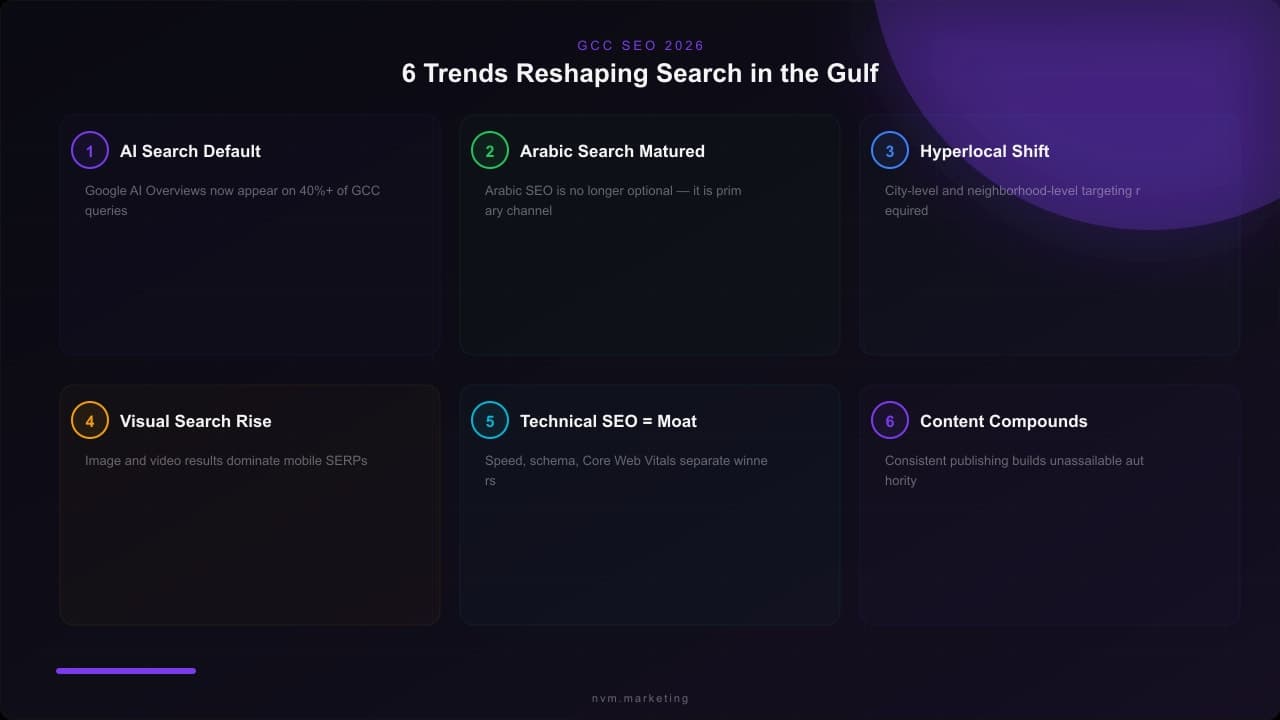
In the Gulf Cooperation Council region, SEO has moved past the era of keyword targeting and backlink accumulation as primary strategies. AI-generated answers, stronger multilingual language models, rising local competition, and shifting user behavior are fundamentally changing how brands earn visibility in search results. The businesses that recognize these shifts and adjust their approach are capturing market share from those still running playbooks designed for a simpler search landscape.
If your SEO strategy is still based on 2023 tactics — keyword density, generic content, and directory link building — you are effectively invisible to your highest-intent audience. Here is what is actually driving search visibility in the GCC in 2026 and what operators need to do about it.
1. AI-Generated Search Experiences Are Now the Default
The most significant shift in search behavior since the introduction of mobile-first indexing is the rise of AI-generated search experiences. Google AI Overviews now appear for the majority of informational and commercial queries in the GCC, providing synthesized answers directly in the search results. Users increasingly expect direct answers rather than a list of links to evaluate.
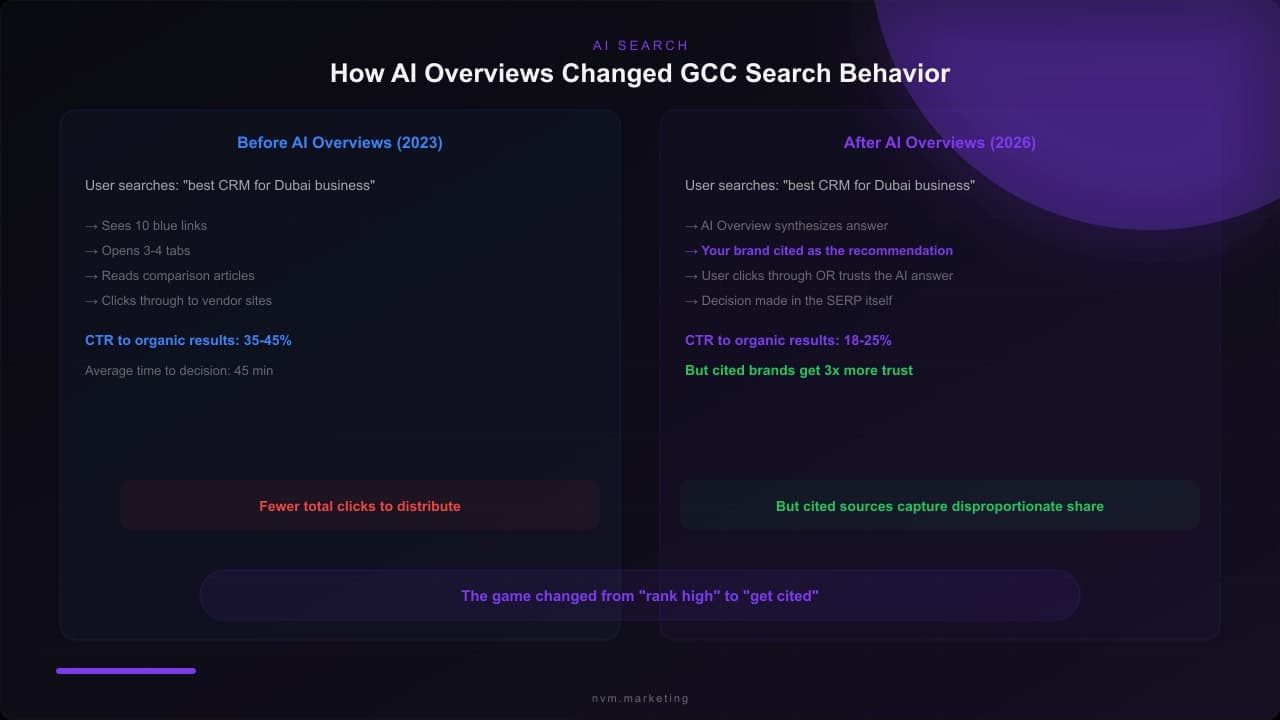
This changes the optimization game in three fundamental ways:
Topic Authority Over Keyword Targeting
Individual page optimization for isolated keywords is no longer sufficient. Google's AI systems evaluate topical authority — whether your site demonstrates comprehensive expertise across a subject area. A site with one page about "SEO in Dubai" ranks worse than a site with interconnected content covering technical SEO, local SEO, Arabic content strategy, link building, and performance optimization in the GCC market.
Building topical authority requires a content architecture approach: pillar pages that cover broad topics comprehensively, supported by detailed pages on each subtopic, all connected through contextual internal linking. The linking is not decorative — it tells Google's language models how your content pieces relate to each other and reinforces the signal that your site is an authoritative source on the topic.
Answer-Engine Optimization
Content structure matters more than ever. AI systems extract answers from content that is organized around clear questions and direct responses. Pages that bury the answer after five paragraphs of introduction perform poorly in AI extraction. The winning format is direct: answer the question in the first paragraph, then expand with supporting evidence, data, and context.
This does not mean writing shallow content. It means structuring deep content so that the key insight is accessible immediately, with the depth available for readers who want it. Think of it as an inverted pyramid — the most important information comes first, and each subsequent section adds depth rather than delaying the answer.
E-E-A-T Becomes Measurable
Experience, Expertise, Authoritativeness, and Trustworthiness are no longer abstract quality guidelines — they are measurable signals that AI systems evaluate when selecting sources to cite. In the GCC context, this means:
- Real-world case studies from Dubai, Riyadh, and Abu Dhabi carry significantly more weight than generic global advice applied to the region
- Named authors with verifiable expertise and published track records are cited more frequently than anonymous content
- First-hand operational data — "we tested this approach across 15 UAE clients and saw a 34 percent improvement" — outperforms theoretical frameworks every time
- Sites with strong brand signals (consistent NAP data, active Google Business Profile, social proof from regional sources) are treated as more trustworthy sources
2. Arabic Search Has Matured Into a Primary Channel
Arabic SEO is no longer an afterthought or a translation exercise. Between 2024 and 2026, Arabic language models improved dramatically, and the competition for Arabic search terms intensified as more businesses recognized the opportunity.
Beyond Modern Standard Arabic
Google's Arabic language understanding now handles dialectal variation with increasing sophistication. This means that searchers in Saudi Arabia, the UAE, Kuwait, and Qatar each have slightly different search patterns that reflect their local Arabic usage. A user in Riyadh might search for a concept using Saudi colloquialisms that differ from how a user in Dubai would phrase the same query.
The practical implication: Arabic keyword research must account for regional dialect variation, not just Modern Standard Arabic equivalents. The businesses that optimize for Gulf Arabic search patterns — the actual phrases people type — capture traffic that competitors optimizing only for MSA miss entirely.
Semantic Search in Arabic
Arabic's root-based morphology creates unique semantic relationships that Google now understands well. A single three-letter root generates dozens of related words, and Google's language models connect these morphological variants when evaluating topical relevance. This means:
- Content that naturally incorporates morphological variants of target keywords signals topical depth without keyword stuffing
- Long-tail Arabic queries often compress multiple English concepts into single Arabic terms, creating high-intent search opportunities that English-only strategies miss
- Arabic content can rank for a broader set of related queries than equivalent English content because of how morphological connections expand the semantic reach of each page
The Bilingual Authority Gap
Most competitors in the GCC optimize for one language or the other. They build an English-first site with minimal Arabic content, or an Arabic-first site with limited English reach. The gap between these approaches is where the opportunity lives.
A bilingual SEO strategy that treats both languages as primary — with independent keyword research, separate content strategies, proper hreflang implementation, and cross-language internal linking — captures traffic from two separate search ecosystems. The combined authority from serving both language audiences creates a competitive moat that monolingual competitors cannot easily cross.
3. Local SEO and the Hyperlocal Shift
"Near me" searches in the UAE have reached all-time highs, and Google's local algorithm has become increasingly sophisticated at matching user intent with geographic proximity. For service businesses, local SEO is not a supplement to organic SEO — it is often the primary acquisition channel.
Google Business Profile as Revenue Driver
Your Google Business Profile is no longer just a directory listing. It is a revenue-generating asset that, for many local service businesses, produces more qualified leads than the website itself. The businesses that treat it as such — with weekly posts, active review management, complete attribute filling, and regular photo updates — consistently outperform those that set it up once and forget it.
The local pack — the map results that appear above organic listings for local queries — captures the majority of clicks for service-oriented searches. Ranking in the local pack requires:
- Complete and accurate business information across all fields
- Consistent NAP (Name, Address, Phone) data across every directory and platform where you appear
- Regular review acquisition with genuine customer responses
- Active posting that signals your business is operational and engaged
- Geographic keyword integration that specifies neighborhoods and districts, not just cities
Neighborhood-Level Optimization
Generic city-level targeting is losing ground to neighborhood-level specificity. "Web design in Business Bay" converts at higher rates than "web design in Dubai" because the specificity matches the user's actual intent. Users searching at the neighborhood level have already narrowed their geographic preference and are closer to a purchase decision.
For multi-location businesses, this means creating location-specific content and Google Business Profiles for each significant service area. A cleaning company serving Dubai Marina, JBR, and Downtown Dubai should have separate, optimized presences for each area rather than a single Dubai-wide listing.
The Reviews Equation
Review signals are now among the strongest local ranking factors. But the equation is not simply "more reviews equals higher rankings." Google evaluates review velocity (how frequently new reviews appear), review quality (detailed reviews with keywords carry more weight), review diversity (reviews across multiple platforms), and review responses (businesses that respond to reviews rank higher than those that do not).
A business with 30 reviews from the last three months will typically outrank a competitor with 200 reviews that are all more than a year old. Recency signals active customer engagement, which Google interprets as a proxy for business quality.
4. Video and Visual Search
The Gulf region has one of the highest per-capita consumption rates for YouTube and TikTok globally. Google is increasingly indexing short-form and long-form video content in search results, creating a visual search layer that text-only strategies miss entirely.
Video SEO as an Acquisition Channel
Video content that ranks on both YouTube and Google's video carousel captures traffic from users who prefer visual learning over text consumption. In the GCC, where video consumption is culturally preferred for many information-seeking contexts, this channel has outsized importance.
Effective video SEO for the GCC market requires:
- Bilingual subtitles: Arabic subtitles on English video content (and vice versa) expand reach across both language audiences and improve accessibility
- Keyword-optimized metadata: YouTube titles, descriptions, and tags should target specific search queries, not generic topic labels
- Chapter timestamps: Video chapters aligned with searchable questions allow Google to index specific sections and surface them as direct answers
- Page embedding: Videos embedded on relevant website pages increase dwell time, reduce bounce rates, and create a content asset that earns both video and page ranking signals
- VideoObject schema: Structured data markup helps Google understand the video's content, duration, and relevance to specific queries
Visual Search and Image Optimization
Google Lens and visual search tools are gaining traction in the GCC, particularly for product discovery and comparison. Optimizing images with descriptive alt text, structured product data, and high-quality visual assets creates an additional discovery channel that most competitors ignore.
5. Technical SEO as Competitive Infrastructure
In a market where content quality and topical authority are converging among top competitors, technical SEO becomes the differentiator. The business with the faster site, better mobile experience, and cleaner technical infrastructure wins the tiebreaker when content quality is comparable.
Core Web Vitals in the GCC Context
Core Web Vitals — LCP, INP, and CLS — are explicit ranking signals, and in the GCC's mobile-dominant search environment, they carry outsized weight. Over 90 percent of search traffic in the Gulf comes from mobile devices, and Google indexes your mobile version first.
The benchmarks that matter in the GCC competitive set:
- LCP under 1.5 seconds on mid-range Android devices over 4G connections — not synthetic lab scores but real-world field data
- INP under 200 milliseconds across all interactive elements
- CLS under 0.1 with no layout shifts from late-loading images, fonts, or dynamically injected content
For bilingual sites, these metrics must be tested independently for each language version. Arabic pages often perform differently than English equivalents because Arabic fonts render differently, RTL layouts calculate differently, and Arabic text blocks have different dimensions.
Structured Data as a Ranking Amplifier
JSON-LD structured data implementation is one of the most underutilized SEO advantages in the GCC market. Most competitors either skip it entirely or implement only basic Organization schema. Comprehensive structured data — LocalBusiness, FAQPage, HowTo, Article, BreadcrumbList, Product, and Service schemas — increases the probability of earning rich results that command higher click-through rates than standard listings.
Site Architecture for Crawl Efficiency
Clean site architecture ensures that Google can discover and index your content efficiently. This includes properly configured XML sitemaps with accurate lastmod dates, canonical tags that prevent duplicate content issues (especially critical for bilingual sites), hreflang tags that connect language versions correctly, and an internal linking structure that distributes authority to your most important pages.
6. Content as a Compounding Asset
The businesses that dominate GCC search results are not the ones that ran an aggressive campaign for three months. They are the ones that have been publishing quality content consistently, building technical foundations methodically, and earning authoritative backlinks through genuine expertise for years.
Content in a mature SEO strategy is a compounding asset. Every piece of high-quality content adds topical authority, earns organic backlinks over time, generates branded search volume, and creates internal linking opportunities that strengthen the entire site. The cost of creating content is fixed, but the traffic it generates compounds over time.
The GCC search landscape is intensifying every quarter. New competitors enter, existing competitors upgrade their strategies, and the cost of catching up grows. The starting point is a technically sound, bilingual website with structured data, correct hreflang implementation, and fast mobile performance. From there, it is a discipline of consistent execution — publishing deeply researched content, building topical authority, and earning backlinks through genuine expertise.
Start building now. The businesses that wait will find the positions they want occupied by competitors who started earlier.
Keep the signal coming
Practical analysis on AI search, automation, and growth, straight to your inbox. No noise.
Related reading
Advanced SEO: Dominating the Middle Eastern Search Landscape
Most brands entering MENA treat Arabic SEO as a translation project — and rank nowhere. Here's what bilingual search markets actually demand.
10 SEO Strategies to Rank Your Dubai Business in 2026
The SEO tactics that worked in 2023 are already outdated in the UAE. Ten strategies tested against the specific realities of the Dubai market in 2026.
E-E-A-T in the AI Era: A 46-Point Audit Guide
Experience, expertise, authority, and trust now influence more than Google rankings. Use this 46-point audit to make your brand, content, and authors easier for search engines and AI assistants to trust.
Have a take on this?
Add a practitioner insight. Approved contributions appear inline with your name.
Comments
Sign in to join the conversation
Sign in