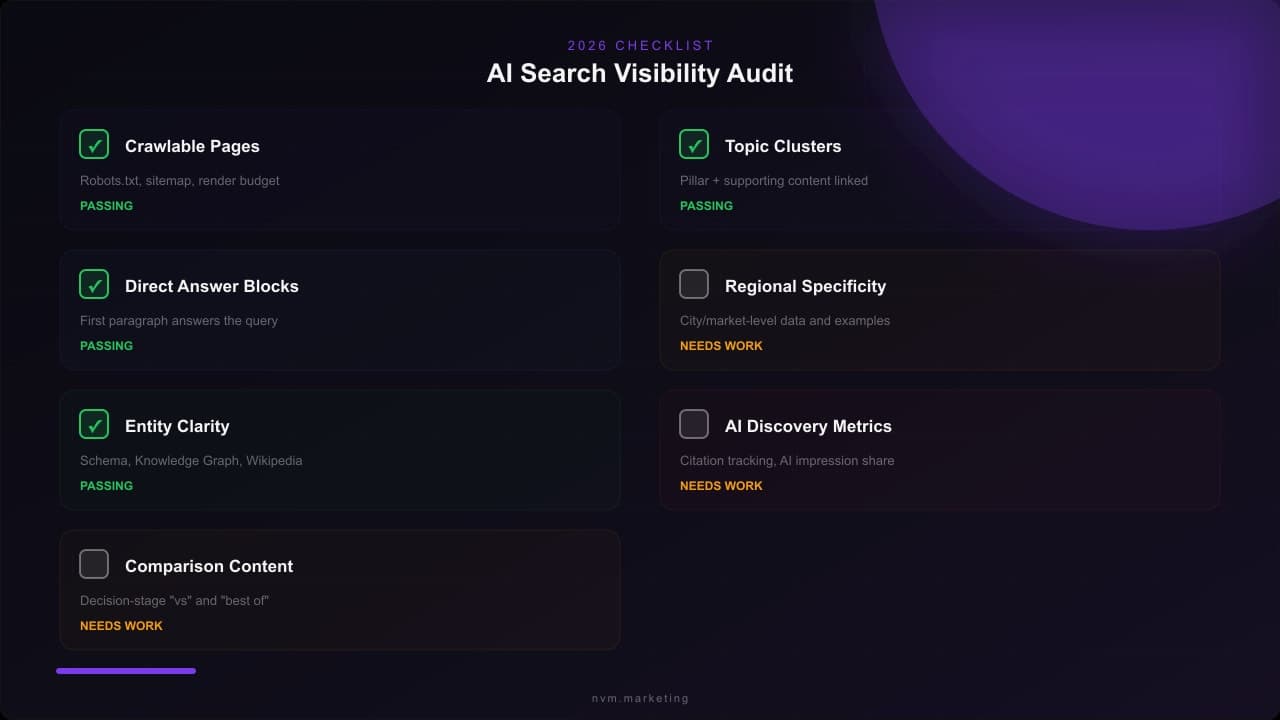
AI Search Visibility Checklist 2026: Be Answer-Ready
Google AI Overviews, ChatGPT, Perplexity — they all cite content differently. Seven areas that decide whether your brand shows up in AI answers.
AI search visibility is the ability of a brand, product, or expert to be understood, cited, compared, and recommended by search engines, answer engines, and AI assistants. It is not a separate discipline from SEO — it is what SEO becomes when the discovery interface shifts from a list of links to a synthesized answer.
Traditional SEO still matters. Crawlable pages, clear titles, internal links, useful content, and technical quality remain the foundation. What changed is the format of discovery: buyers now ask longer questions and expect direct answers. Google AI Overviews, ChatGPT, Perplexity, and Gemini all extract, synthesize, and cite content differently than traditional search results display it. Your content needs to work for both formats.
This checklist covers the seven areas that determine whether your brand appears in AI-generated answers — and what to fix if it does not.
1. Start with Crawlable, Indexable Pages
AI visibility does not fix weak technical SEO. No amount of answer-optimized content matters if Google cannot reliably crawl and understand the page. Answer engines depend on the same underlying index that traditional search uses. If your pages are not in that index — or are in it with errors — AI systems have less reliable source material to work with.
Your important pages must:
- Return a working 200 status: Pages that intermittently return 500 errors, redirect chains, or soft 404s get deprioritized in both traditional and AI search results. Audit your server logs monthly for status code anomalies.
- Be crawlable through real HTML links: JavaScript-rendered content that requires client-side execution to display creates crawling ambiguity. Server-side render or statically generate your important pages so Googlebot sees the content immediately.
- Avoid accidental noindex tags: A surprisingly common issue — development or staging noindex directives that survive into production. Check every important page with Google's URL Inspection tool after any deployment that touches robots configuration.
- Use self-consistent canonical URLs: Canonical tags should point to the exact URL you want indexed, and that URL should return a 200 status. Conflicting canonicals — where page A canonicalizes to page B, but page B canonicalizes to page C — confuse both traditional and AI search systems.
- Appear in the sitemap only when index-worthy: Your XML sitemap should be a curated list of your best, indexable pages — not an automated dump of every URL on your domain. Include accurate lastmod dates so crawlers prioritize recently updated content.
For bilingual sites targeting the GCC, add hreflang validation to this technical checklist. Every page pair must have bidirectional hreflang references (English page points to Arabic, Arabic page points to English), self-referencing hreflang tags, and a consistent x-default declaration. Hreflang errors are the most common technical SEO problem in bilingual MENA sites, and they directly impact which language version AI systems choose to cite.
2. Write Direct Answer Blocks
Every important page should answer the core question quickly — not after three paragraphs of introduction, not after a company history section, not after a generic industry overview. The answer should be in the first 50 to 100 words of the page or section.
This is the inverted pyramid approach: lead with the answer, then expand with supporting evidence, context, and depth. AI systems extract from the top of the content, not the bottom. Content that buries the answer performs poorly in AI extraction even if it contains excellent information deeper in the page.
Good answer-ready content usually has:
- A direct definition or answer in the first paragraph that a reader (or AI system) can extract as a standalone statement
- Short paragraphs of two to four sentences that each make a single clear point
- Clear subheadings phrased as questions or topic labels that help both readers and AI systems navigate the content structure
- Specific examples with numbers, dates, locations, and named entities rather than abstract generalizations
- Comparison sections that explicitly evaluate alternatives — AI systems frequently cite content that compares options because comparison queries are among the most common conversational search patterns
- Practical checklists that condense actionable steps into scannable formats
The discipline is not simplifying your content — it is front-loading your content. The depth should still be there. The structure should make the key insight immediately accessible while the supporting evidence rewards deeper reading.
3. Build Entity Clarity
AI systems need to understand what your brand is, what it does, who it serves, and why it should be trusted. This understanding is built from the consistency and clarity of entity signals across your digital presence. If your own site cannot explain the entity clearly, AI systems will struggle to represent you accurately in their responses.
Entity Signals to Tighten
About page: This should be a comprehensive entity declaration — not a marketing narrative. State clearly what your company does, who it serves, where it operates, when it was founded, and what specific expertise it offers. Include specific credentials, certifications, partnerships, and geographic coverage.
Author bios: Named authors with verifiable expertise earn more AI citations than anonymous content. Each author bio should include their specific area of expertise, relevant experience, published work, and professional affiliations. Link author bios to LinkedIn profiles, industry publications, and other verifiable sources.
Service and product pages: Each page should clearly define what the service or product is, who it is for, what problem it solves, and how it differs from alternatives. Use specific language rather than marketing abstractions — "We build Next.js e-commerce sites for UAE retail brands" is more citable than "We create world-class digital experiences."
Case studies: Detailed case studies with specific metrics, named (or categorized) clients, defined timelines, and clear methodology are among the most cited content types in AI responses. They simultaneously satisfy E-E-A-T requirements and provide the specific data points that AI systems prefer to extract.
Organization schema: JSON-LD Organization schema should include your legal name, description, founding date, location, service areas, contact information, and sameAs links to your social profiles and directory listings. This structured data helps AI systems understand your entity attributes programmatically.
SameAs identity links: Link your website to your Google Business Profile, LinkedIn company page, industry directory listings, and other authoritative profiles. These connections reinforce your entity identity across the web and help AI systems connect information about your brand from multiple sources.
4. Add Comparison and Decision-Stage Content
AI-assisted buyers compare before they click. The research phase that previously involved visiting five separate websites now happens within a single conversational interaction. The content that gets cited in these interactions is content that directly supports comparison and evaluation.
Build content that helps buyers evaluate options:
- Head-to-head comparisons: SEO vs GEO, agency vs in-house, platform A vs platform B. Structure these with clear criteria, specific data points, and a summary recommendation. AI systems frequently cite comparison content because it matches the most common conversational query format.
- Best-of lists with criteria: "Best CRM for UAE real estate agencies" with specific evaluation criteria and ranked recommendations. Include pricing, features, limitations, and use-case fit.
- Cost and pricing guides: "How much does X cost in the UAE?" Content that provides specific cost ranges, factors that affect pricing, and budget planning frameworks answers high-intent queries that directly precede purchase decisions.
- Common mistakes and pitfalls: "Mistakes to avoid when choosing X" content gets cited because it answers the risk-assessment questions that careful buyers ask before committing.
- Process and methodology guides: "How to evaluate," "How to implement," and "How to measure" content supports buyers who have decided what they want but need guidance on execution.
These content types support both traditional search intent (they rank for commercial and informational keywords) and AI answer extraction (they match the question-answer format that AI systems prefer to cite).
5. Connect Articles into Clusters
Isolated articles do not build topical authority. Connected content clusters do. When you publish a series of related articles and link them together with descriptive anchor text, you create a content network that signals comprehensive expertise on a topic.
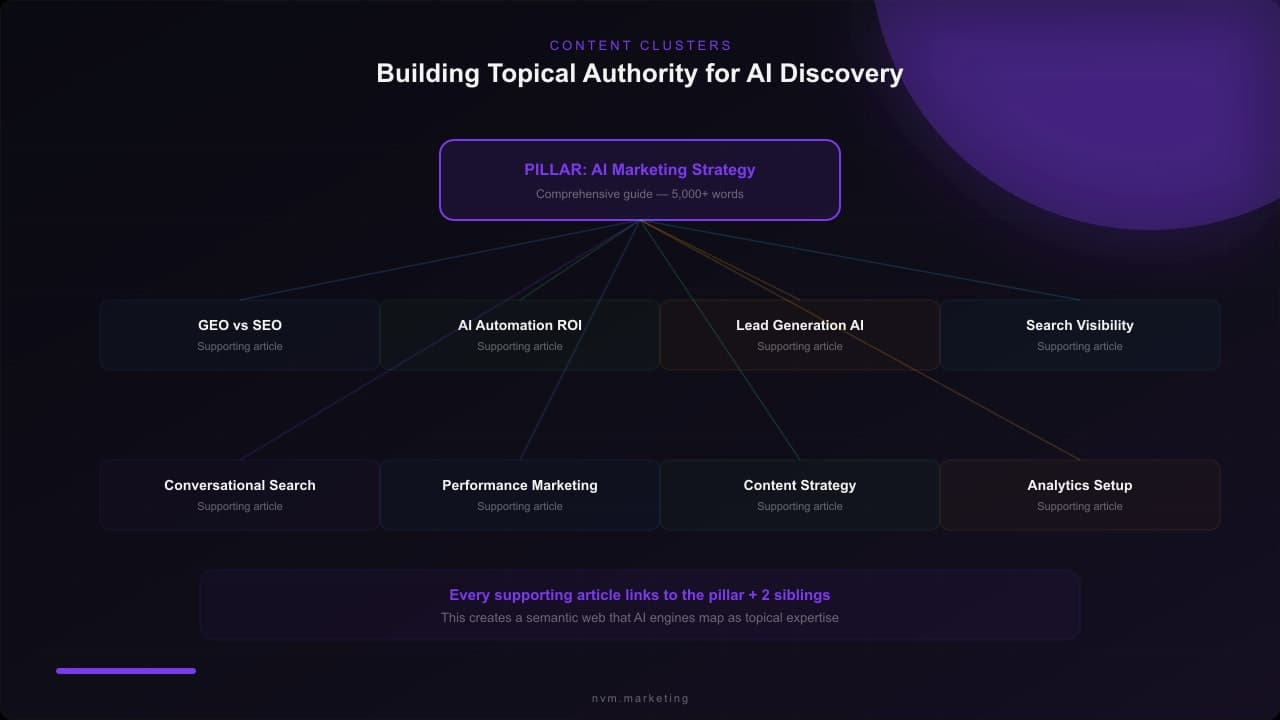
A useful cluster might include:
- A pillar guide that covers the broad topic comprehensively (2,000+ words, covering all major subtopics)
- Supporting articles that go deep on specific subtopics (each 1,200+ words, providing practitioner-level detail)
- A practical checklist that condenses the key actions into an actionable format
- A comparison article that evaluates alternatives within the topic area
- A regional field note that adapts the global advice to a specific market (MENA, GCC, UAE)
Internal linking between these pages should use descriptive anchor text — not "click here" or "read more," but "our guide to hreflang implementation for bilingual sites" or "the comparison between GEO and traditional SEO." This descriptive linking helps both readers navigate the content and AI systems understand the topical relationships between your pages.
6. Keep Regional Content Specific
Global strategy articles should not pretend every market behaves the same. Regional articles are strongest when they explain specifically where and how execution changes in a particular market.
For MENA and GCC markets, regional specificity typically means:
- Arabic and English search behavior: How bilingual audiences search differently in each language, and what that means for content strategy
- Local trust signals: WhatsApp as a conversion path, BNPL integration, Cash on Delivery considerations, and local payment platform logos
- Mobile-first reality: Over 90 percent mobile search traffic and the technical implications for performance and UX
- Local payment and checkout patterns: Tabby, Tamara, regional bank integrations, and how payment options affect conversion
- Regional proof and entity signals: UAE-specific case studies, GCC market data, Arabic language authority signals
- Regulatory considerations: UAE data protection requirements, advertising restrictions, industry-specific compliance
The key distinction: not every article needs to be regional. Keep global pieces global — they serve international audiences and build broad topical authority. Make regional pieces genuine field notes that provide actionable insight specific to the market, not generic advice with a "Dubai" modifier added.
7. Measure the New Discovery Path
Analytics built for click-based discovery do not fully capture AI-driven discovery. Users may see your brand cited in an AI answer, remember it, and search for you directly — but that journey never appears as a referral in your analytics. Building a measurement framework for AI visibility requires additional tracking layers:
- Newsletter signups by page: Track which content pages drive the most email signups as a proxy for content quality and audience engagement
- Tool or waitlist signups by page: If you offer tools, audits, or gated resources, measure which content drives the most signups
- Blog-to-conversion path tracking: Monitor which blog pages lead to service inquiries, tool usage, or newsletter subscriptions
- AI referral traffic: Create separate analytics segments for traffic from ChatGPT, Perplexity, Google AI Overviews, and other AI platforms. This segment is small but growing rapidly
- Brand search volume trends: Monitor branded search queries in Google Search Console. Increases that do not correlate with advertising campaigns may indicate growing AI citation visibility
- Search Console query analysis: Review the specific queries driving impressions and clicks. Conversational, question-format queries are growing and indicate AI-adjacent search behavior
AI search measurement is imperfect. That imperfection makes clean first-party conversion tracking more important, not less. If you cannot track the full journey from AI citation to purchase, at least track the conversion events on your site with enough granularity to detect changes in traffic quality and source composition.
The Operator Takeaway
The winning pattern is simple in concept and demanding in execution: keep SEO fundamentals clean, write answer-first content, clarify the entity, build comparison and decision-support content, connect related pages into clusters, make regional content genuinely specific, and measure the new discovery paths that AI search creates.
GEO is not a replacement for SEO. It is a stricter version of the same principles — content clarity, trust signals, and structural organization — applied to a discovery interface that extracts and synthesizes rather than ranks and lists. The brands that execute on both traditional SEO and AI visibility build a compounding advantage that becomes increasingly difficult for competitors to replicate.
Keep the signal coming
Practical analysis on AI search, automation, and growth, straight to your inbox. No noise.
Related reading
E-E-A-T in the AI Era: A 46-Point Audit Guide
Experience, expertise, authority, and trust now influence more than Google rankings. Use this 46-point audit to make your brand, content, and authors easier for search engines and AI assistants to trust.
Conversational Buying Shift: How AI Changed Search
Between 2023 and 2026, how consumers discover and buy changed more than in the previous decade of mobile. The data on what shifted and why.
What Is Digital Marketing? Channels, Strategy & ROI
Digital marketing isn't a department — it's an operating system for growth. Six disciplines, one coordinated system, every dollar traceable.
Have a take on this?
Add a practitioner insight. Approved contributions appear inline with your name.
Comments
Sign in to join the conversation
Sign in