What Is Digital Marketing? Channels, Strategy & ROI
Digital marketing isn't a department — it's an operating system for growth. Six disciplines, one coordinated system, every dollar traceable.
Digital marketing is the use of online channels, content, data, and paid media to attract the right audience, generate demand, and turn interest into measurable business results. It is not a department or a tool — it is an operating system for growth that connects how your company is found, evaluated, and chosen.
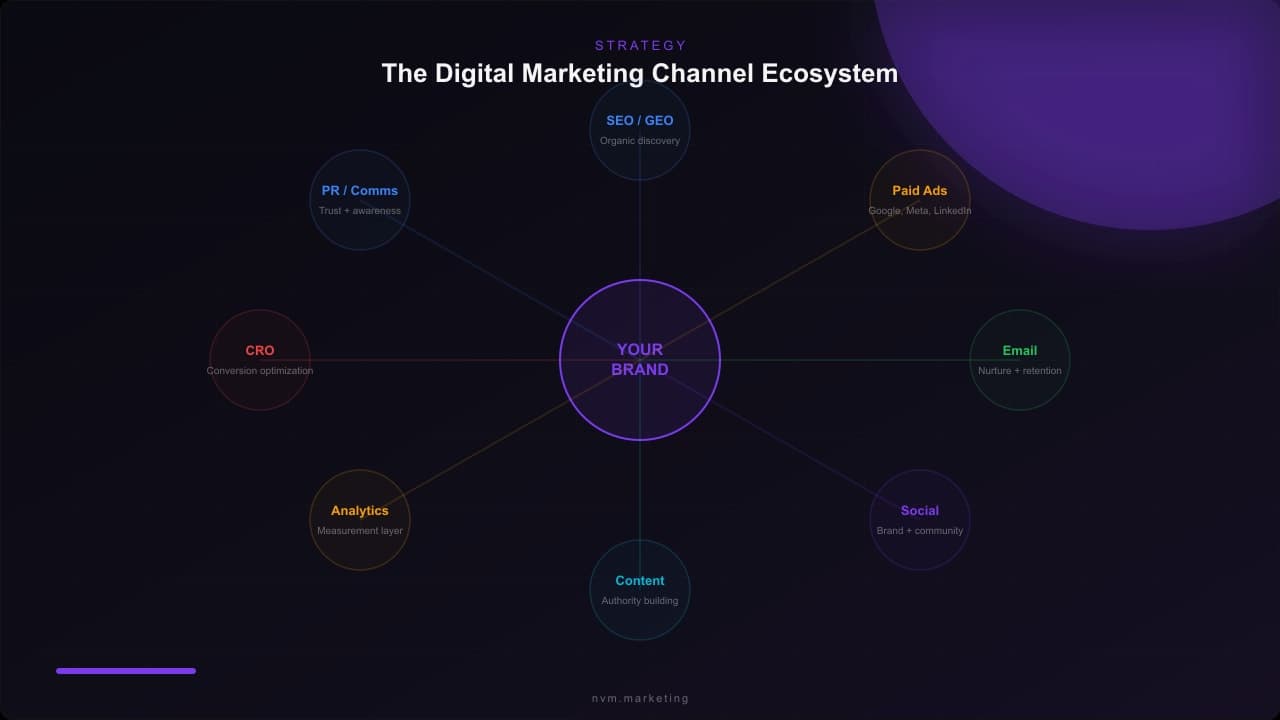
For most companies, that means combining search, content, paid ads, social, email, and analytics into one coordinated system instead of treating each channel as a separate activity. The businesses that grow consistently are not the ones spending the most — they are the ones where every channel reinforces the others and every dollar of spend is traceable to an outcome.
What Does Digital Marketing Include?
Digital marketing spans every channel where your buyer researches, compares, and decides. In practice, six disciplines make up the core system:
Search Engine Optimization (SEO) — improving pages so they rank for relevant search intent. SEO is not a one-time project. It is an ongoing practice of matching your content to the queries your buyers actually type, building topical authority through depth and structure, and maintaining the technical quality that search engines require.
Paid Search and Paid Social — running campaigns on Google, Meta, LinkedIn, TikTok, and similar platforms. Paid channels give you speed and precision that organic channels cannot match on day one. They also generate the data you need to understand which messages, audiences, and offers convert — intelligence that feeds back into every other channel.
Content Marketing — publishing articles, landing pages, videos, case studies, and guides that answer questions and support buying decisions. Content is the connective tissue of digital marketing. Without it, SEO has nothing to rank, paid ads have nowhere useful to send traffic, and email has nothing valuable to deliver.
Email Marketing — nurturing leads, onboarding users, and keeping existing customers engaged through targeted sequences and broadcasts. Email remains one of the highest-ROI channels because you own the audience list and control the timing and frequency of communication.
Conversion Rate Optimization (CRO) — improving pages and funnels so more visits turn into leads or sales. CRO is where strategy meets execution. A page that converts at 3 percent instead of 1.5 percent effectively doubles the value of every traffic source pointing to it.
Analytics and Attribution — measuring what actually drives pipeline, revenue, and retention. Without clean measurement, every other activity is guesswork. Analytics answers the question that matters most: which efforts produce revenue, and which produce vanity metrics?
Why Digital Marketing Matters Now
The buying process has fundamentally changed. Buyers now research, compare, and shortlist before they ever speak to a salesperson. In B2B, the average buyer is 70 percent through their decision process before engaging with a vendor. In e-commerce, a customer may evaluate five competitors in ten minutes without clicking a single ad.
This shift creates specific requirements that every digital marketing system must address:
Mobile-First Execution — in the GCC, over 90 percent of search traffic comes from mobile devices. If your landing pages, forms, and checkout flows are not designed for mobile-first interaction, you are losing the majority of your potential conversions before the buyer even engages with your content.
Bilingual Coverage in Multilingual Markets — in the UAE, Saudi Arabia, and across the GCC, buyers search in both English and Arabic for the same products and services. A business that only optimizes for English search misses the Arabic-language demand entirely — and that demand is growing faster than English search in several GCC verticals.
Speed as a Revenue Variable — every second of page load time costs conversions. A site that loads in 1.5 seconds versus 4 seconds can see 50 to 100 percent higher conversion rates on the same traffic. Speed is not a technical nice-to-have. It is a revenue lever.
Trust Signals That Match Buyer Expectations — strong service pages, clear business details, author credibility, verifiable case studies, and visible proof matter more than ever. AI search systems and answer engines prioritize content from entities they can verify. The brands with the clearest trust signals get cited more frequently.
The Main Digital Marketing Channels — How They Actually Work Together
SEO: The Compounding Engine
SEO helps you earn traffic from queries your audience already searches for. Unlike paid channels, SEO compounds — a well-optimized page can generate traffic for years with minimal ongoing cost. But SEO is slow to start and requires consistent investment in content quality, technical maintenance, and authority building.
SEO works best when your site has clear information architecture that helps search engines understand your topic coverage, useful content that answers specific questions with depth and accuracy, strong internal linking that distributes authority across your important pages, and technically clean pages that load fast and render correctly for crawlers.
In the GCC context, SEO also requires bilingual optimization — separate content strategies for English and Arabic that account for different search behaviors, different keyword patterns, and different competitive landscapes in each language.
Paid Ads: Speed and Controlled Testing
Paid campaigns give you speed and controlled testing that no organic channel can match. When you need lead volume this week, want to validate a new offer or message, or need to compete on high-intent commercial searches where organic positions are locked by established competitors, paid is the right tool.
The discipline of paid advertising is not in spending money — it is in spending money efficiently. That means tight audience targeting, strong negative keyword management, dedicated landing pages for each campaign theme, and conversion tracking that goes beyond the click to measure actual business outcomes.
In the UAE, Google Ads CPCs vary dramatically by industry — real estate keywords can cost 25 to 120 AED per click, while e-commerce keywords may cost 2 to 15 AED. Understanding your industry's cost structure and acceptable CPA thresholds determines whether paid channels are profitable or wasteful.
Content Marketing: The Trust Builder
Content marketing is how you build topical authority and answer the questions buyers ask before converting. Strong content usually supports both SEO (by providing the pages that rank) and sales enablement (by providing the proof and education that sales teams share with prospects).
The most effective content for digital marketing is not generic thought leadership. It is specific, practical, and structured for extraction:
- Service and product pages that clearly explain what you do, who you serve, and how you differ
- Comparison content that helps buyers evaluate options — your solution versus alternatives, with honest assessment
- Case studies with specific metrics, timelines, and methodology that prove your claims
- How-to guides that demonstrate expertise while helping the reader accomplish something concrete
- FAQ content that addresses the objections and questions that arise during the buying process
Social Media: Distribution and Brand Recall
Social media works well for distribution, remarketing, brand recall, and community building. It amplifies the content you create, keeps your brand visible between active buying cycles, and provides a channel for engagement that builds familiarity and trust over time.
However, social media rarely works as a standalone acquisition system. It is most powerful when integrated with content marketing (social distributes your content), paid advertising (social platforms provide retargeting and lookalike audiences), and CRM (social engagement signals buying intent that your sales team can act on).
Email Marketing: The Highest-ROI Channel
Email remains one of the most efficient channels for lead nurturing, customer education, reactivation, and retention. The reason is simple: you own the audience, you control the message, and the marginal cost of sending is near zero.
Effective email marketing in a digital strategy requires segmentation based on behavior and buying stage, automated sequences that deliver the right content at the right time, regular broadcasts that keep your brand top-of-mind, and clean list management that maintains deliverability.
Analytics and CRO: The Multiplier
Traffic without measurement is noise. Every serious digital marketing system needs clean tracking infrastructure, clearly defined conversion points, regular A/B experiments on page structure and messaging, and attribution modeling that connects marketing activity to revenue.
CRO is the multiplier that makes every other channel more valuable. A 1 percent improvement in conversion rate on your highest-traffic pages can be worth more than a 20 percent increase in traffic — and it costs a fraction of the price.
How to Build a Practical Digital Marketing Strategy
Step 1: Set One Primary Business Goal
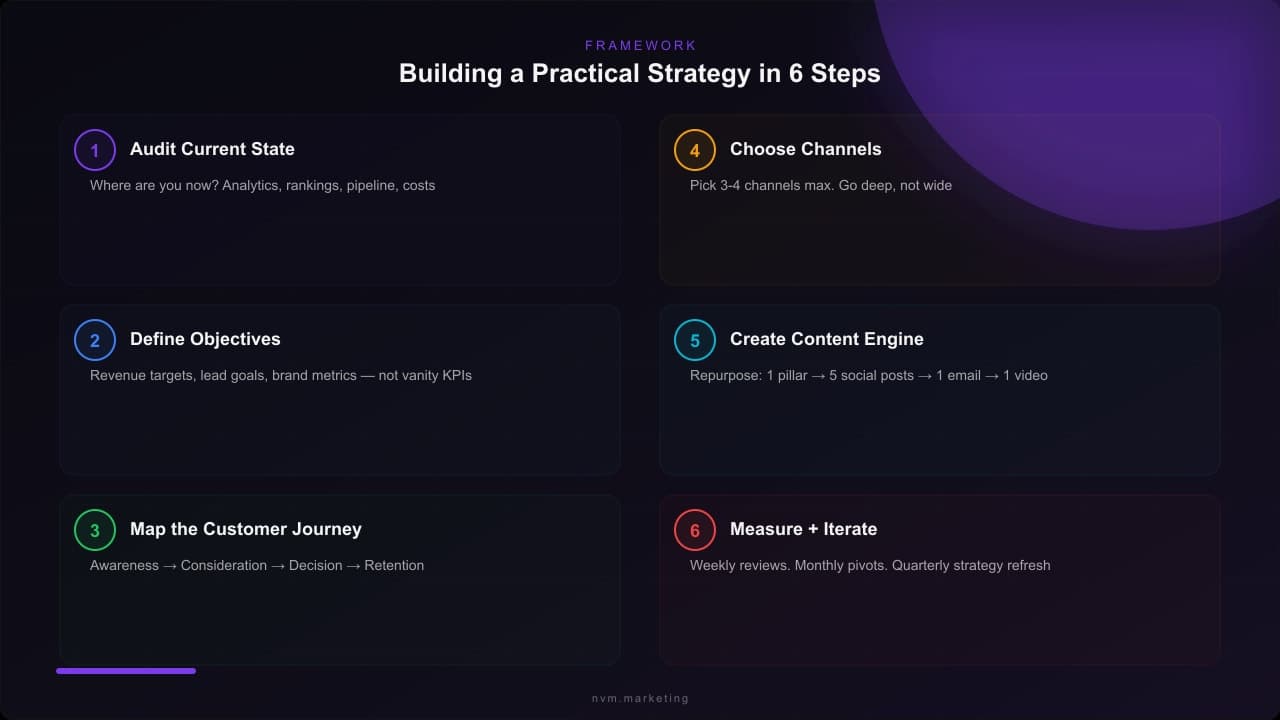
Start with the outcome, not the channel. Are you trying to generate more qualified leads? Increase online purchases? Reduce cost per acquisition? Improve customer retention? The goal determines every subsequent decision — which channels to prioritize, what content to create, and what metrics to track.
Avoid compound goals like "increase traffic and improve brand awareness and generate more leads." When everything is a priority, nothing gets the focus it needs. Pick the single metric that matters most to your business right now, and orient the entire strategy around moving it.
Step 2: Define the Audience and Buying Stage
Not all traffic is equal. A visitor searching "what is CRM software" is in a different buying stage than someone searching "HubSpot vs Salesforce pricing." They need different pages, different messages, and different calls to action.
Map your audience by buying stage — awareness (problem recognition), consideration (solution comparison), and decision (vendor selection). Then identify the specific queries, questions, and concerns at each stage. This mapping determines your content calendar, your ad targeting, and your landing page architecture.
Step 3: Pick the Right Channel Mix
Do not start everywhere. Start where search intent or customer attention is strongest, and expand from there. For most B2B companies in the GCC, that means Google Search (paid and organic) plus LinkedIn. For e-commerce, it typically means Google Shopping, Meta ads, and SEO.
The channel mix should be driven by data, not assumptions. Where does your current traffic come from? Which sources produce the highest-quality leads? Where are your competitors investing? Start with two or three channels, execute them well, measure the results, and then expand.
Step 4: Create the Right Assets
Strategy without assets is a plan that never executes. The minimum viable asset set for most digital marketing strategies includes:
- Service or product pages optimized for both search and conversion
- Landing pages dedicated to each major paid campaign theme
- Supporting blog content that builds topical authority and captures informational queries
- Proof assets — case studies, testimonials, client logos, certifications
- Email sequences for lead nurturing and customer onboarding
- Conversion mechanisms — forms, chat widgets, booking calendars, WhatsApp integration
Step 5: Measure, Learn, and Reallocate
Track the metrics that connect marketing activity to business results. The exact metrics depend on your model, but these are the ones that matter for most businesses:
- Qualified leads or purchases — the primary output metric
- Conversion rate — the efficiency of your pages and funnels
- Cost per acquisition (CPA) — how much you spend to acquire a customer
- Return on ad spend (ROAS) — the revenue generated per dollar of ad spend
- Organic impressions and clicks — the trajectory of your SEO investment
- Lead-to-sale rate — how effectively leads convert to revenue
- Revenue by channel — which channels produce the most valuable outcomes
Review these metrics monthly. Reallocate budget and effort toward what is working. Cut what is not. Digital marketing is not a set-and-forget system — it is a continuous cycle of measurement, hypothesis, testing, and optimization.
Common Digital Marketing Mistakes
Publishing content without clear intent. Every piece of content should target a specific query, serve a defined audience, and advance a business objective. Content published without these anchors generates traffic that does not convert and pages that dilute your site's topical focus.
Sending paid traffic to generic pages. When you pay for a click on "CRM software for real estate UAE," the visitor should land on a page about CRM software for UAE real estate — not your homepage, not a generic product page, not a blog post about CRM in general. Landing page specificity is the single biggest lever in paid campaign performance.
Measuring clicks without tracking conversions. Clicks tell you that your ad or title was compelling enough to earn attention. They tell you nothing about whether that attention converted to a business outcome. Without conversion tracking that extends to lead quality and revenue, you optimize for the wrong metric.
Ignoring Arabic-language demand. In the GCC, Arabic search demand is significant and growing. Businesses that only optimize for English keywords leave an entire demand pool untapped — and often face less competition in Arabic search than in English.
Treating channels as isolated workstreams. SEO, content, paid media, email, and CRO are not separate strategies. They are components of one system. Content supports SEO and feeds email. Paid data informs organic strategy. CRO multiplies the value of every traffic source. The businesses that integrate these channels outperform those that run them in silos.
FAQ
What is the difference between digital marketing and online marketing?
In practice, the terms are used interchangeably. Digital marketing is the broader term and can include channels beyond the website itself — apps, email, social platforms, digital advertising systems, and offline digital touchpoints like SMS.
Should a business start with SEO or paid ads?
If you need immediate lead flow and data, paid ads are faster. If you want compounding visibility and lower marginal acquisition cost over time, SEO and content should start early. The best approach for most businesses is to run both in parallel — paid for short-term volume and learning, organic for long-term compounding.
How long does digital marketing take to show results?
Paid media can produce actionable data within days or weeks. SEO and content usually take three to six months to show meaningful organic growth, and twelve or more months to compound into a significant traffic and lead source. The timeline depends on your starting authority, the competitiveness of your market, and the quality and consistency of your execution.
How much should a company spend on digital marketing?
There is no universal answer, but a useful framework: spend enough to generate statistically significant data within your first 90 days. For paid channels in the GCC, that typically means a minimum of 5,000 to 15,000 AED per month per channel. For SEO and content, the investment is primarily in people and production — expect 3 to 6 months before the investment begins to compound.
If you want sharper channel and measurement thinking each week, read the NVM newsletter.
Keep the signal coming
Practical analysis on AI search, automation, and growth, straight to your inbox. No noise.
Related reading
E-E-A-T in the AI Era: A 46-Point Audit Guide
Experience, expertise, authority, and trust now influence more than Google rankings. Use this 46-point audit to make your brand, content, and authors easier for search engines and AI assistants to trust.
AI Search Visibility Checklist 2026: Be Answer-Ready
Google AI Overviews, ChatGPT, Perplexity — they all cite content differently. Seven areas that decide whether your brand shows up in AI answers.
Conversational Buying Shift: How AI Changed Search
Between 2023 and 2026, how consumers discover and buy changed more than in the previous decade of mobile. The data on what shifted and why.
Have a take on this?
Add a practitioner insight. Approved contributions appear inline with your name.
Comments
Sign in to join the conversation
Sign in