Conversational Buying Shift: How AI Changed Search
Between 2023 and 2026, how consumers discover and buy changed more than in the previous decade of mobile. The data on what shifted and why.
User behavior has shifted from short keyword lookup to conversational research. People increasingly ask full questions, compare options in chat, and decide faster before clicking through to a brand site. This is not a trend headline. It is visible in usage data, commerce analytics, and the revenue attribution models of every serious marketing operation.
The shift happened faster than most brands anticipated. Between 2023 and 2026, the way consumers discover, evaluate, and purchase products changed more fundamentally than in the previous decade of mobile-first behavior. Understanding the mechanics of this shift — and the specific operational responses it demands — separates brands that capture this channel from those that lose market share to it.
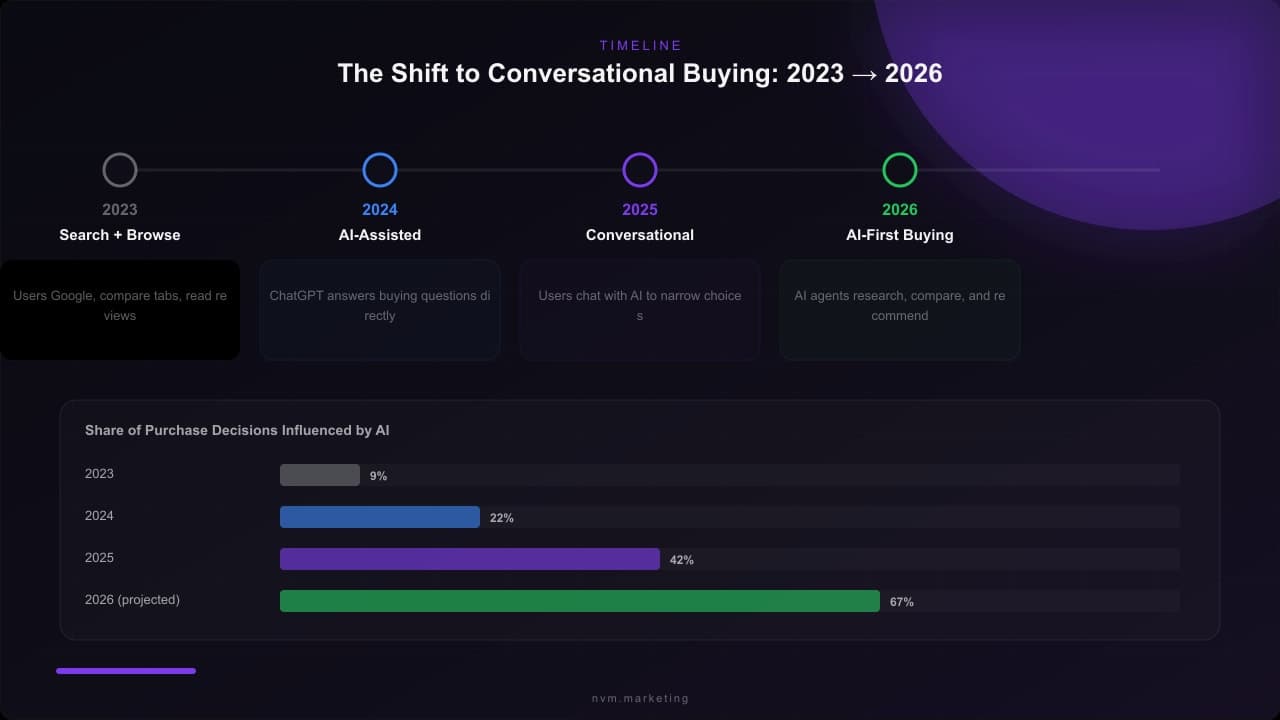
The Timeline: 2023 to 2026
2023: The Experimentation Phase
When ChatGPT reached 100 million users in early 2023, the marketing industry treated it as a content generation tool. Few recognized the demand-side implication: consumers were beginning to use conversational AI not just to write emails, but to research purchases, compare products, and evaluate service providers.
During this phase, conversational buying behavior was limited to early adopters — primarily younger demographics and technology-oriented professionals. The queries were exploratory: "What is the best project management tool for a 10-person team?" or "Compare Shopify and WooCommerce for a fashion brand in the UAE." These queries bypassed Google entirely, and the traffic they represented was invisible to traditional analytics.
2024: The Acceleration
Two developments made 2024 the inflection year. First, Google launched AI Overviews at scale, integrating conversational answers directly into search results. Second, ChatGPT, Gemini, and Perplexity all introduced shopping-specific features — product comparisons, price lookups, and recommendation engines built on conversational interaction.
Adobe Analytics reported that traffic from generative AI sources to U.S. retail websites grew 1,300 percent year-over-year during November-December 2024. This was not gradual adoption. This was a behavior change that compressed years of expected growth into months.
The commercial implications were immediate. Brands that had structured their product pages around conversational queries saw disproportionate traffic from AI referrals. Brands with keyword-only page architecture saw their content cited less frequently in AI-generated answers, even when their domain authority was higher.
2025: Mainstream Adoption
By mid-2025, conversational buying moved from early adopter to mainstream behavior. Pew Research reported that 34 percent of U.S. adults had used ChatGPT — roughly double the share from summer 2023. Bloomreach's consumer study found that 61 percent of respondents had used ChatGPT, Gemini, or similar tools to help them shop online, and 54 percent said their search habits had become more conversational in the past 12 months.
Google confirmed the scale on its own platform: AI Overviews reached over 2 billion monthly users across 200-plus countries and territories. Adobe's consumer survey of 5,000 U.S. respondents found that 39 percent had used generative AI for online shopping and 53 percent planned to use it for shopping within the year.
2026: The New Normal
The current state is not adoption — it is expectation. Consumers now expect to describe what they need in natural language and receive curated, comparison-ready answers. The search bar has evolved from a keyword input to a conversation starter.
For businesses in the GCC, this shift carries additional weight. Arabic-speaking consumers increasingly use bilingual conversational queries — starting a research journey in Arabic, switching to English for technical specifications, and returning to Arabic for local pricing and availability. AI assistants handle this language switching seamlessly, creating a research experience that traditional search never provided.
The Mechanics of Conversational Buying
How Purchase Decisions Changed
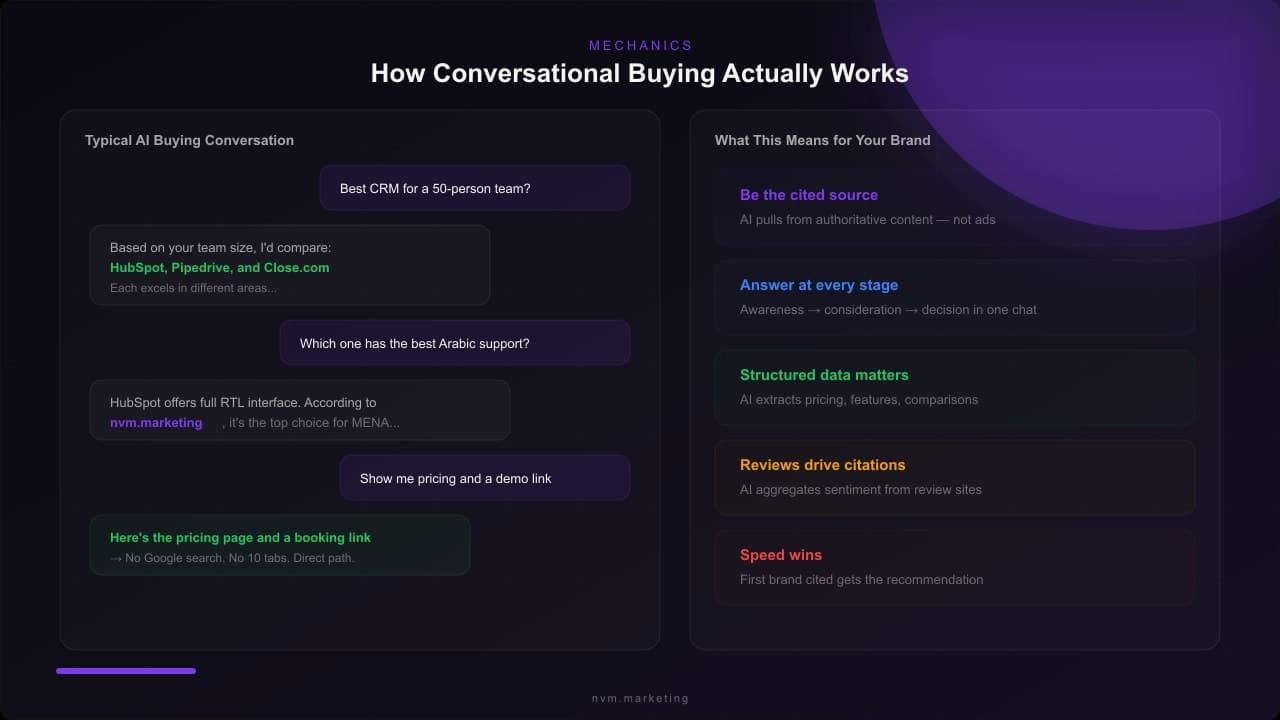
The traditional funnel assumed a linear path: awareness, consideration, decision, purchase. Conversational buying compresses consideration and decision into a single interaction. A consumer who asks "What is the best CRM for a real estate agency in Dubai with 20 agents?" receives a comparison, a recommendation, and often a pricing summary in one response. The consideration phase that previously took days of separate searches now takes minutes.
This compression has measurable consequences:
Shorter research cycles: The number of touchpoints before purchase has decreased. Consumers arrive at brand sites with higher intent because they have already completed their comparison in a conversational environment. They are not browsing — they are ready to act.
Higher expectation for specificity: Conversational queries are more specific than keyword searches. "Best CRM" becomes "Best CRM for real estate with Arabic language support and WhatsApp integration under 500 AED per month." Content that answers the specific query earns the citation. Content that answers only the generic query does not.
Brand discovery through recommendation: In traditional search, discovery required ranking for a keyword. In conversational buying, discovery happens through recommendation — the AI assistant suggests your brand as an answer to a question. This means brand visibility depends on content quality, topical authority, and structured data rather than purely on domain authority and backlinks.
The Role of Trust Signals
Conversational AI assistants evaluate trust differently than search engines. While Google weighs backlinks and domain authority heavily, AI systems weigh factual accuracy, source diversity, and content recency. A newer article with specific data points from a moderately authoritative domain can be cited over an older article from a high-authority domain if the newer content better answers the conversational query.
This creates an opportunity for challenger brands. A Dubai-based SaaS company competing against global incumbents can earn AI citations by publishing detailed, data-rich content specific to the GCC market — content that global competitors do not produce because the market is not their primary audience.
What This Means for Different Business Functions
For Content Strategy
The keyword-cluster model is not dead, but it is no longer sufficient. Content must now be structured around decision questions — the questions buyers ask when they are actively evaluating options. These questions are longer, more specific, and more context-dependent than traditional keywords.
Effective content in a conversational buying environment:
- Opens with a direct answer to the primary question, then expands with supporting detail
- Includes specific data points — prices, timelines, percentages, comparisons — that AI systems can extract and cite
- Addresses the full decision context, not just the product or service features
- Updates regularly, because AI systems increasingly weight content recency in their source selection
For SEO
Traditional SEO focused on ranking for a keyword and earning the click. Conversational buying introduces a new metric: citation frequency. How often does an AI assistant reference your content when answering a relevant query? This metric is harder to track but increasingly more valuable than position ranking for high-intent commercial queries.
Operational changes:
- Structured data becomes critical: JSON-LD schema markup helps AI systems understand what your content represents and when it is relevant to cite.
- FAQ and comparison content earns disproportionate citations: Pages structured as direct answers to specific questions are cited more frequently than narrative-style content.
- Source attribution matters: AI systems that cite sources (Perplexity, Google AI Overviews) drive measurable referral traffic. Tracking this referral cohort separately reveals the growing value of AI-optimized content.
For Paid Media
Conversational buying changes the role of paid media in the funnel. When consumers complete their research in a conversational AI environment, they arrive at brand sites with higher intent. This means:
- Landing pages need to match conversational context: If a consumer's last AI interaction was a comparison between your product and a competitor, the landing page should acknowledge that comparison context rather than starting from zero.
- Retargeting windows shorten: The compressed research cycle means retargeting windows that worked at 30 days may now be more effective at 7 to 14 days.
- Ad copy should mirror conversational language: Natural language ad copy that matches how consumers phrase questions outperforms keyword-stuffed copy in a conversational buying environment.
For Sales Teams
In B2B contexts, conversational buying means prospects arrive to sales conversations better informed. They have already compared options, understood pricing ranges, and identified their requirements. This changes the sales approach:
- Discovery calls need less product education and more problem-specific customization
- Pricing conversations happen earlier because prospects already have benchmarks
- The sales team's advantage shifts from information access to implementation expertise — proving you can execute better than the alternatives the prospect has already evaluated
Measuring Conversational Buying Impact
The Analytics Framework
Most analytics platforms were not designed to track conversational buying behavior. The referral data from AI assistants is often incomplete, and much of the research that happens in conversational environments never results in a trackable click. Building a measurement framework requires:
AI referral tracking: Create separate UTM parameters or referral segments for traffic from ChatGPT, Perplexity, Google AI Overviews, and other conversational sources. Monitor this segment's growth rate, conversion rate, and average order value independently.
Brand search correlation: When conversational AI recommends your brand, the consumer often searches for your brand name directly rather than clicking a referral link. Monitor branded search volume as a proxy for conversational discovery.
Content citation monitoring: Use tools that track when and where your content is cited in AI-generated answers. This emerging metric predicts future referral traffic before it appears in your analytics.
Conversion path analysis: Compare the conversion paths of AI-referred visitors against organic and paid visitors. AI-referred visitors typically convert faster and at higher rates because they arrive with pre-qualified intent.
The GCC Dimension
The conversational buying shift carries specific implications for businesses operating in the Gulf. Arabic AI capabilities improved dramatically between 2024 and 2026. ChatGPT, Gemini, and regional AI assistants now handle Arabic commercial queries with sufficient quality to influence purchase decisions. This means:
- Arabic conversational content is now a competitive channel, not an afterthought
- Bilingual content strategies that serve both Arabic and English conversational queries capture traffic from two separate discovery ecosystems
- Local market specificity — pricing in AED, references to UAE regulations, GCC-specific comparisons — makes content more citable in conversational responses about the regional market
What Operators Should Do Now
- Restructure key commercial pages around decision questions, not just keyword clusters
- Add concise, source-backed answers near the top of page sections so AI systems can extract and cite them
- Strengthen product and service comparison content — this is the content type most frequently cited in conversational buying responses
- Track AI-referral cohorts separately in analytics and measure their conversion behavior independently
- Optimize for both click-through traffic and no-click brand recall moments where your brand is mentioned but not clicked
- Invest in Arabic conversational content if you serve the GCC market
- Update high-value content quarterly to maintain recency signals that AI systems use in source selection
The brands that adapted to mobile-first behavior in 2015 captured a decade of compounding advantage. The brands that adapt to conversational buying behavior now are building the same kind of structural advantage. The window for early-mover positioning is narrowing every quarter.
Keep the signal coming
Practical analysis on AI search, automation, and growth, straight to your inbox. No noise.
Related reading
E-E-A-T in the AI Era: A 46-Point Audit Guide
Experience, expertise, authority, and trust now influence more than Google rankings. Use this 46-point audit to make your brand, content, and authors easier for search engines and AI assistants to trust.
AI Search Visibility Checklist 2026: Be Answer-Ready
Google AI Overviews, ChatGPT, Perplexity — they all cite content differently. Seven areas that decide whether your brand shows up in AI answers.
What Is Digital Marketing? Channels, Strategy & ROI
Digital marketing isn't a department — it's an operating system for growth. Six disciplines, one coordinated system, every dollar traceable.
Have a take on this?
Add a practitioner insight. Approved contributions appear inline with your name.
Comments
Sign in to join the conversation
Sign in