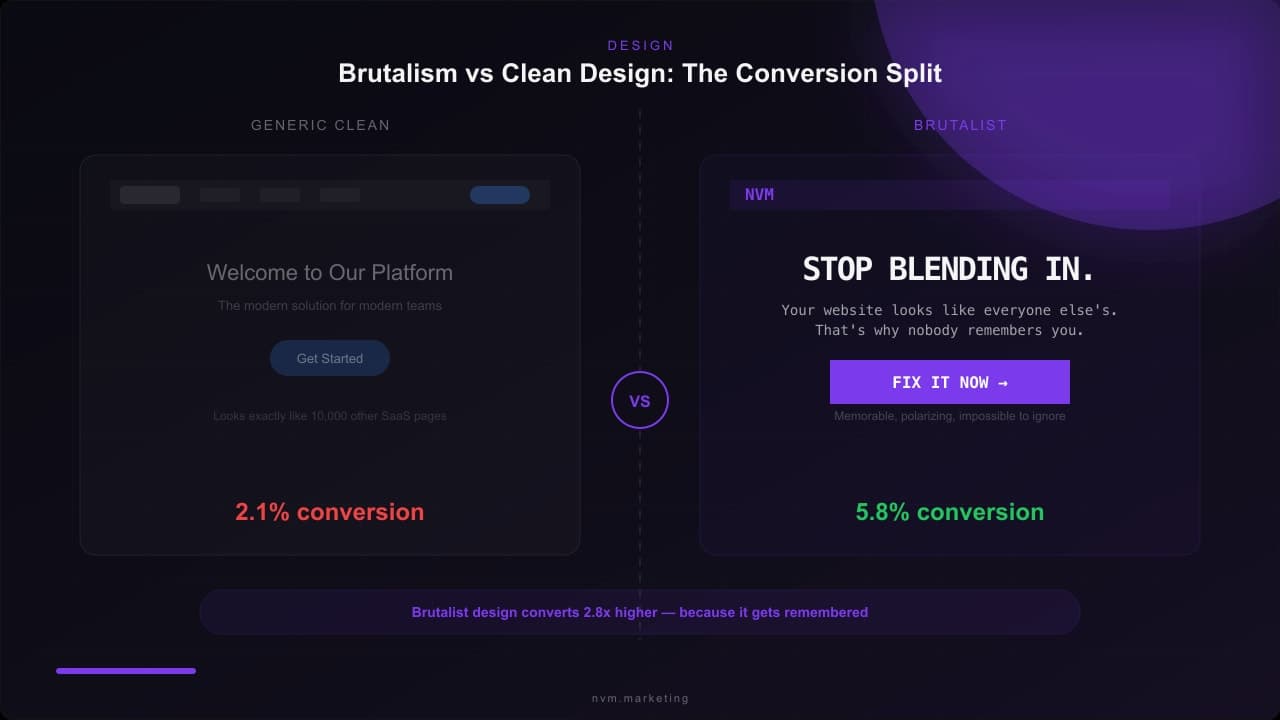
Brutalist Design: Why Bold Choices Win in Saturated Markets
Open twenty SaaS landing pages and try to tell them apart. You can't. That's the opening brutalist design walks through.
Open twenty SaaS landing pages in a row and try to tell them apart. Soft gradients, rounded corners, polite sans-serif fonts, pastel illustrations of cheerful humans holding laptops. You cannot, because they all look like the same Figma template wearing a different logo. We have reached what designers quietly call "Peak Clean," the point where visual conformity becomes visual invisibility.
That is the opening the brutalist design movement walks through.
What Digital Brutalism Actually Means
The term borrows from Brutalist architecture, the mid-century movement that celebrated raw concrete, exposed structures, and functional honesty. In digital design, brutalism translates those principles into interfaces that refuse to hide behind polish. Instead of smooth animations and decorative flourish, you get hard-edged borders, monospace type, high-contrast palettes, visible grids, and elements that look exactly like what they are.
This is not about making ugly websites. It is about making honest ones.
A brutalist button does not pretend to float above the page with a drop shadow and a gradient. It sits on a stark background, clearly labeled, daring you to click it. A brutalist headline does not whisper in thin, light-grey Helvetica. It shouts in heavy black type with generous negative space around it, making its message impossible to miss.
The distinction matters because honesty, in 2026, is a design strategy with measurable returns.
The Psychology Behind Why Brutalism Converts
Users develop what psychologists call "banner blindness," a learned ability to ignore anything that looks like advertising or default corporate design. When every website follows the same visual playbook, the brain files them all under "generic" and moves on. Attention goes to what breaks the pattern.
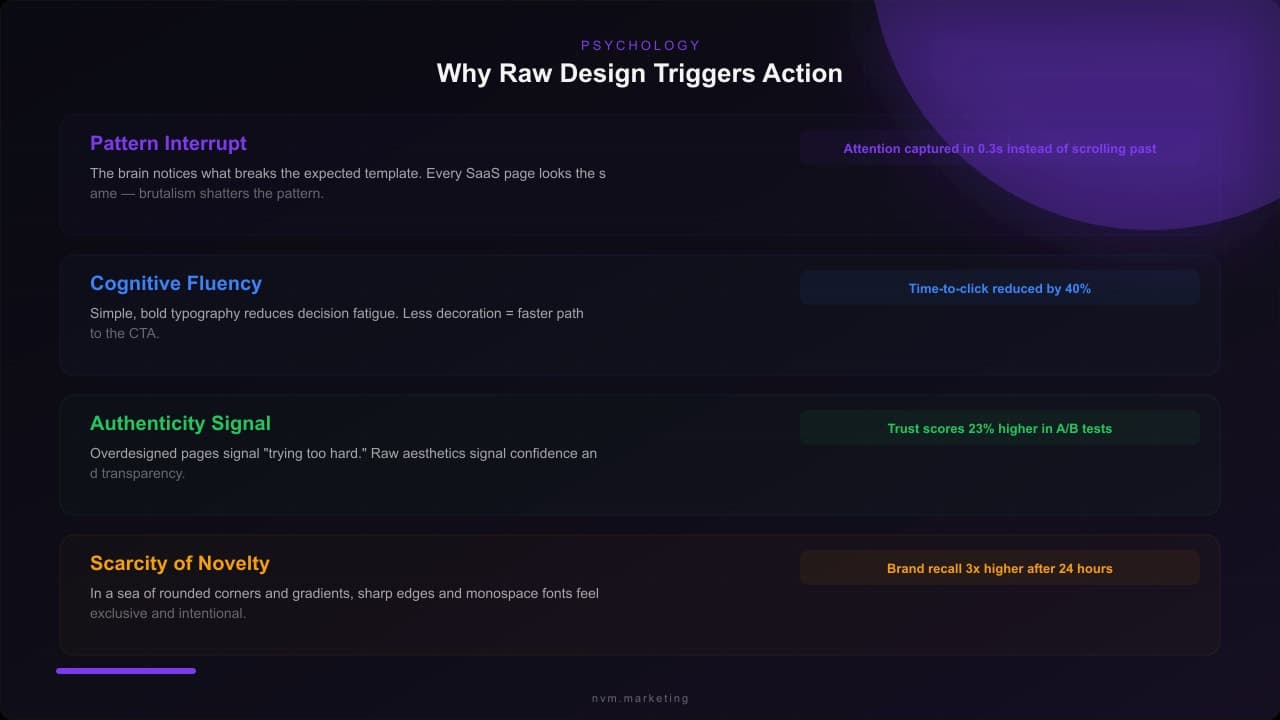
Brutalist design breaks every pattern at once.
Cognitive Disruption Creates Engagement
When a visitor lands on a page that violates their mental model of what a website "should" look like, the brain shifts from passive scanning to active processing. This is not speculation; it is a well-documented phenomenon in cognitive psychology called the Von Restorff effect. Items that stand out from their surroundings are remembered more clearly and processed more deeply.
For conversion, this means the visitor actually reads your headline instead of skimming past it. They notice your call-to-action because it does not blend into a sea of identical blue buttons. The friction of the unfamiliar forces engagement.
Confidence Signaling Through Design
There is a second psychological layer at work. A brand that chooses brutalism signals something specific: "We do not need to look like everyone else because our value speaks for itself." This communicates confidence, which builds trust in a different way than polished corporate aesthetics do.
Think about the luxury market. The most expensive restaurants often have the simplest menus, sometimes just a single page with no descriptions. The lack of decoration signals that quality is assumed, not argued for. Brutalist design works on the same principle in digital spaces. By stripping away the expected polish, you imply that your product or service is strong enough to stand without visual crutches.
Where Brutalism Outperforms Clean Design
Not every context rewards brutalism, but several high-stakes scenarios favor it consistently.
Brand Differentiation in Crowded Verticals
If you operate in a vertical where every competitor looks identical, which is most B2B SaaS, fintech, and agency markets, brutalism creates instant visual separation. When a prospect is evaluating five vendors and four of them look interchangeable, the one that looks dramatically different gets remembered. Memory drives shortlisting, and shortlisting drives revenue.
Content-Heavy Platforms
Blogs, newsletters, and editorial products benefit enormously from brutalist typography. Heavy type, generous whitespace, and strong visual hierarchy guide the eye through long-form content more effectively than decorated layouts. The absence of visual noise lets the words do the work, which is exactly what a content brand needs.
Portfolio and Creative Work
Agencies and freelancers showcasing creative work face a particular challenge: the frame should not compete with the art. A brutalist portfolio site puts work front and center without the visual commentary of elaborate UI patterns. The design becomes a stage, not a co-performer.
How to Apply Brutalism Without Breaking Usability
The most common mistake with brutalist design is treating it as permission to ignore user experience. It is not. Brutalism is an aesthetic philosophy, not an excuse for confusion. The best brutalist sites are actually more usable than their polished counterparts because every element is intentionally placed and clearly functional.
Typography: Raw Headers, Readable Body
Use bold, high-impact typefaces for headings, oversized, heavy, and unapologetic. But pair them with highly legible body text. A monospace font at 14px with tight line-height might look "brutalist," but if users cannot comfortably read a 1,200-word article in it, you have failed the fundamental test. Reserve the raw aesthetic for display elements and keep body text optimized for sustained reading.
Interaction Design: Make It Physical
Brutalist buttons should feel tactile. Use hard borders, clear state changes on hover and click, and obvious visual feedback. The goal is to make interactions feel mechanical and satisfying, like pressing a physical switch rather than tapping a ghost. CSS transitions on background-color and border-width, kept under 150ms, create that snappy physical response without feeling animated in the decorative sense.
Motion: Guide, Do Not Decorate
If you use animation in a brutalist context, it should serve navigation, not aesthetics. A scroll-triggered reveal that helps users understand page structure is appropriate. A parallax effect that makes text float around for visual pleasure is not. Every motion should answer the question "where should I look next?" If it does not answer that question, remove it.
Color: High Contrast, Limited Palette
Brutalist palettes work best with two or three colors at maximum contrast. Black on white is the classic foundation, with a single accent color for interactive elements and calls to action. Avoid gradients entirely. If you need visual warmth, introduce it through texture or photography rather than color transitions.
Brutalism in the MENA Market
The Middle Eastern digital landscape presents an interesting case for brutalism. Regional web design has historically leaned toward rich, layered visuals with heavy use of gold tones, ornamental patterns, and detailed imagery. Introducing brutalist elements in this context creates an even stronger contrast effect than in Western markets.
However, the application needs cultural sensitivity. Arabic typography has its own calligraphic traditions that do not map directly onto the monospace, grid-heavy aesthetic of Western brutalism. The most effective approach is what we call "structured boldness," applying brutalist principles of honesty, contrast, and functional clarity while respecting the visual rhythm of Arabic script. Use bold Naskh or geometric Kufi-inspired typefaces rather than forcing Latin monospace conventions onto Arabic text.
In Dubai and Riyadh specifically, where the market is saturated with agencies and SaaS products all using the same premium-clean templates, a well-executed brutalist approach can capture attention precisely because it contrasts with regional design norms without disrespecting them.
When Not to Use Brutalism
Honesty about limitations is itself a brutalist principle, so let us be direct: brutalism does not fit everywhere.
Healthcare and financial services targeting conservative audiences should proceed carefully. Trust in these verticals is built through familiarity, and too much visual disruption can trigger anxiety rather than engagement.
E-commerce product pages where users need to evaluate physical goods benefit from clean, image-forward layouts. Brutalism can work for the brand layer, the homepage, the about page, and the editorial content, but product detail pages need to prioritize product visibility over design expression.
Accessibility-first contexts require extra care. High contrast is beneficial for accessibility, but some brutalist choices like very small text, unconventional navigation, or hidden menus can create barriers. Always test with screen readers and keyboard navigation, brutalist or not.
The NVM Approach
At NVM, we do not use brutalism as a trend to follow. We use it as a tool to solve a specific problem: how do you earn attention in a market where visual sameness has made most brands invisible?
The answer is intentional contrast. Not randomness, not ugliness, but a deliberate choice to look different in ways that communicate confidence and clarity. Every element on a brutalist page should justify its existence. If it does not serve function or communication, it gets removed.
In fast-moving markets like the GCC, where new brands launch daily and attention spans compress further every quarter, being visually interchangeable with your competitors is not playing it safe. It is the riskiest choice you can make, because it guarantees you will be forgotten.
Brutalism is not about being loud. It is about being impossible to ignore.
Keep the signal coming
Practical analysis on AI search, automation, and growth, straight to your inbox. No noise.
Related reading
A No-Nonsense Guide to Digital Transformation
The failure rate for digital transformation is 70%. The reason is consistent: businesses buy platforms before understanding their problems.
E-E-A-T in the AI Era: A 46-Point Audit Guide
Experience, expertise, authority, and trust now influence more than Google rankings. Use this 46-point audit to make your brand, content, and authors easier for search engines and AI assistants to trust.
AI Search Visibility Checklist 2026: Be Answer-Ready
Google AI Overviews, ChatGPT, Perplexity — they all cite content differently. Seven areas that decide whether your brand shows up in AI answers.
Have a take on this?
Add a practitioner insight. Approved contributions appear inline with your name.
Comments
Sign in to join the conversation
Sign in