A No-Nonsense Guide to Digital Transformation
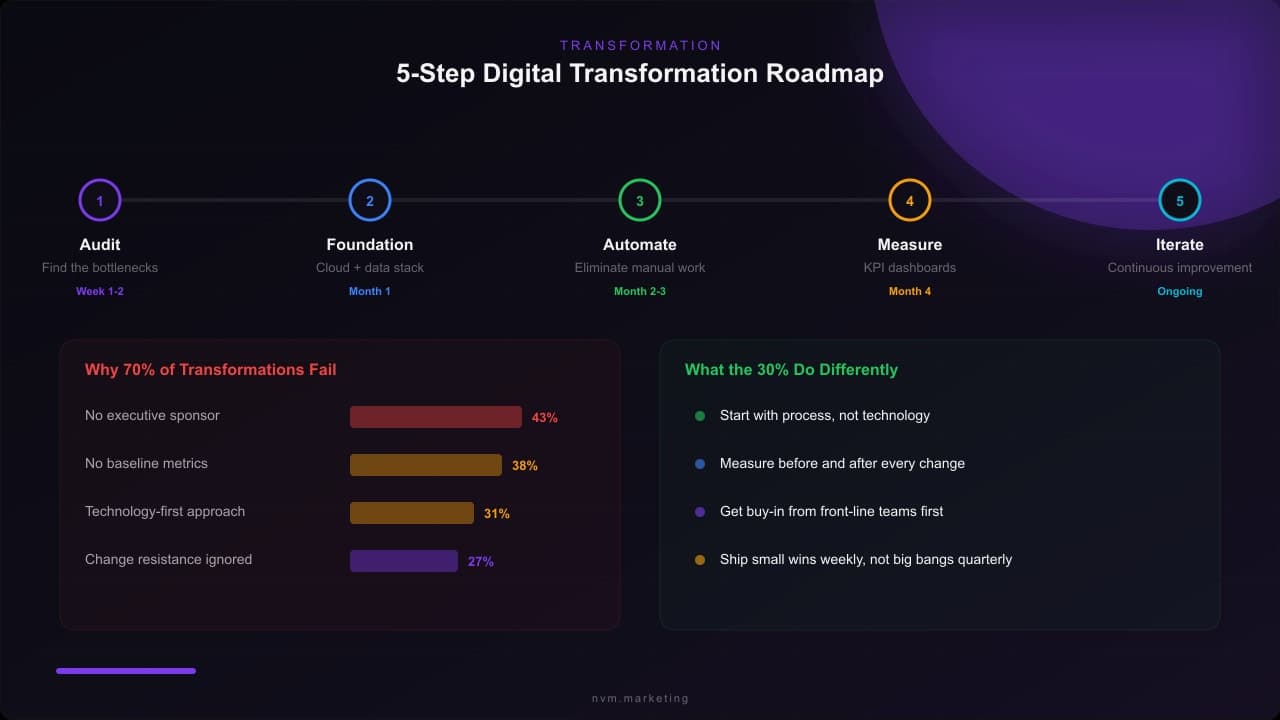
The failure rate for digital transformation is 70%. The reason is consistent: businesses buy platforms before understanding their problems.
"Digital Transformation" has become the most expensive buzzword in consulting. Firms charge six figures to produce strategy decks full of maturity models, capability assessments, and roadmaps that stretch to the horizon. For enterprises with thousands of employees and legacy systems from the 1990s, some of that complexity is warranted. For the vast majority of businesses, it is theater.
True digital transformation is not a framework. It is the disciplined process of using technology to remove friction from how your business operates and how your customers experience your service. That is it. Everything else is decoration.
Why Most Transformation Projects Fail
The failure rate for digital transformation initiatives hovers around 70 percent, a figure that has barely moved in a decade. The reason is consistent: businesses treat transformation as a technology project rather than an operational one. They buy platforms before understanding their problems, hire consultants to produce strategies without execution mandates, and measure success by the number of tools deployed rather than the friction removed.
The businesses that succeed approach transformation differently. They start with a specific problem — a bottleneck, a manual process, a customer pain point — and apply technology to solve it. Then they move to the next problem. This iterative approach lacks the drama of a comprehensive transformation roadmap, but it produces results.
The Consultant Trap
The typical transformation consulting engagement follows a predictable pattern: three months of discovery, a comprehensive strategy document, a phased implementation plan spanning 18 to 24 months, and a bill that makes the C-suite question the entire initiative. By the time the plan is ready to execute, the business environment has changed enough that the assumptions underlying the strategy are already stale.
The alternative is to skip the comprehensive planning phase and start with action. Identify your three biggest operational bottlenecks, pick the one with the highest impact-to-effort ratio, and solve it. The learning from that first project informs the second, and the momentum from early wins funds and justifies the next round.
Step One: Audit Your Bottlenecks
Before you touch any technology, map where your business loses time, money, or customers due to manual processes or poor systems. This audit does not require a consultant or a workshop. It requires honest conversations with the people who do the work.
Finding the Real Friction Points
Ask your team three questions:
-
What do you do repeatedly that feels like a waste of time? The answers will reveal data entry tasks, copy-paste workflows, manual report generation, and communication gaps between departments. Every one of these is a transformation candidate.
-
Where do customers get stuck or frustrated? Check your support tickets, chat logs, and call recordings. If customers regularly ask the same questions — about pricing, availability, process — your digital experience is failing to provide information they need.
-
What decisions do you make that could be automated? Many business decisions follow clear rules: if the order is under a certain amount, approve it automatically. If the customer has purchased three times, upgrade their tier. If the invoice is overdue by 30 days, escalate. These rule-based decisions consume human attention that could be redirected to judgment-intensive work.
Prioritizing by Impact
Not all bottlenecks deserve equal attention. Score each one on two dimensions: how much time or money it costs weekly, and how technically complex it would be to solve. Start with high-impact, low-complexity items. These quick wins build organizational confidence and create budget for tackling the harder problems.
A common high-impact, low-complexity item is lead response time. If your team takes 24 hours to respond to website inquiries, implementing an automated acknowledgment with intelligent routing can cut that to minutes. The technology is straightforward — a form integration with your CRM and an automated email or WhatsApp trigger — but the business impact is substantial.
Step Two: Build a Fast, Scalable Foundation
Your website is the center of your digital identity. Every marketing channel, every sales conversation, and every customer interaction eventually points back to it. If your digital foundation is slow, fragile, or difficult to update, it creates a ceiling on every other transformation effort.
Why Platform Choice Matters
A business running on a bloated WordPress theme with 47 plugins is not in a position to execute a modern digital strategy. Every page load takes four seconds. Every update risks breaking three plugins. Every design change requires a developer to untangle template files. This is not a foundation for transformation — it is a constraint.
Modern performance-oriented stacks built on frameworks like Next.js provide a fundamentally different foundation. Pages load in under a second. Content updates deploy in minutes. Design changes are isolated and testable. The technology disappears into the background, which is exactly what a foundation should do.
The Speed Imperative
Page speed is not a vanity metric. It directly affects revenue, search rankings, and customer perception. Google explicitly uses Core Web Vitals as ranking signals. Users abandon pages that take more than three seconds to load. And in markets like the UAE, where speed equals trust, a slow website actively damages your brand.
The performance target for a modern business website is a Largest Contentful Paint under 1.5 seconds, a First Input Delay under 100 milliseconds, and a Cumulative Layout Shift under 0.1. These are not aspirational goals — they are the baseline for competing effectively online.
Content Architecture
A scalable foundation includes a content architecture that allows non-technical team members to publish and update content without developer involvement. This means structured content models, not page-builder drag-and-drop interfaces that create unmaintainable layouts.
Structured content separates what you say from how it looks. A blog post, a case study, a product page — each has a defined set of fields (title, body, metadata, images) that can be rendered consistently across any device or channel. This approach scales because adding a new content type or redesigning the layout does not require rebuilding existing content.
Step Three: Automate Relentlessly
The rule is simple: any process that a human performs more than three times a week and that follows a predictable pattern should be automated. Not "could be" automated — should be. The cost of continued manual execution compounds weekly, and the technology to automate most business processes is now accessible to companies of any size.
Where to Start
The highest-value automation targets typically fall into four categories:
Communication sequences: Follow-up emails after form submissions, appointment reminders, onboarding sequences, and renewal notifications. These are high-volume, rule-based, and directly impact customer experience. A missed follow-up email is a lost opportunity, and it happens at every company that relies on human memory to manage communication timing.
Data synchronization: Keeping your CRM, email platform, accounting software, and project management tools in sync. When a deal closes in your CRM, the accounting system should generate an invoice automatically. When a new subscriber joins your email list, the CRM should create a contact record. Manual data entry between systems is the highest-friction, lowest-value activity in any business.
Reporting and dashboards: Monthly reports that someone spends hours assembling from multiple data sources. Automated dashboards that pull real-time data from your ad platforms, CRM, and analytics tools provide better information with zero ongoing effort. The initial setup takes a few hours; the time savings compound indefinitely.
Customer service triage: Automated classification and routing of support tickets, FAQ chatbots that handle common questions, and intelligent escalation based on issue severity and customer value. These systems reduce response times and free your support team to focus on complex issues that actually require human empathy and judgment.
The Integration Layer
Modern automation runs on APIs — the standardized interfaces that allow different software systems to exchange data. The tools for connecting these APIs have become dramatically simpler. Platforms like n8n, Make, and Zapier allow non-developers to build sophisticated multi-step automations using visual interfaces. For more complex requirements, custom integrations using serverless functions provide unlimited flexibility.
The key principle is that no human should be a data bridge between two systems. If information needs to move from Tool A to Tool B, a machine should move it. Humans should only be involved when judgment, creativity, or empathy is required.
Step Four: Measure Everything That Matters
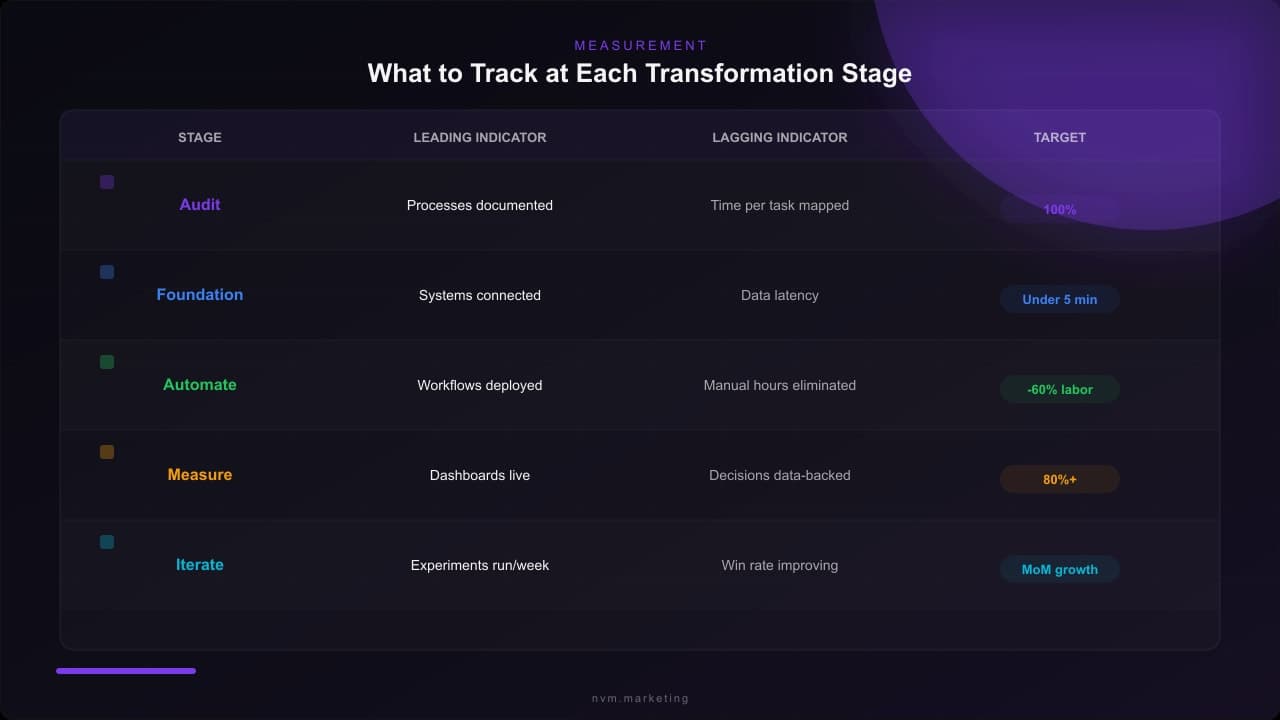
Transformation without measurement is just activity. Every change you make should be tied to a metric that tells you whether it worked. But the emphasis is on "that matters" — measuring everything is as useless as measuring nothing.
The Metrics That Actually Matter
For most businesses, the metrics that drive decisions fall into four categories:
Revenue efficiency: Cost per acquisition, customer lifetime value, and return on marketing spend. These tell you whether your growth is profitable.
Operational speed: Lead response time, order fulfillment time, and support resolution time. These tell you whether your operations are getting faster.
Customer experience: Net Promoter Score, customer effort score, and churn rate. These tell you whether your customers are satisfied.
Team capacity: Hours spent on manual tasks per week, automation success rates, and error rates. These tell you whether your transformation is actually removing friction.
Track these four categories and you have enough signal to make informed decisions about where to invest next. Track fifty metrics and you have a dashboard nobody reads.
Step Five: Build a Culture of Iteration
The businesses that sustain transformation over time are the ones that build it into their operating rhythm. This does not mean hiring a "Chief Transformation Officer" or forming a committee. It means establishing a regular cadence of identifying friction, solving it, measuring the result, and moving to the next problem.
A monthly "friction review" where team leads identify their biggest operational bottleneck, paired with a quarterly automation sprint where the top priorities are implemented, creates a sustainable transformation practice. No consultants required. No maturity models needed. Just disciplined attention to what is not working and systematic effort to fix it.
The Transformation Mindset
Digital transformation is not a destination. It is a habit. The businesses that thrive are not the ones that complete a transformation — they are the ones that never stop transforming. Every quarter, they are a little faster, a little more automated, and a little more responsive to their customers.
The good news is that the starting point does not matter. Whether you are running your business on spreadsheets and email or on a sophisticated tech stack with dozens of integrations, the approach is the same: find the friction, remove it, measure the impact, and repeat.
The goal is not transformation theater. The goal is faster execution, cleaner data flow, and a better customer experience. Start with the bottleneck that costs you the most, fix it this week, and let the momentum carry you forward.
Keep the signal coming
Practical analysis on AI search, automation, and growth, straight to your inbox. No noise.
Related reading
Brutalist Design: Why Bold Choices Win in Saturated Markets
Open twenty SaaS landing pages and try to tell them apart. You can't. That's the opening brutalist design walks through.
E-E-A-T in the AI Era: A 46-Point Audit Guide
Experience, expertise, authority, and trust now influence more than Google rankings. Use this 46-point audit to make your brand, content, and authors easier for search engines and AI assistants to trust.
AI Search Visibility Checklist 2026: Be Answer-Ready
Google AI Overviews, ChatGPT, Perplexity — they all cite content differently. Seven areas that decide whether your brand shows up in AI answers.
Have a take on this?
Add a practitioner insight. Approved contributions appear inline with your name.
Comments
Sign in to join the conversation
Sign in