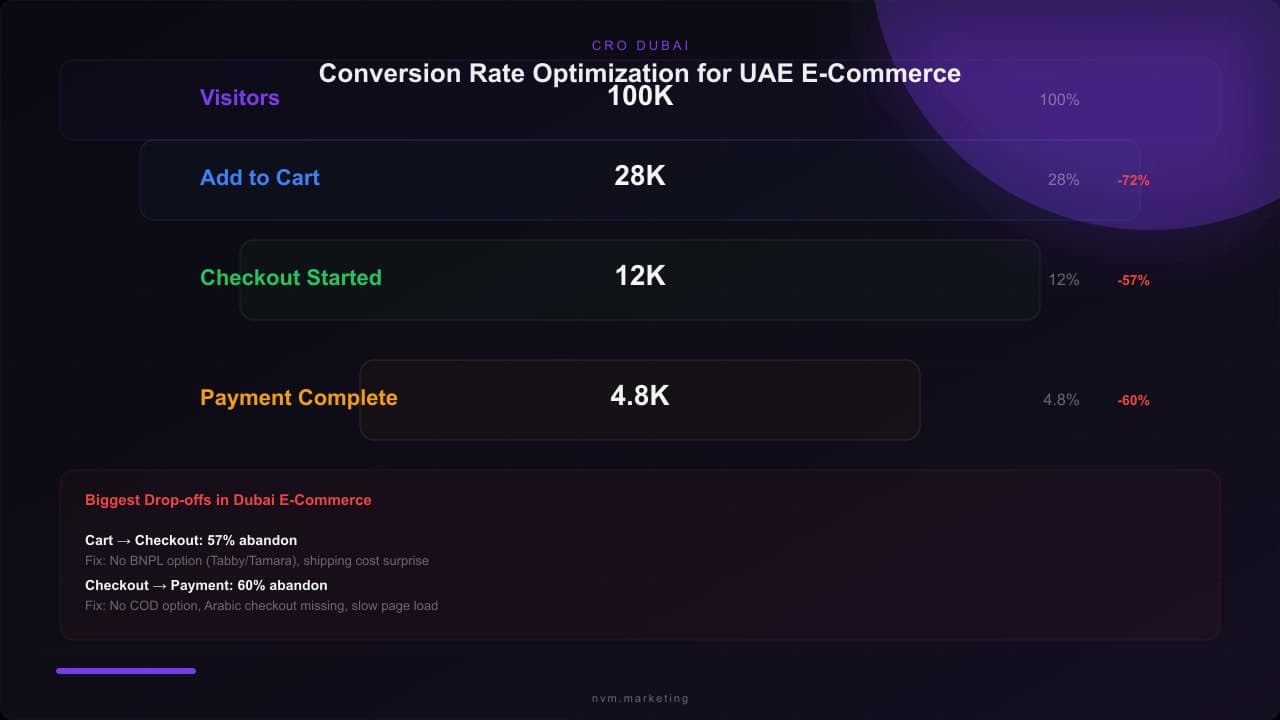
Conversion Rate Optimization Strategies for Dubai E-commerce
If your UAE conversion rate is below 2.5%, you're not losing to competitors — you're losing to friction. The CRO playbook for GCC e-commerce.
When managing an e-commerce platform in the UAE, driving traffic is only half the equation. If your conversion rate is below 2.5 percent, you are leaving revenue on the table — not because your products are wrong, but because your site introduces friction at the moments when buyers are ready to act. Every unnecessary click, every moment of confusion, every missing trust signal costs you a percentage of the visitors who arrived ready to purchase.
Conversion Rate Optimization in the Dubai market operates under different conditions than Western e-commerce. The buyer demographics skew toward high-income, mobile-first users who expect premium experiences. The payment landscape includes BNPL platforms that fundamentally change checkout psychology. The cultural context demands specific trust signals that generic global best practices miss entirely. And the bilingual requirement means every optimization must work equally well in English and Arabic.
This is the practitioner's guide to CRO that works in the GCC — the specific techniques, psychological triggers, and technical implementations that move conversion rates in this market.
1. Eliminate Choice Paralysis
The paradox of choice is not a theory in e-commerce — it is a measurable conversion killer. Research consistently shows that presenting too many options overwhelms users and reduces their likelihood of making a decision. In the UAE market, where consumers are accustomed to curated, premium experiences, this effect is even more pronounced.
The Decision Architecture Framework
Every page on your site should have a single primary objective that is immediately obvious to the visitor. When you present competing calls to action — "Shop Now," "Learn More," "Subscribe," "Download Our App" — you force the visitor to make a meta-decision about which action to take before they can take any action. Most visitors resolve this conflict by leaving.
High-contrast CTA buttons: Your primary call to action should be the single most visually prominent element above the fold. Use color contrast that makes the button impossible to miss — not just noticeable, but the first thing the eye hits when the page loads. In A/B testing across GCC e-commerce sites, high-contrast CTAs consistently outperform muted, design-forward buttons by 15 to 25 percent in click-through rate.
One goal per viewport: As the user scrolls, each screenful of content should advance a single narrative and present a single next step. A product page that simultaneously promotes related products, features a newsletter signup, displays social media feeds, and presents the add-to-cart button is asking the user to process five decisions at once. Strip it down to what matters: the product, the reason to buy, and the action to take.
Progressive disclosure: Rather than displaying all product information at once — specifications, reviews, shipping details, warranty information, size guides — use expandable sections that let interested users access information without overwhelming casual browsers. This reduces cognitive load while keeping detailed information available for buyers who need it.
Typography and Readability
Poor typography is invisible friction. Users do not consciously notice that a font is hard to read — they simply bounce faster. For bilingual Dubai e-commerce:
- Use typefaces that render clearly at mobile sizes in both Latin and Arabic scripts
- Maintain adequate line height (1.5x or greater) for Arabic text, which is visually denser than English
- Ensure that RTL text alignment is consistent and does not break at responsive breakpoints
- Set body text at a minimum of 16px — anything smaller creates squinting friction on mobile
2. Speed Is Revenue: The 1-Second Rule
In Dubai's fast-paced digital ecosystem, page load speed has a direct, measurable impact on conversion. A one-second delay in page load time correlates with approximately 7 percent reduction in conversions. For an e-commerce store doing 500,000 AED per month, that one second costs 35,000 AED per month in lost revenue.
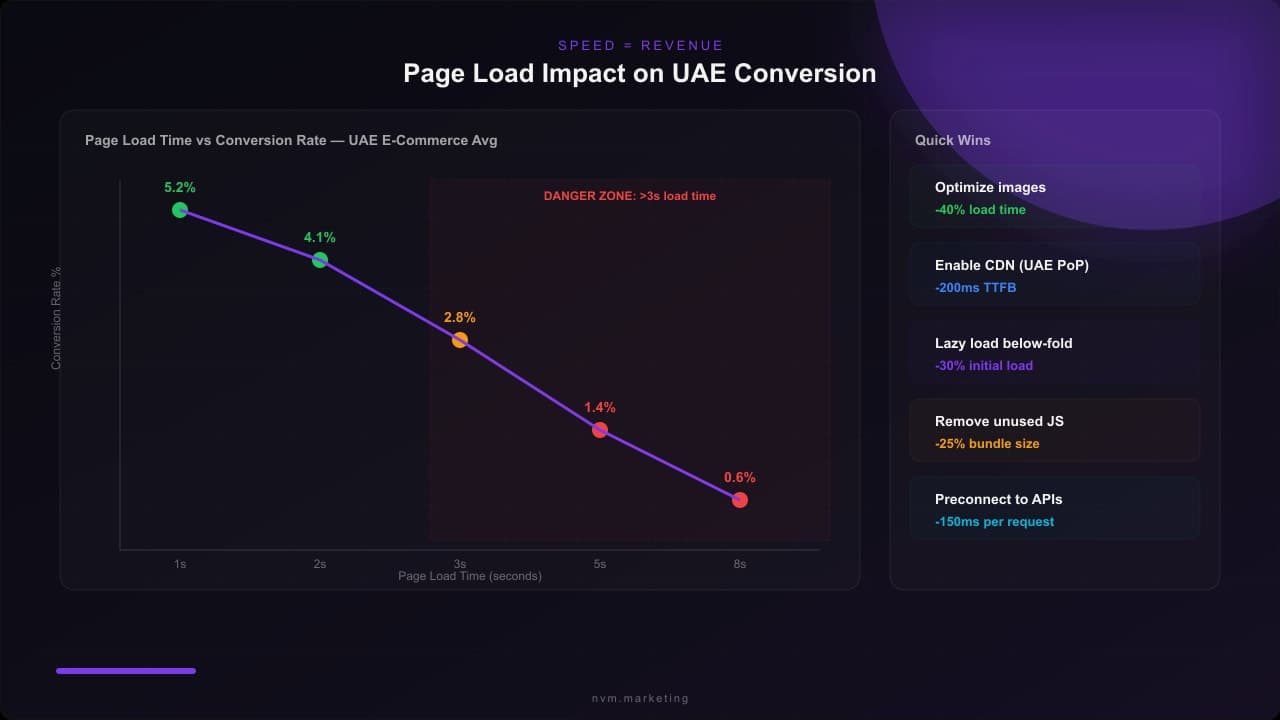
Core Speed Metrics for the GCC
Largest Contentful Paint (LCP) under 1.5 seconds: This is the time it takes for the main content of the page to become visible. In the UAE, where 5G and high-speed fiber are prevalent, users have zero tolerance for slow loading. The official Google threshold of 2.5 seconds is the floor — competitive UAE e-commerce sites target sub-1.5-second LCP.
Cumulative Layout Shift (CLS) at zero: Elements should never visually shift position as the page loads. Layout shifts are particularly damaging for e-commerce because they can cause misclicks — a user reaches for the "Add to Cart" button, the page shifts, and they accidentally click "Remove" or navigate away. Set explicit dimensions for all images and media, preload critical fonts, and avoid dynamically injected content above the fold.
Time to First Byte (TTFB) under 200 milliseconds: Use infrastructure with regional presence — AWS Bahrain, Google Cloud Doha, Vercel Edge Network, or Azure UAE — to minimize the physical distance between your server and your customer. For a Dubai-focused e-commerce store, hosting on US or European servers adds 100 to 300 milliseconds of unnecessary latency.
Technical Implementation for Speed
Build on frameworks designed for performance. Next.js with static generation and server-side rendering provides the architecture needed for sub-second load times. Headless commerce architectures — separating the frontend presentation from the backend commerce engine — allow you to optimize the user experience independently of the product catalog and order management systems.
Specific optimizations that move the needle:
- Image optimization: Serve WebP or AVIF formats with responsive srcset attributes. Product images are typically the largest assets on e-commerce pages. A single unoptimized hero image can add two seconds to LCP. Use lazy loading for below-fold images to prioritize above-fold content rendering.
- Third-party script management: Analytics, chat widgets, advertising pixels, and social proof tools commonly add 500 milliseconds to 2 seconds of load time. Load them asynchronously after the main content renders, or use server-side implementations that do not block the browser.
- Critical CSS inlining: Extract and inline the CSS needed for above-fold content rendering, then load the full stylesheet asynchronously. This eliminates the render-blocking delay caused by waiting for the complete CSS file to download.
3. Localized Trust Signals and BNPL
The modern Middle Eastern consumer is security-conscious in specific ways that differ from Western markets. Trust in the GCC is not built through badges and seals alone — it is built through visible local relevance, payment flexibility, and human accessibility.
Payment Clarity Before Checkout
Do not wait until the checkout page to show payment options. Display accepted payment methods — including specific bank logos, card networks, and BNPL options — on product pages and in the site header or footer. When a visitor knows that their preferred payment method is available before they add items to cart, they proceed with higher confidence and lower abandonment rates.
In testing across UAE e-commerce stores, displaying Tabby and Tamara logos on product pages alongside the price (with the installment amount shown) increases add-to-cart rates by 12 to 18 percent compared to showing BNPL only at checkout.
BNPL as a Conversion Architecture
Buy Now, Pay Later through Tabby and Tamara is not just a feature in the UAE and KSA — it is a conversion architecture that fundamentally changes purchase psychology. When a 2,000 AED product is displayed as "4 payments of 500 AED, interest-free," the perceived cost drops dramatically, even though the total price is identical.
BNPL optimization for the GCC:
- Display installment amounts prominently on product pages, not just at checkout
- Show BNPL eligibility before the customer begins the checkout flow
- Use BNPL messaging in advertising and landing pages to reduce price objections before the visitor reaches the product page
- For higher-value items, calculate and display the per-installment cost — "Only 250 AED/month" is psychologically easier to process than "1,000 AED"
WhatsApp as Trust Infrastructure
In the GCC, WhatsApp is not just a messaging app — it is the primary business communication channel. A visible WhatsApp contact option on your e-commerce site serves as a trust signal that says "there are real humans behind this store who you can reach instantly."
WhatsApp integration for CRO:
- Place a WhatsApp contact button on every product page and the checkout page
- Use pre-filled messages that include the product name and page URL so the support team has immediate context
- Offer WhatsApp-based order tracking and post-purchase support to reduce return rates and increase repeat purchases
- During high-intent moments — cart page, checkout — display "Need help? Chat with us on WhatsApp" messaging that reduces abandonment from uncertainty
Cash on Delivery Considerations
Despite the growth of digital payments, Cash on Delivery remains significant in several GCC markets. Not offering COD can reduce your addressable market by 15 to 25 percent in some segments. However, COD also introduces higher return rates and no-show deliveries. The optimization approach is to offer COD but incentivize digital payment — a small discount or free express shipping for prepaid orders nudges customers toward digital payment while maintaining the COD safety net for those who need it.
4. Hyper-Localization: Beyond Translation
Standard translation is not CRO. True conversion optimization for a bilingual market requires hyper-localization — adapting not just the language but the entire user experience to match the expectations and behavior patterns of each audience.
RTL Layout Integrity
Right-to-left layout for Arabic is not a mirror of the English design. It requires intentional adaptation:
- Navigation, buttons, and progress indicators must flow right to left
- Image carousels and galleries should swipe in the RTL direction
- Form fields must support RTL input without breaking layout
- Icons with directional meaning (arrows, progress indicators) must be mirrored
- Shopping cart and checkout flow must feel as native in Arabic as in English — not like a retrofitted English experience
Currency and Pricing UX
Display prices in AED or SAR by default based on IP geolocation. Do not require users to manually select their currency or country. Show currency conversions transparently for international products, and include VAT in the displayed price (UAE consumers expect VAT-inclusive pricing, unlike some Western markets where tax is added at checkout).
Cultural Micro-Copy
The small text elements — button labels, form placeholders, error messages, confirmation text — carry disproportionate weight in conversion. These elements must be written in natural, culturally appropriate language — not translated from English templates. A checkout button that reads "أكمل الشراء" (complete the purchase) converts differently than one that reads "إتمام الطلب" (finalize the order), and both may be technically correct translations of "Complete Order."
Use local dialects in micro-copy for specific markets when your audience is primarily local. Gulf Arabic phrasing in micro-copy signals local relevance that builds trust.
5. The Psychology of Scarcity in a Luxury Market
Dubai is a city that responds to exclusivity and prestige. Scarcity signals that work in mass-market e-commerce (countdown timers, low-stock warnings) need to be adapted for the GCC luxury context.
Stock Indicators That Build Urgency Without Cheapening the Brand
"Only 2 left" works for fast-fashion e-commerce. For premium brands in the Dubai market, the framing matters more than the number. "Limited edition — exclusive to UAE" or "Final allocation — Downtown Dubai" creates urgency while reinforcing the premium positioning that the Dubai consumer responds to.
Social Proof Calibrated for GCC Buyers
Standard review widgets show star ratings and text reviews. GCC-calibrated social proof includes:
- Review content from verified UAE buyers (geographic relevance increases trust)
- Photo reviews showing the product in local contexts (Dubai apartments, UAE landscapes)
- WhatsApp-based reviews and recommendations (social proof from the platform buyers trust most)
- Influencer or celebrity endorsements from regional figures that the local audience recognizes
VIP and Loyalty Integration
The high-net-worth demographic in the UAE responds to exclusivity signals. VIP access, early sale notifications, priority shipping, and loyalty tier benefits create a sense of special treatment that increases both conversion rates and customer lifetime value. Display VIP benefits prominently during the checkout flow — "As a Gold member, you receive free same-day delivery" — to reduce friction for your most valuable customers.
6. Mobile Checkout Optimization
Over 85 percent of e-commerce traffic in the UAE comes from mobile devices. If your checkout flow is not optimized for mobile-first interaction, you are losing the majority of your potential conversions.
One-Page Checkout
Multi-step checkout flows increase abandonment at each step. A single-page checkout that displays shipping, payment, and order summary simultaneously reduces the number of decision points and keeps the total cost visible throughout the process.
Autofill and Input Optimization
Reduce the number of form fields to the absolute minimum. Use address autofill for UAE addresses, auto-detect card type from the first four digits, and pre-populate saved payment methods for returning customers. Every field you remove from the checkout form measurably increases conversion.
Guest Checkout
Forcing account creation before purchase is one of the most common conversion killers. Offer guest checkout as the default, with an optional "save your details for faster checkout next time" after the purchase is complete. The conversion rate increase from guest checkout typically outweighs the loss in account creation rates.
Continuous Testing, Not One-Time Fixes
CRO is not a project with a completion date. It is a continuous discipline of measurement, hypothesis formation, testing, and iteration. The strategies above provide the starting framework, but the specific optimizations that move your conversion rate depend on your audience, your products, and your market position.
Run A/B tests with sufficient sample sizes to reach statistical significance. Prioritize tests by potential revenue impact — a 1 percent improvement on the checkout page is worth more than a 5 percent improvement on an about page. Measure everything, trust the data over opinions, and iterate relentlessly.
The businesses that win in Dubai e-commerce are not the ones with the largest advertising budgets. They are the ones that convert the highest percentage of every visitor into a customer — and compound that advantage with every optimization cycle.
Keep the signal coming
Practical analysis on AI search, automation, and growth, straight to your inbox. No noise.
Related reading
Conversion Psychology: Decoding the Dubai Digital Consumer
Your website isn't competing against other websites in Dubai. It's competing against every frictionless experience the user had today.
E-E-A-T in the AI Era: A 46-Point Audit Guide
Experience, expertise, authority, and trust now influence more than Google rankings. Use this 46-point audit to make your brand, content, and authors easier for search engines and AI assistants to trust.
AI Search Visibility Checklist 2026: Be Answer-Ready
Google AI Overviews, ChatGPT, Perplexity — they all cite content differently. Seven areas that decide whether your brand shows up in AI answers.
Have a take on this?
Add a practitioner insight. Approved contributions appear inline with your name.
Comments
Sign in to join the conversation
Sign in