Conversion Psychology: Decoding the Dubai Digital Consumer
Your website isn't competing against other websites in Dubai. It's competing against every frictionless experience the user had today.
A visitor in Dubai opens your website. Within two seconds, they have already made three subconscious judgments: Is this fast? Is this trustworthy? Does this feel like a premium experience? If any answer is no, they leave. Not because they are impatient, but because everything else in their daily life sets the bar impossibly high.
This is the reality of selling to the Dubai digital consumer. They live in a city where a government service app processes a visa renewal in forty-five seconds, where a coffee order arrives in eight minutes, and where a luxury hotel anticipates their preferences before they state them. Your website is not competing against other websites. It is competing against every frictionless experience the user has had today.
Understanding this competitive frame is the first step toward building a conversion strategy that actually works in the UAE.
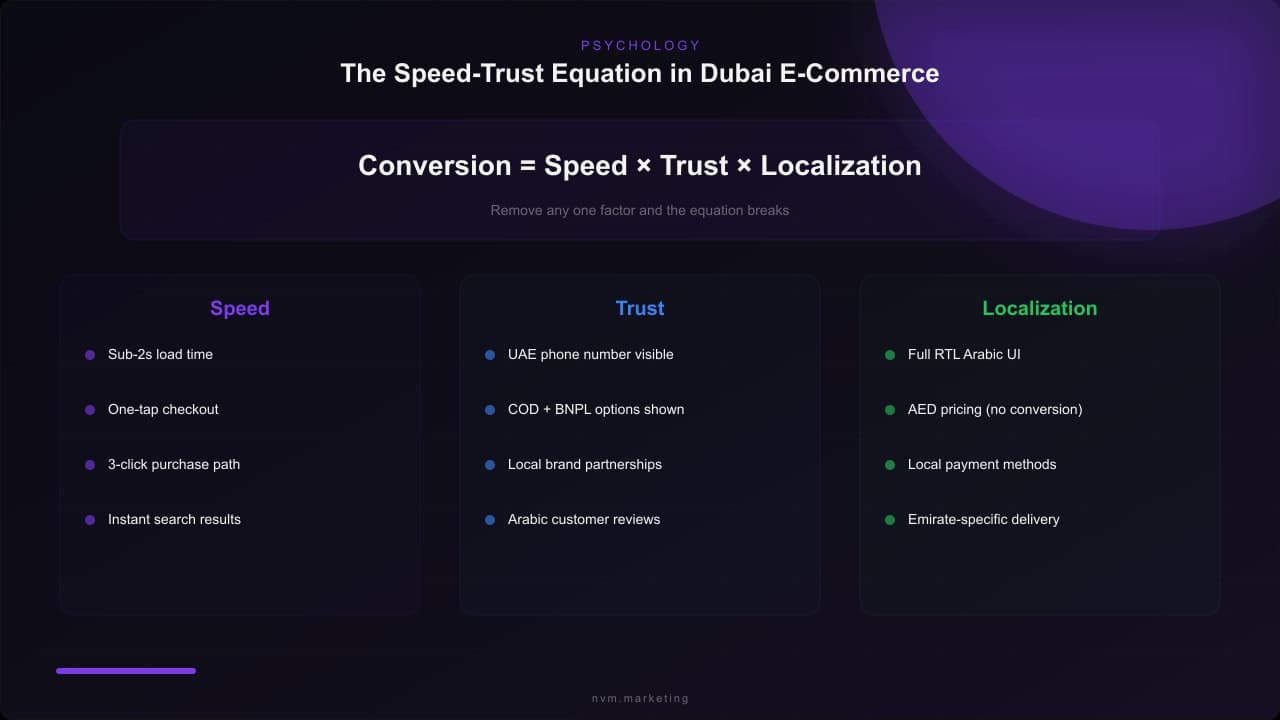
The Speed-Trust Equation
In most Western markets, speed is a technical optimization. In the UAE, speed is a brand signal. When a website loads slowly, the Dubai consumer does not think "their server must be far away." They think "if their website is slow, their service will be slow, their follow-up will be slow, everything about working with them will be slow."
This is not irrational. It is pattern recognition from an environment where speed and quality are correlated daily. The five-star hotel that checks you in through a mobile app in ninety seconds. The bank that processes a loan approval digitally in hours, not weeks. The delivery app that tells you your driver's name and exact arrival time before you finish the checkout. Speed, in this market, is proof of operational competence.
What This Means for Your Site
The technical threshold is clear: your Largest Contentful Paint must be under 1.5 seconds. Not 2.5 seconds, which is Google's "good" benchmark for most markets. In the UAE, 2.5 seconds feels slow against the competitive set.
But speed perception extends beyond actual load time. A skeleton screen that shows layout structure immediately feels faster than a blank white page that fills in after 1.2 seconds. Progress indicators on form submissions signal that something is happening. Instant visual feedback on button clicks confirms the system received the input. These micro-interactions shape perceived speed, which matters as much as measured speed.
The Implication for Design Systems
Every design element should be evaluated through the speed-trust lens. A hero video that takes three seconds to buffer destroys trust before the message even plays. A complex animation sequence that delays content visibility trades visual impression for brand credibility. In this market, the fastest path to content is the most trustworthy one.
Social Proof: Why Generic Testimonials Fail in the GCC
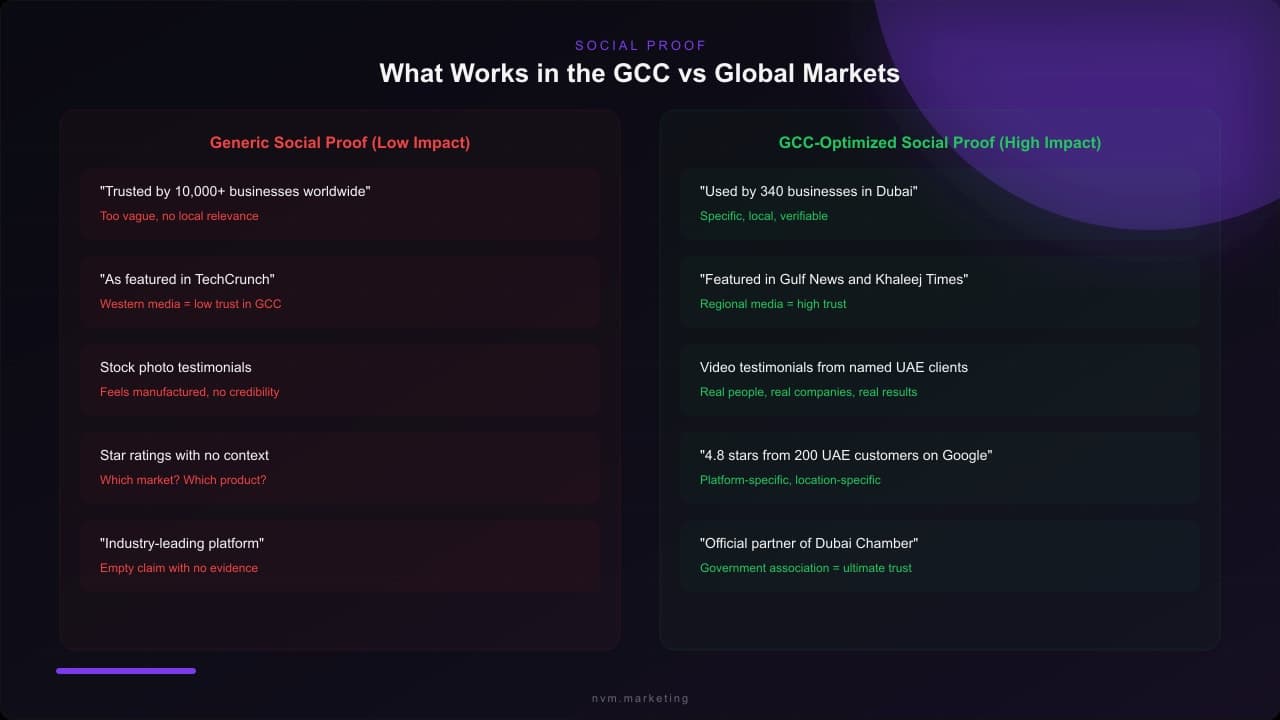
A testimonial that says "Great service, highly recommended — Sarah M., Marketing Manager" converts well in many markets. In the GCC, it converts almost nothing. The Dubai consumer has a specific social proof hierarchy, and generic endorsements sit at the bottom of it.
The Local Prominence Filter
The first question a Dubai prospect asks is not "Is this good?" but "Who else in my market uses this?" Proximity matters enormously. A case study from a company in Dubai Internet City carries ten times the weight of one from a company in San Francisco, even if the San Francisco company is larger and more recognizable globally.
This means your social proof strategy needs to be geographically specific. Name the neighborhood, the free zone, the industry vertical within the UAE. "Trusted by 200 companies in DIFC and Business Bay" is more persuasive than "Trusted by 10,000 companies worldwide" because it answers the proximity question directly.
The WhatsApp Factor
In the GCC, the most trusted channel is the most personal one. WhatsApp is not just a messaging app here — it is the primary business communication tool. A "Contact Us" form feels institutional and slow. A WhatsApp button feels direct and human.
The data consistently shows that adding a WhatsApp CTA alongside or instead of a traditional contact form increases lead capture rates by 40 to 60 percent in the UAE market. But the implementation matters. The WhatsApp button should pre-fill a contextual message ("Hi, I'm interested in [specific service] — I found you through [page name]") so the conversation starts with context rather than a blank chat window.
Physical Reality Markers
Online-only businesses face a specific trust deficit in the GCC. The consumer wants to know you exist in their physical world. This does not mean you need a showroom on Sheikh Zayed Road, but it does mean your website should signal local presence:
- A mapped office address, even if it is a co-working space
- Photos of actual team members, not stock imagery
- References to local events, partnerships, or community involvement
- Arabic language options that feel native, not machine-translated
Each of these markers reduces the psychological distance between your brand and the prospect's decision to trust you with their money or data.
Visual Design Cues That Convert in the MENA Market
While global design trends lean toward flat, minimal aesthetics, the Middle Eastern digital consumer often responds better to what we call "tactile depth," elements that feel substantial, clickable, and high-quality rather than ethereal and abstract.
Why Tactile Design Works Here
The answer is partly cultural and partly environmental. In a region where physical luxury is the benchmark for quality, digital interfaces that feel "light" or "flat" can subconsciously register as cheap. A button with visible depth, a shadow that suggests physical presence, a card element that looks like it could be picked up — these elements borrow the language of premium physical goods and apply it to digital interactions.
This does not mean returning to skeuomorphic design. It means understanding that the visual weight of interface elements communicates value. A thin, borderless button on a white background might feel modern in Stockholm. In Dubai, it can feel insubstantial.
Color Psychology in the Gulf
Color carries cultural weight that differs significantly from Western associations. Gold and deep blue are not just popular in the GCC — they are loaded with connotations of trust, authority, and prosperity. Green connects to both Islamic tradition and growth. White signals purity and space rather than minimalism.
Using these colors does not mean defaulting to cliches. It means understanding that your palette communicates through cultural filters that your global design system may not account for. A financial services brand using predominantly grey and white, which works well in London or New York, may need to introduce gold accents or deeper blues to signal the same level of credibility in the Gulf.
Typography and Bilingual UX
A conversion-optimized site in the UAE must handle Arabic typography as a first-class design element, not an afterthought. This means more than just flipping the layout from left-to-right to right-to-left. Arabic text requires different line heights, different spacing ratios, and different heading hierarchies than Latin text.
The most common mistake is using a single CSS stylesheet that simply mirrors the English layout. The result is Arabic text that feels cramped, awkward, or rushed. Conversion-optimized Arabic layouts increase line-height by 15 to 20 percent over the English equivalent, use slightly larger font sizes for body text, and give headings more breathing room to accommodate the natural flow of Arabic script.
The Decision Architecture of the UAE Buyer
Dubai consumers make purchasing decisions through a specific sequence that differs from the typical Western funnel. Understanding this sequence is essential for optimizing conversion.
Stage One: Social Validation
Before visiting your website, the prospect has likely asked their network. WhatsApp group recommendations, LinkedIn endorsements from peers in their industry, or Instagram stories from people they follow carry more initial weight than any ad or organic search result. By the time they arrive at your site, they are already partially sold — or partially skeptical — based on their network's input.
Stage Two: Speed and Visual Assessment
This happens in the first three seconds. The site loads fast, looks premium, and immediately signals relevance to their market. If it passes this test, they proceed. If not, they return to the search results and try the next option.
Stage Three: Local Credibility Verification
They look for signals that you understand their market. Local case studies, Arabic content, regional references, a Dubai phone number, a physical address. These are not optional trust signals — they are gatekeeping criteria.
Stage Four: Direct Communication
Rather than filling out a form and waiting for a response, the UAE buyer wants to talk to someone now. WhatsApp, direct call, or live chat. The speed of your response at this stage often determines whether you win or lose the deal.
Optimizing for This Sequence
Your website should be structured to support each stage in order. Above the fold: speed, premium design, and a clear value proposition. First scroll: social proof with local specificity. Second scroll: case studies and credibility markers. Persistent: WhatsApp CTA and direct contact options visible throughout.
Measuring What Matters
Standard conversion metrics need reinterpretation for the UAE market. A low form submission rate does not necessarily indicate poor conversion — it may indicate that users are converting through WhatsApp instead, which many analytics setups fail to track.
Implement event tracking for WhatsApp clicks, phone call taps, and direct message initiations alongside traditional form submissions. Your true conversion rate is the sum of all contact initiations, not just form fills. In our experience, UAE businesses that track only form submissions undercount their actual conversion rate by 30 to 50 percent.
Building for the Dubai Consumer
Understanding conversion psychology in the UAE is not an exercise in cultural sensitivity for its own sake. It is a competitive advantage. Most international brands entering the market apply their global playbook without modification. They use the same templates, the same social proof format, the same contact flow. And they consistently underperform against local competitors who understand the psychological triggers unique to this market.
The brands that win in Dubai are the ones that treat local conversion psychology as a design input, not an afterthought. Speed is not just a technical metric — it is a trust signal. Social proof is not just testimonials — it is geographic validation. Visual design is not just aesthetics — it is a value statement calibrated to cultural expectations.
Build for the Dubai consumer's actual decision process, and you will not just convert better. You will convert in a market where most competitors cannot figure out why their proven playbook stopped working.
Keep the signal coming
Practical analysis on AI search, automation, and growth, straight to your inbox. No noise.
Related reading
Conversion Rate Optimization Strategies for Dubai E-commerce
If your UAE conversion rate is below 2.5%, you're not losing to competitors — you're losing to friction. The CRO playbook for GCC e-commerce.
E-E-A-T in the AI Era: A 46-Point Audit Guide
Experience, expertise, authority, and trust now influence more than Google rankings. Use this 46-point audit to make your brand, content, and authors easier for search engines and AI assistants to trust.
AI Search Visibility Checklist 2026: Be Answer-Ready
Google AI Overviews, ChatGPT, Perplexity — they all cite content differently. Seven areas that decide whether your brand shows up in AI answers.
Have a take on this?
Add a practitioner insight. Approved contributions appear inline with your name.
Comments
Sign in to join the conversation
Sign in