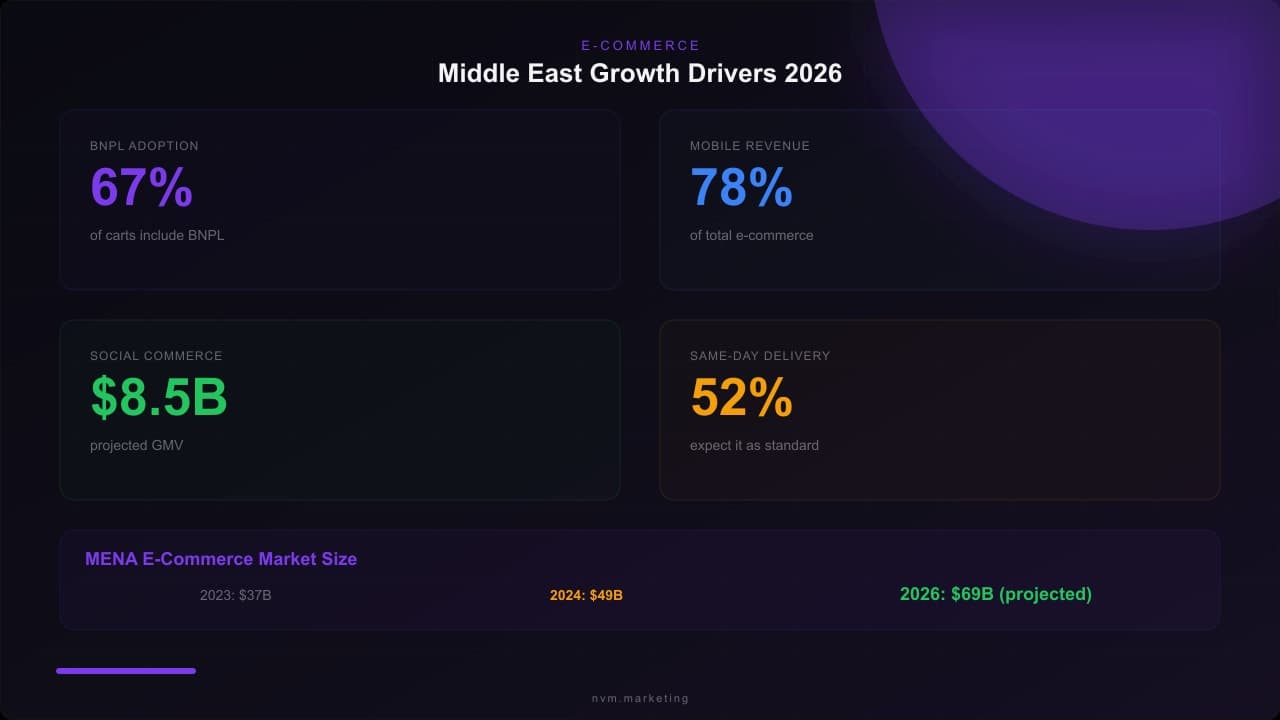
E-Commerce Growth Trends to Watch in the Middle East
The GCC e-commerce buyer who started online during the pandemic is now sophisticated, demanding, and nothing like the Western model. What's different and why.
The Middle Eastern e-commerce market is not simply growing — it is restructuring. The consumer who bought online for the first time during the pandemic is now a sophisticated digital buyer with specific expectations around payment flexibility, delivery speed, and mobile experience. Retailers who treat the region as a smaller version of Western e-commerce markets are making an expensive mistake.
The GCC presents a unique combination of high disposable income, extremely high smartphone penetration, and cultural buying patterns that do not map neatly onto North American or European models. Understanding what is different, and why, is the difference between a store that scales and one that stalls.
Buy Now, Pay Later Is Now Table Stakes
Three years ago, offering a split-payment option was a competitive advantage. Today, it is checkout infrastructure. Platforms like Tabby and Tamara have become household names across the UAE and Saudi Arabia, and their integration into checkout flows has fundamentally changed consumer expectations.
The Cart Size Effect
The data is consistent across verticals: stores that integrate BNPL services see average order values increase by 25 to 35 percent. The mechanism is straightforward. A customer who hesitates at a 600 AED price point will complete the purchase when presented with four payments of 150 AED. The total cost has not changed, but the psychological barrier has been removed.
This effect is particularly strong in categories like electronics, fashion, and home goods, where the average ticket sits in the range that triggers price sensitivity but falls well within the customer's actual ability to pay. BNPL bridges the gap between what the customer can afford and what they are willing to commit to in a single transaction.
Implementation Considerations
Simply adding a BNPL badge to your checkout is not enough. The most effective implementations surface the split-payment option at the product level, not just at checkout. When a product page shows "Or 4 payments of 150 AED with Tabby," the customer begins evaluating the purchase against the installment price rather than the full price. This reframing happens before the add-to-cart decision, which is where it has the most impact.
Additionally, offering multiple BNPL providers gives customers choice and reduces friction for those who already have an account with a specific service. In the UAE market, Tabby and Tamara have different user bases with limited overlap, so supporting both captures a wider audience than supporting either alone.
Mobile-First Is a Revenue Decision
With over 90 percent of GCC internet users accessing the web through smartphones, mobile-first design is not a best practice — it is a revenue architecture decision. But "mobile-first" in the Middle East means something more specific than responsive layouts and large tap targets.
The Thumb Zone Priority
GCC mobile users shop in contexts that Western UX patterns do not fully account for: in the backseat of a car, during commutes in extreme heat where screen glare is an issue, and often while managing multiple apps simultaneously. Your checkout flow needs to be completable with one thumb, minimal typing, and no horizontal scrolling.
Auto-fill integration is critical. Apple Pay and Google Pay adoption in the UAE is among the highest in the world, and stores that offer one-tap payment options consistently outperform those requiring manual card entry. Every field you eliminate from the checkout process has a measurable impact on completion rates.
Speed as a Conversion Variable
Page speed in the GCC directly correlates with revenue more than in most markets. A one-second delay in mobile load time translates to a 7 to 10 percent drop in conversions, higher than the global average of around 4 to 5 percent. The reason connects to the speed-trust relationship discussed earlier: in a market where fast equals premium, a slow mobile experience signals a substandard operation.
The technical targets are specific: Time to Interactive under 3 seconds on a mid-range Android device over a 4G connection. This is the real-world testing benchmark, not a Lighthouse score on a developer's MacBook. Test on the devices your customers actually use, which in the GCC means mid-range Samsung and Huawei phones on Etisalat and du networks.
Social Commerce Is Not Optional
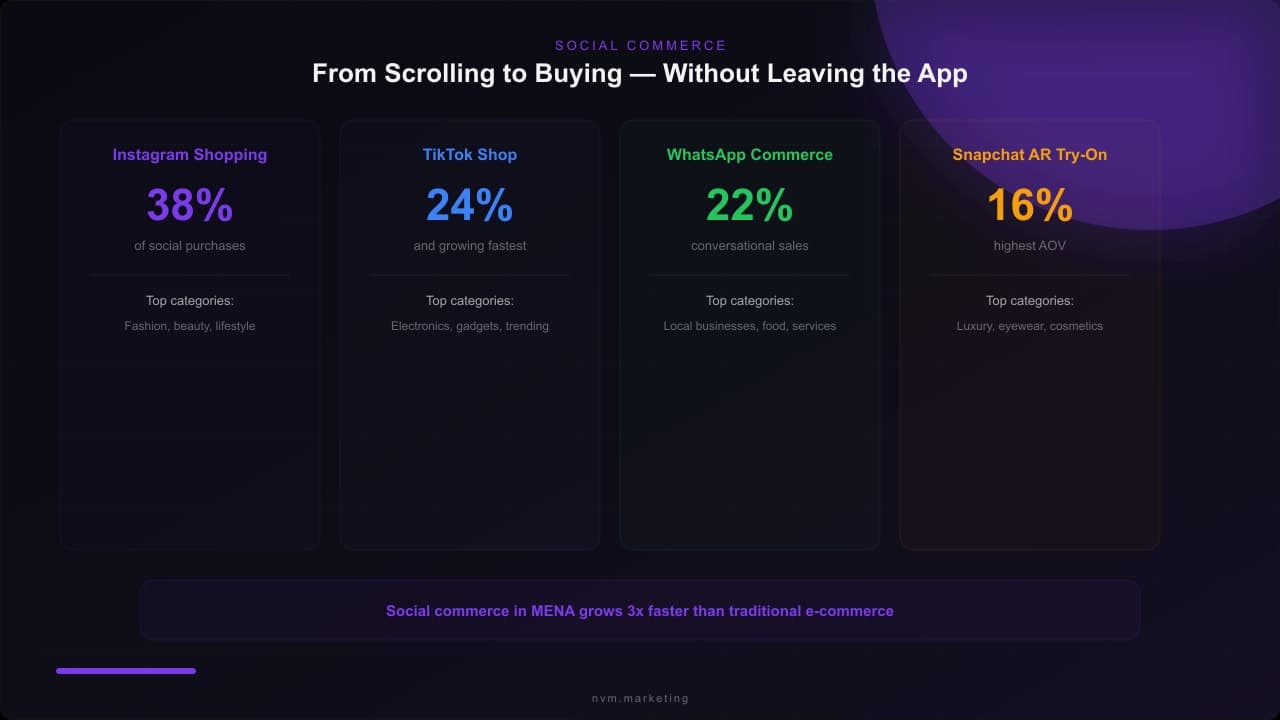
The line between social media and e-commerce has effectively disappeared in the Middle East. Instagram, TikTok, and WhatsApp are not just marketing channels — they are sales channels where transactions begin and often complete entirely within the platform.
Instagram as a Storefront
For fashion, beauty, and lifestyle brands in the GCC, Instagram is frequently the primary discovery and consideration channel. Users find products through reels, evaluate them through stories and comments, and expect to purchase without leaving the platform. Brands that force a redirect to a separate website at the point of purchase lose a significant percentage of high-intent buyers.
The solution is integrated shopping experiences. Instagram Shops, tagged products in posts and reels, and checkout-enabled catalogs allow the purchase to happen where the intent was created. The brands winning in GCC social commerce treat Instagram as a full sales channel with its own conversion optimization, not just a traffic source for their website.
WhatsApp Commerce
WhatsApp is where the Middle Eastern consumer prefers to negotiate, ask questions, and receive personalized recommendations. For categories where the purchase decision involves any complexity — custom products, services, high-ticket items — WhatsApp conversations convert at rates that dwarf traditional e-commerce funnels.
The most successful implementations use WhatsApp Business API with automated welcome flows, catalog sharing, and cart management. A customer can browse a catalog, add items to a cart, and complete payment without leaving WhatsApp. This is not a future trend — it is a current revenue channel that many international brands entering the region fail to activate.
TikTok Shop and Live Commerce
Live shopping events are gaining traction faster in the GCC than in Western markets. The format aligns with the region's preference for personality-driven recommendations and real-time interaction. TikTok Shop's expansion into the UAE and Saudi Arabia creates a direct purchase path from entertainment content to transaction.
Early data from GCC-focused live commerce events shows conversion rates between 8 and 15 percent, significantly above the 2 to 3 percent typical of standard e-commerce product pages. The interactive format — viewers can ask questions, see products in real-time, and receive limited-time offers — creates urgency and trust simultaneously.
Logistics as a Competitive Moat
In a market where same-day delivery is becoming the expected standard, your logistics infrastructure is not a back-office concern — it is a front-line competitive differentiator.
The Same-Day Expectation
Amazon.ae, Noon, and local delivery services have trained the UAE consumer to expect delivery within hours, not days. For e-commerce brands that cannot match this speed directly, the solution is transparent communication rather than false promises. Providing real-time tracking, accurate delivery windows, and proactive updates on delays builds more trust than promising same-day and missing it.
Cash on Delivery Is Still Alive
Despite the growth of digital payments, cash on delivery remains a significant payment method in Saudi Arabia and other GCC markets outside the UAE. COD accounts for 30 to 40 percent of orders in Saudi Arabia and even higher in markets like Egypt and Iraq. Removing COD to simplify operations means removing a substantial portion of your addressable market.
The smart approach is not to eliminate COD but to incentivize digital payment adoption through small discounts, loyalty points, or priority shipping for prepaid orders. Over time, this shifts the payment mix without losing the customers who are not yet ready to trust online payments fully.
Localization Beyond Translation
Arabic localization is not optional for serious GCC e-commerce, but effective localization goes far beyond running product descriptions through a translation service.
Cultural Calendar Alignment
The GCC shopping calendar follows different peaks than Western markets. Ramadan is the single largest e-commerce event in the region, with online spending increasing by 40 to 60 percent compared to baseline months. White Friday (the regional equivalent of Black Friday) is significant but secondary. National Day sales in the UAE (December 2) and Saudi National Day (September 23) create additional spikes.
Your marketing calendar, inventory planning, and promotional strategy need to align with these regional events, not just mirror a global calendar. Brands that run their heaviest promotions during Western holidays while underinvesting in Ramadan leave significant revenue on the table.
Product Curation for Local Taste
The products that sell best in the GCC often differ from global best-sellers in the same category. Fragrance preferences lean toward oud-based and oriental scents over the fresh and floral profiles popular in Europe. Fashion sizing and style preferences reflect both local climate and cultural norms. Electronics purchasing patterns favor premium tiers and the latest models at higher rates than most other markets.
Understanding these preferences and curating your product selection accordingly is a growth lever that many international retailers underestimate. A "one global catalog" approach leaves conversion optimization on the table that a locally curated selection would capture.
The Subscription and Loyalty Opportunity
Subscription e-commerce and loyalty programs are underpenetrated in the GCC relative to the market's purchasing power. Consumers here have the disposable income and purchase frequency to support robust subscription models, but few regional players have built compelling offerings.
The opportunity is particularly strong in consumables — coffee, personal care, pet supplies, health supplements — where repeat purchase rates are high and convenience is valued. Subscription models that bundle free delivery, exclusive products, or early access to new releases align well with the GCC consumer's preference for premium, effortless experiences.
Building for Regional Growth
E-commerce in the Middle East is not a scaled-down version of the Western model. It is a distinct market with its own payment norms, social commerce patterns, delivery expectations, and cultural rhythms. The brands that grow are the ones that build for these specificities rather than trying to force-fit a global template.
Mobile speed, BNPL integration, WhatsApp commerce, local social proof, and logistics transparency are not optional optimizations — they are the foundational requirements for competing in a market that is growing fast and becoming more sophisticated every quarter.
Keep the signal coming
Practical analysis on AI search, automation, and growth, straight to your inbox. No noise.
Related reading
E-E-A-T in the AI Era: A 46-Point Audit Guide
Experience, expertise, authority, and trust now influence more than Google rankings. Use this 46-point audit to make your brand, content, and authors easier for search engines and AI assistants to trust.
AI Search Visibility Checklist 2026: Be Answer-Ready
Google AI Overviews, ChatGPT, Perplexity — they all cite content differently. Seven areas that decide whether your brand shows up in AI answers.
Conversational Buying Shift: How AI Changed Search
Between 2023 and 2026, how consumers discover and buy changed more than in the previous decade of mobile. The data on what shifted and why.
Have a take on this?
Add a practitioner insight. Approved contributions appear inline with your name.
Comments
Sign in to join the conversation
Sign in