GEO vs SEO: How AI Search Changes Visibility
If your search strategy is still built on 2018-era blue-link SEO, you're invisible where buying decisions now begin. GEO vs SEO — and why you need both.
The way consumers search for products and B2B services has fundamentally changed. If your search strategy is still built around 2018-era blue link SEO alone, you are losing market share — not because your content is bad, but because it is invisible in the channels where buying decisions now begin.
Search in 2026 is generative. Users no longer want a list of ten links to evaluate. They want a synthesized, direct answer from an AI system — whether that is Google AI Overviews, ChatGPT, Perplexity, Gemini, or Claude. This shift does not eliminate SEO. It creates a parallel optimization discipline that operates alongside traditional search: Generative Engine Optimization (GEO) and Answer Engine Optimization (AEO).
Understanding the difference between these approaches — and building a strategy that covers both — is now a competitive requirement for any brand that depends on organic discovery.
What Is Generative Engine Optimization (GEO)?
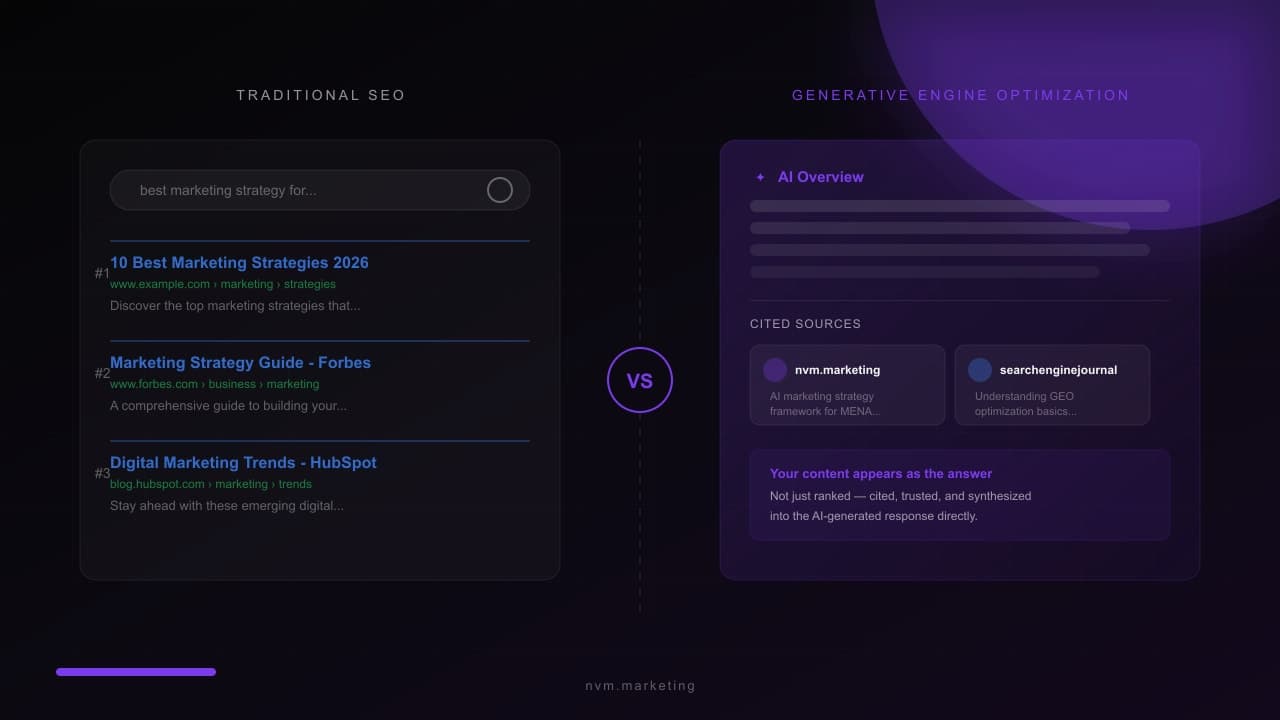
Generative Engine Optimization is the process of structuring your brand's digital content so that Large Language Models and AI search engines cite your website as a definitive source when answering user queries. The distinction from traditional SEO is precise: while SEO optimizes for algorithms that rank pages, GEO optimizes for algorithms that extract facts.
In traditional search, success means ranking on page one for a target keyword. In generative search, success means being the source that an AI system quotes when a user asks a question related to your expertise. The user may never visit your website directly — but they see your brand, your data, and your authority presented as the answer to their question.
How GEO Differs from SEO
Optimization target: SEO targets ranking position in a list of results. GEO targets citation frequency in synthesized answers. A page can rank poorly in traditional search but be cited frequently by AI systems if it contains specific, well-structured data that answers common questions.
Content structure: SEO-optimized content often follows a long-form narrative approach, building context before delivering the key insight. GEO-optimized content follows an inverted pyramid — the direct answer appears first, followed by supporting evidence and deeper context. AI systems extract from the top, not the bottom.
Authority signals: SEO weights backlinks and domain authority heavily. GEO weights factual accuracy, source diversity, content recency, and entity clarity. A newer article from a moderately authoritative source can earn AI citations over an older article from a high-authority domain if the newer content better answers the specific query.
User behavior: In SEO, the goal is to earn a click. In GEO, the goal may be to earn a citation without a click — a brand impression that builds trust and recall even when the user does not visit your site. This no-click visibility is a new form of brand building that traditional SEO never addressed.
Measurement: SEO measures rankings, organic traffic, and click-through rates. GEO measures citation frequency, brand mention volume in AI responses, and indirect traffic from users who search for your brand after seeing it cited in an AI answer.
The Inverted Pyramid: Writing for AI Extraction
AI systems are not patient readers. They scan content for direct answers, extract the most relevant statement, and present it to the user. Content that buries the answer after five paragraphs of context loses to content that states the answer immediately and expands afterward.
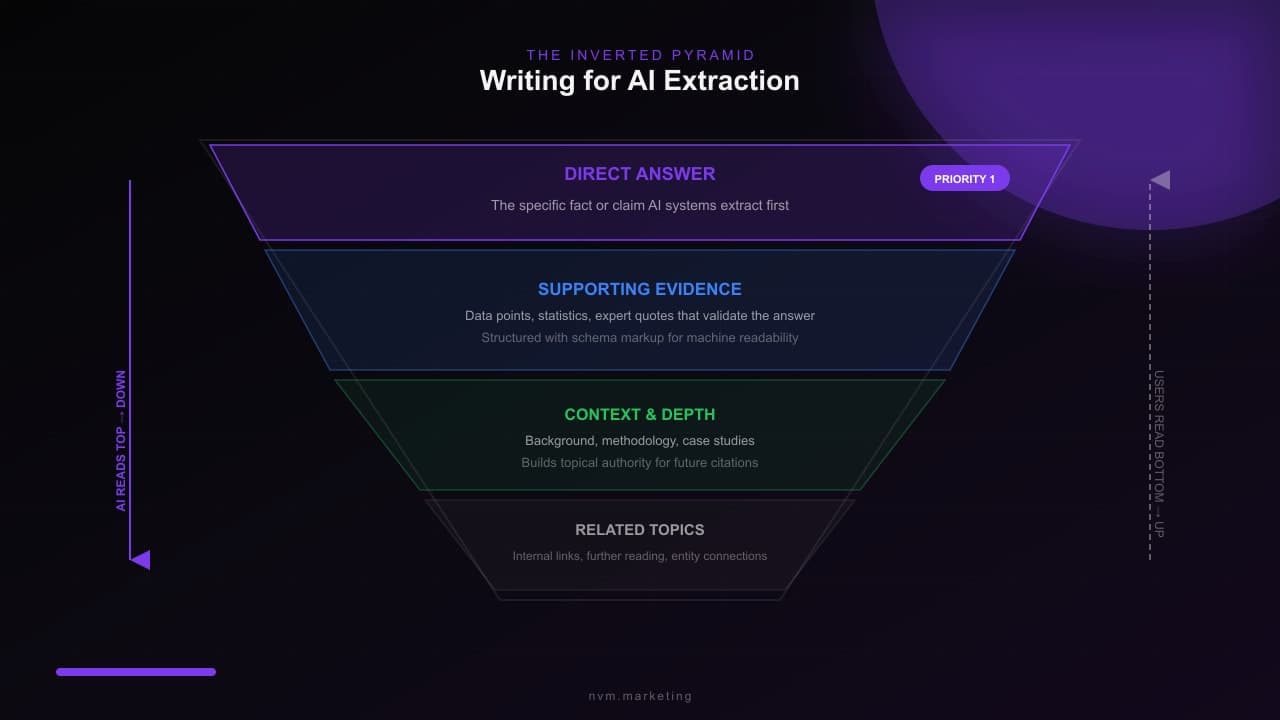
The inverted pyramid writing method — borrowed from journalism — is the optimal structure for GEO:
Layer 1: The Direct Answer (First 50 Words)
Start every page section or article with a concise, factual, and complete answer to the user's implied question. If someone searches "What is the average CPA for Google Ads in UAE real estate?" your content should answer that question in the first sentence — with a specific number, a date range, and a qualification — before providing any context.
This is counterintuitive for writers trained in SEO content, where introductions build interest before delivering value. In GEO, the value must come first. The introduction is the answer.
Layer 2: Supporting Context (Next 200-300 Words)
After the direct answer, provide the methodology, data sources, and nuances that validate the answer. This layer serves two purposes: it gives the AI system confidence that your answer is well-sourced, and it provides depth for human readers who want to understand the reasoning behind the number.
Include specific data points, comparisons, and qualifications. "The average CPA varies by property type — residential properties average X AED while commercial properties average Y AED" gives the AI system multiple extractable facts rather than a single data point.
Layer 3: Deeper Exploration (Remaining Content)
The final layer provides broader context, related topics, case studies, and actionable recommendations. This content may not be directly cited by AI systems, but it contributes to topical authority signals that make the entire page more trustworthy as a source.
Why GEO Matters Most in Multilingual Markets
GEO creates disproportionate advantage in markets where users compare options across multiple languages, sources, and formats. The GCC is a prime example of this dynamic.
The Arabic GEO Opportunity
Arabic content optimization for answer engines still lags significantly behind English in most verticals. The competitive landscape for Arabic GEO is approximately where English GEO was in 2023 — early enough that first movers can establish dominant positions before the market matures.
The specific advantages of Arabic GEO:
Lower competition: Fewer brands are optimizing Arabic content for AI citation, which means that well-structured Arabic content earns citations with less effort than equivalent English content.
Growing Arabic AI capability: Arabic language models improved dramatically between 2024 and 2026. ChatGPT, Gemini, and regional AI assistants now handle Arabic commercial queries with sufficient quality to influence purchase decisions. The demand side is ready — the supply of GEO-optimized Arabic content has not caught up.
Bilingual citation advantage: Brands that optimize for both Arabic and English GEO capture citations in two separate AI ecosystems. A question asked in Arabic may cite your Arabic content; the same question asked in English may cite your English content. Each citation reinforces your brand's authority in the AI system's understanding.
Entity Signals in Multilingual GEO
AI systems understand brands as entities — distinct concepts with attributes, relationships, and authority scores. For multilingual GEO, your entity signals must be consistent across languages:
- Your brand name, service descriptions, and geographic claims should be consistent between your Arabic and English content
- Structured data (JSON-LD) should appear on both language versions with equivalent information
- Author attribution should link to the same entity across languages — the AI system should understand that the author of your English content and your Arabic content is the same expert
- Cross-language internal linking reinforces the entity connection between your language versions
Building a Combined SEO + GEO Strategy
The goal is not to replace SEO with GEO. The goal is to build content that performs in both traditional search and generative search simultaneously. These are not opposing objectives — they are complementary when executed correctly.
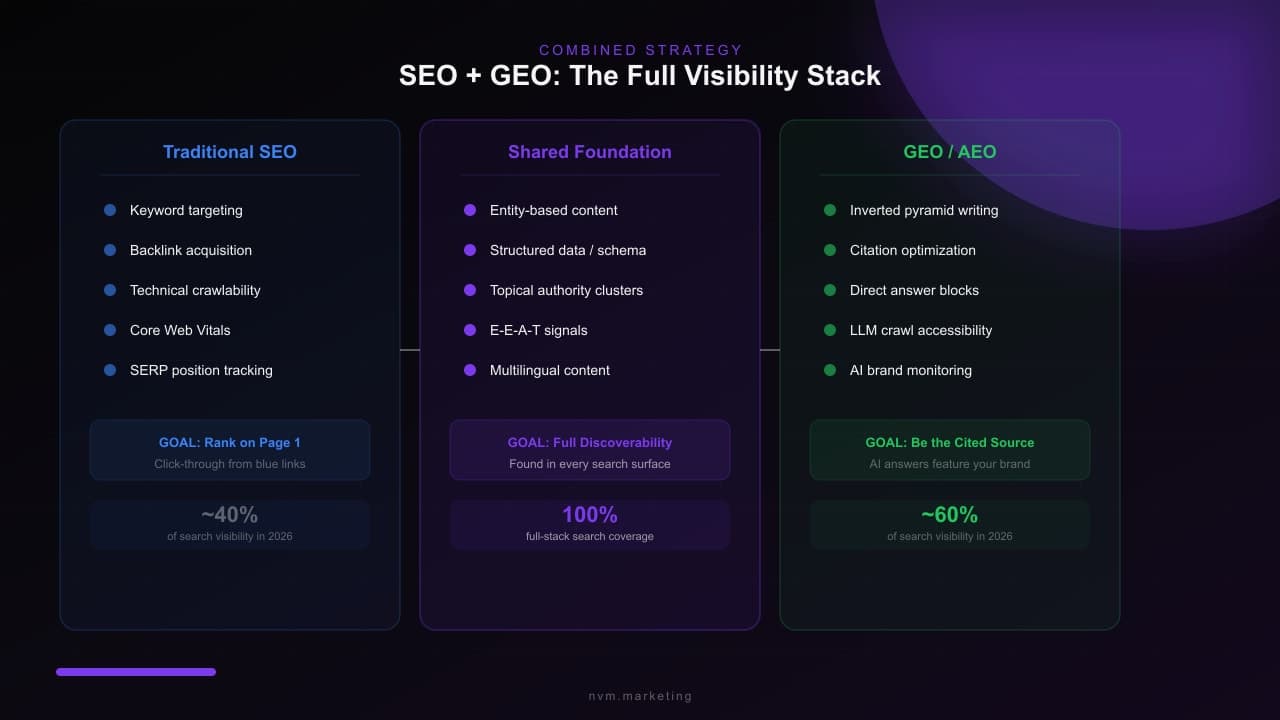
Content Architecture for Dual Optimization
Structure for extraction, write for depth: Use the inverted pyramid to make your key answers immediately accessible to AI systems, then expand with the comprehensive coverage that traditional SEO rewards. The same page can rank for a keyword and be cited in an AI answer if it is structured correctly.
Implement comprehensive structured data: JSON-LD schema markup serves both SEO (earning rich results in traditional search) and GEO (helping AI systems understand what your content represents). FAQPage, HowTo, Article, and Product schemas are particularly valuable for dual optimization.
Build question-based content architecture: Organize your content around the specific questions your audience asks, not just the keywords they search. Each question becomes a section header, with the answer as the first sentence of that section. This serves both users who scan headers in traditional search results and AI systems that extract question-answer pairs.
Maintain factual precision: AI systems increasingly verify claims before citing them. Content that includes specific numbers, dated references, named sources, and verifiable claims earns more citations than content that makes general assertions. "Conversion rates improved by 23 percent across 12 UAE e-commerce clients between Q1 and Q3 2025" is citable. "Conversion rates improved significantly" is not.
Authority Building for Both Channels
Author identity: Named authors with verifiable expertise earn more citations from AI systems and more trust from search engine E-E-A-T evaluations. Your About page, author bios, and LinkedIn profiles should clearly establish credentials, specializations, and geographic expertise.
Case studies as citation magnets: Detailed case studies with specific metrics, named (or anonymized but categorized) clients, and clear methodology are among the highest-cited content types in GEO. They simultaneously build SEO authority through demonstration of experience.
Original data and research: Content that presents original data — survey results, market analysis, benchmark studies — earns citations from both traditional publications (backlinks for SEO) and AI systems (citations for GEO). A single original research report can generate more GEO and SEO value than dozens of derivative articles.
Measuring GEO Performance
New Metrics for a New Channel
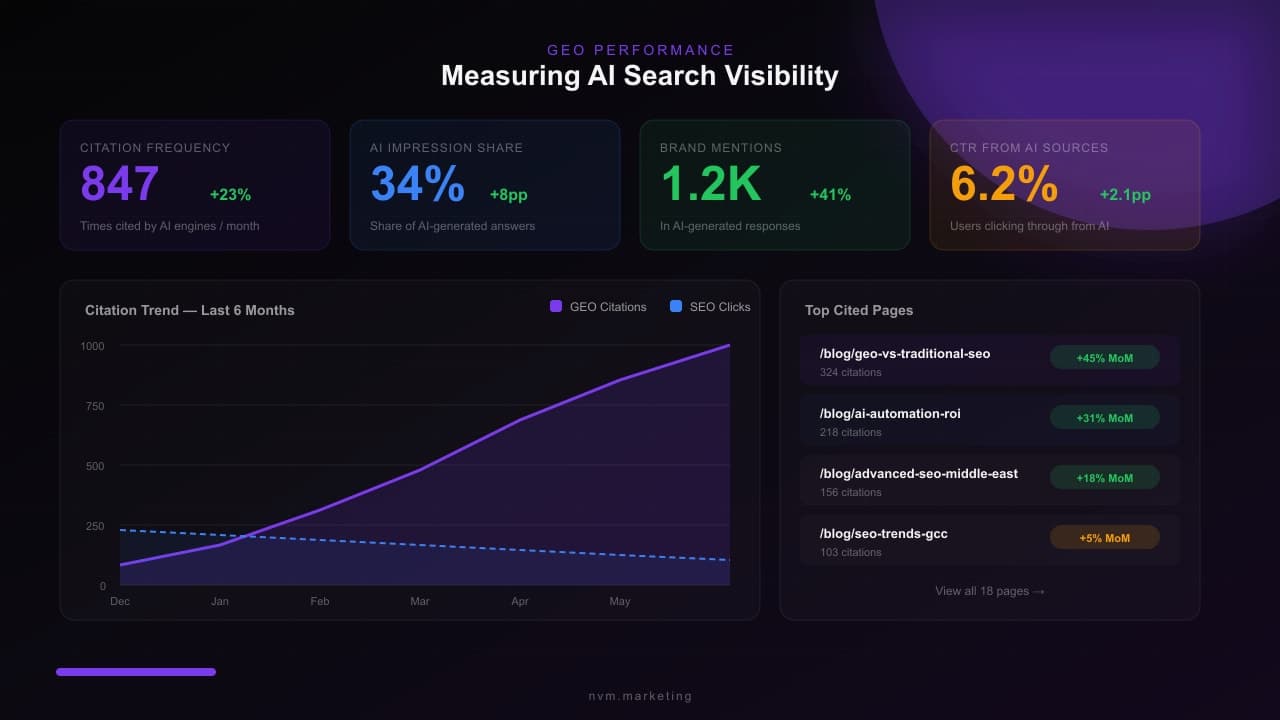
Traditional SEO metrics — rankings, organic traffic, click-through rates — do not capture GEO performance. You need additional measurement layers:
Citation monitoring: Track when and where your content appears in AI-generated answers. Tools are emerging that monitor AI responses for brand mentions and source citations. This is the GEO equivalent of ranking tracking in SEO.
Brand search volume: When an AI system cites your brand, users often search for your brand name directly rather than clicking a referral link. Monitor branded search volume as a proxy for GEO visibility. Increases in branded search that do not correlate with traditional marketing campaigns may indicate growing AI citation frequency.
Referral traffic from AI sources: Create separate analytics segments for traffic from ChatGPT, Perplexity, Google AI Overviews, and other AI platforms. Monitor this segment's growth rate, conversion behavior, and average session value independently.
Content citation rate: Measure which of your pages are cited most frequently and identify the content patterns that earn citations. This data informs your content strategy — produce more of what gets cited, less of what does not.
The Compounding Effect
GEO performance compounds more aggressively than SEO. As an AI system cites your content more frequently, it develops a stronger association between your brand and your topic area. Future queries on related topics are more likely to reference your content because the AI system has already established your authority. This creates a first-mover advantage that is expensive for competitors to overcome — they need to not only produce better content but also break the AI system's existing preference for your brand as a source.
The Convergence Timeline
GEO is not a future consideration — it is a current competitive requirement. AI-generated search experiences already influence purchase decisions for a significant and growing percentage of commercial queries. The businesses that build GEO into their content strategy now capture citations and brand visibility that compound over time.
The businesses that wait for GEO to become "proven" will find themselves in the same position as businesses that waited to adopt mobile-first design or social media marketing. By the time the opportunity is obvious to everyone, the early movers have established positions that are prohibitively expensive to challenge.
Start building dual-optimized content now. Structure for AI extraction, write for human depth, measure both channels, and iterate based on what earns citations. The convergence of SEO and GEO is not a theory — it is already happening in every competitive search market.
Keep the signal coming
Practical analysis on AI search, automation, and growth, straight to your inbox. No noise.
Related reading
E-E-A-T in the AI Era: A 46-Point Audit Guide
Experience, expertise, authority, and trust now influence more than Google rankings. Use this 46-point audit to make your brand, content, and authors easier for search engines and AI assistants to trust.
AI Search Visibility Checklist 2026: Be Answer-Ready
Google AI Overviews, ChatGPT, Perplexity — they all cite content differently. Seven areas that decide whether your brand shows up in AI answers.
Conversational Buying Shift: How AI Changed Search
Between 2023 and 2026, how consumers discover and buy changed more than in the previous decade of mobile. The data on what shifted and why.
Have a take on this?
Add a practitioner insight. Approved contributions appear inline with your name.
Comments
Sign in to join the conversation
Sign in