Google Ads Cost in the UAE: Benchmarks & Budget
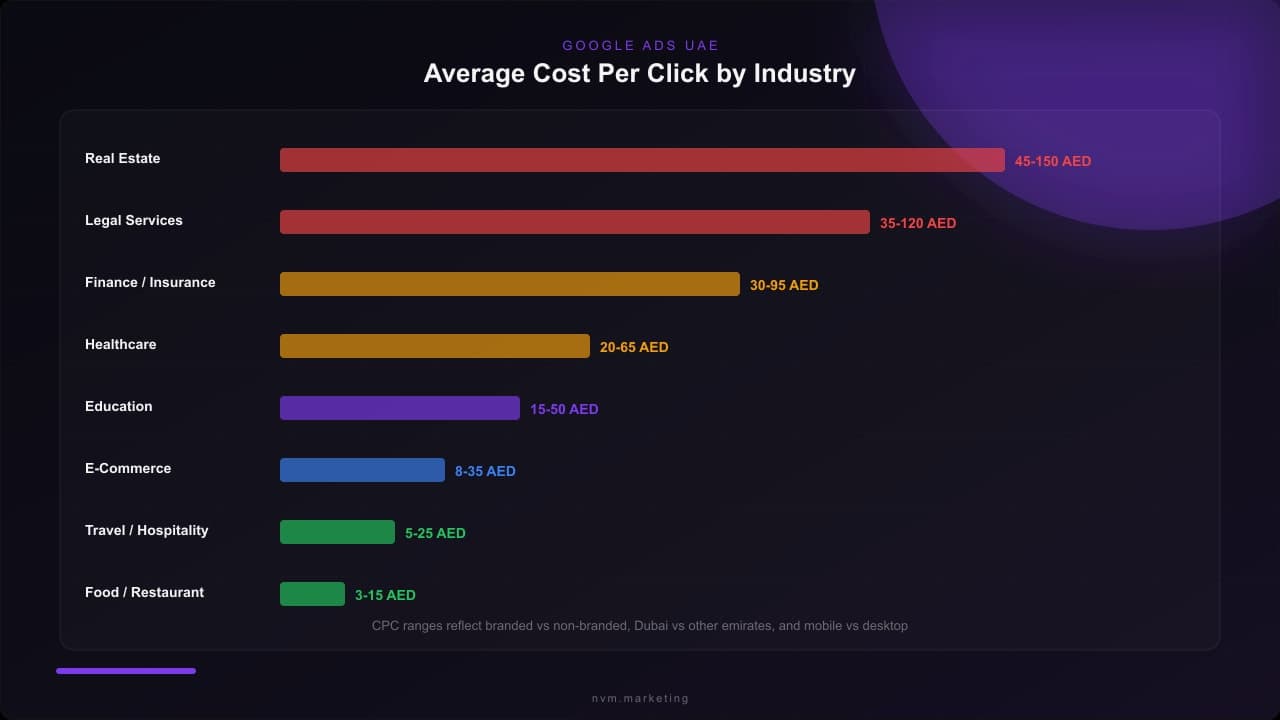
UAE CPCs range from 3 AED to 150+ AED. But CPC tells you the price of attention — not whether it converts to revenue. The full cost breakdown.
A common question from CEOs and CMOs across Dubai and Abu Dhabi: "How much should we be spending on Google Ads, and what is the average cost per click?" The question is reasonable. The typical answer — a range of CPCs by industry — is not useful enough to make budget decisions.
The average Cost Per Click in the UAE ranges from 3 AED for broad retail to over 150 AED for highly competitive B2B software and real estate keywords. But focusing solely on CPC is the fastest way to burn your marketing budget, because CPC tells you the price of attention without telling you whether that attention converts into revenue.
What follows is the data-driven breakdown of Google Ads costs in the UAE — not just what you pay per click, but where budgets leak, how account structure amplifies or destroys ROI, and what separates profitable campaigns from expensive experiments.
Average Google Ads Costs in the UAE by Industry
Real Estate (Off-Plan and Secondary)
CPC range: 25 AED to 120 AED per click. Off-plan property keywords are among the most expensive in the UAE advertising market. The competition includes major developers with unlimited budgets, aggregator platforms like Bayut and Property Finder, and dozens of brokerages bidding on the same terms.
Success in real estate Google Ads requires surgical precision. Generic terms like "buy apartment Dubai" attract tire-kickers and researchers. High-converting campaigns target specific intent signals: "Downtown Dubai 2-bedroom off-plan payment plan" captures a buyer much closer to decision than "Dubai property for sale."
Negative keyword management is non-negotiable. Without a robust exclusion list, you pay for clicks from people searching for "Dubai property news," "Dubai real estate market crash," or "free zone office Dubai" — none of which convert for a residential off-plan developer. A well-managed negative keyword list can reduce wasted spend by 30 to 40 percent.
Landing page quality directly impacts cost. Google assigns a Quality Score to each keyword-ad-landing page combination, and Quality Score directly determines your actual CPC. A real estate ad that sends users to a generic website homepage instead of a dedicated project page with floor plans, payment details, and a lead form will pay 20 to 40 percent more per click than a competitor with a purpose-built landing page.
Healthcare and Clinics
CPC range: 15 AED to 50 AED per click. Healthcare Google Ads in the UAE are heavily dependent on location targeting and intent differentiation. "Dentist near me" is a high-conversion query from someone ready to book. "Invisalign cost Dubai" is a research query from someone comparing options across multiple clinics.
Separating these intent layers into different campaigns with different bidding strategies is essential. High-intent queries warrant aggressive bidding because the conversion probability justifies the cost. Research-oriented queries should use lower bids and nurturing landing pages that capture contact information for follow-up rather than pushing for immediate booking.
Healthcare ads in the UAE also face regulatory considerations. Google restricts certain medical claims in advertising, and the UAE's health authority has specific guidelines about promotional language for medical services. Ads that violate these guidelines get disapproved, wasting the time and budget spent on creative development.
B2B SaaS and Professional Services
CPC range: 40 AED to 150+ AED per click. B2B keywords in the UAE have the highest CPCs but also the highest potential return per conversion. A single enterprise software deal can be worth 100,000 AED or more annually, which justifies CPCs that would be unsustainable in consumer markets.
The challenge with B2B Google Ads is search volume. The total addressable audience for most B2B products in the UAE is small — a few thousand decision-makers at most. This low volume means campaigns must be extremely precise in targeting, because every wasted click represents a significant percentage of the total available traffic.
Effective B2B campaigns in the UAE layer multiple signals: keyword intent (bottom-of-funnel terms like "enterprise CRM pricing UAE"), audience targeting (company size, industry, job title), and remarketing to site visitors who showed engagement signals. The combination of these layers ensures that the high CPC delivers high-quality leads rather than casual researchers.
E-commerce and Retail
CPC range: 2 AED to 15 AED per click. E-commerce Google Ads in the UAE have shifted heavily toward Performance Max and Google Shopping campaigns rather than traditional Search campaigns. Product-based queries like "buy running shoes Dubai" are increasingly served through Shopping results that display price, image, and merchant information directly in the search results.
The competitive advantage in e-commerce Google Ads is feed optimization. Your product data feed — the structured information about each product including title, description, price, availability, and images — determines which queries trigger your Shopping ads. A product title that reads "Nike Air Max 90 Men's Running Shoe Size 42 Black" outperforms "Men's Shoe" because it matches the specific queries that convert.
For UAE e-commerce businesses, shipping and delivery messaging in ad extensions significantly impacts click-through rates. "Same day delivery in Dubai" or "Free delivery UAE" as sitelink extensions can increase CTR by 15 to 25 percent compared to ads without delivery-related messaging.
The Hidden Costs That Destroy ROI
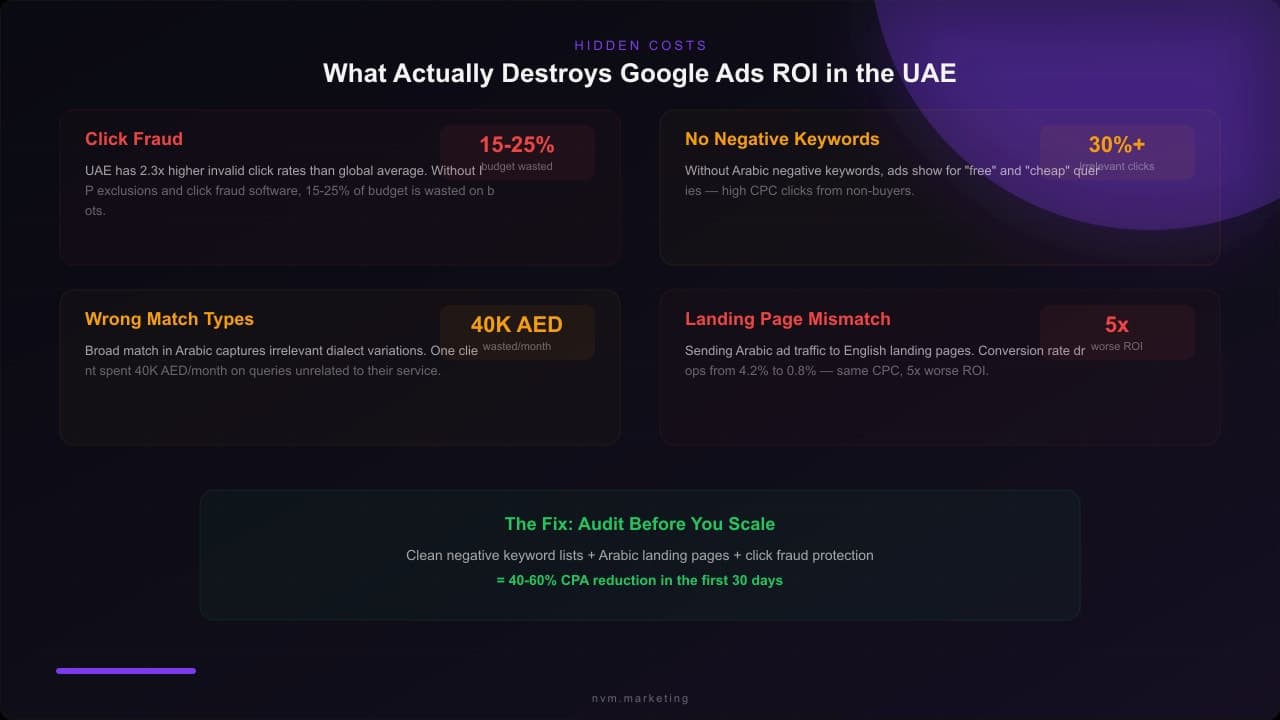
Most businesses in the UAE do not lose money because Google Ads is too expensive. They lose money because of structural problems in their account setup that silently drain budget without producing results.
Broad Match Bleed
Using broad match keywords without a robust negative keyword list is the single most common budget drain in UAE Google Ads accounts. Broad match tells Google to show your ad for any query that Google considers related to your keyword. "Web design Dubai" on broad match can trigger your ad for "free website builder," "web design internship," or "Dubai web design course" — none of which represent a potential customer.
The fix is straightforward but requires ongoing maintenance: build and maintain a comprehensive negative keyword list, review the Search Terms report weekly, and progressively tighten match types as you identify which queries actually convert.
The "Dubai" Modifier Trap
Bidding on keywords with "in Dubai" or "Dubai" as a modifier often captures the wrong audience. Many of these searches come from tourists planning visits, researchers writing about the Dubai market, or job seekers looking for positions in Dubai — not potential customers for your product or service.
The solution is layering audience signals over geographic modifiers. Instead of relying on the keyword alone, combine keyword targeting with audience targeting that filters for demographic and behavioral signals indicating purchase intent. In-market audiences, custom intent audiences, and remarketing lists help ensure that your "Dubai" keywords reach buyers rather than browsers.
Landing Page Disconnect
This is the most expensive hidden cost because it compounds. When your ad promises a specific service but sends the user to a generic homepage, the user bounces. You pay for the click but get zero conversions. Worse, the poor conversion rate tells Google's algorithm that your ads are not relevant, which lowers your Quality Score, which increases your CPC for future clicks. A landing page disconnect does not just waste today's budget — it permanently increases the cost of all future clicks.
Every ad group should point to a landing page that directly matches the ad's promise. An ad for "off-plan apartments in Business Bay" should land on a page specifically about Business Bay off-plan projects, not a homepage with a generic "View Our Properties" section.
Conversion Tracking Gaps
Browser-based tracking like standard GA4 pixels misses up to 30 percent of conversions due to ad blockers, iOS privacy updates, and cross-device attribution gaps. When Google's algorithm does not see conversions, it cannot optimize bidding effectively. It either bids too conservatively (missing opportunities) or too aggressively (overspending on low-quality traffic).
Server-side tracking resolves this by sending conversion data directly from your server to Google's systems, bypassing browser-level blocking. The implementation requires technical setup — typically through Google Tag Manager Server-Side Container or a platform like Stape — but the ROI improvement from accurate conversion data typically pays for the implementation cost within the first month.
How to Reduce Your Google Ads CPA
Campaign Structure Optimization
The foundation of CPA reduction is campaign structure. Each campaign should target a distinct intent level with appropriate bidding and landing pages:
Bottom-of-funnel campaigns target high-intent keywords where the user is ready to buy or inquire. These campaigns use aggressive bidding because the conversion probability justifies the cost. Exact match and phrase match keywords ensure precision.
Mid-funnel campaigns target research-oriented queries where the user is comparing options. These campaigns use moderate bids and landing pages designed to capture contact information for nurture sequences rather than pushing for immediate conversion.
Brand campaigns protect your branded search terms from competitor bidding. Without brand campaigns, competitors can bid on your brand name and capture clicks from people specifically searching for your business. Brand campaigns typically have the lowest CPC and highest conversion rates of any campaign type.
Arabic Intent Localization
Simply translating English keywords to Arabic does not work. Arabic search behavior in the UAE reflects specific cultural and linguistic patterns that direct translation misses entirely. How a consumer in Dubai searches for "accounting software" in Arabic is different from a literal translation of the English term — the colloquial phrasing, the word order, and the qualifying terms all differ.
Localized, colloquial Arabic keyword targeting often yields 30 to 40 percent lower CPC than standard translated terms because the competition is lower. Few advertisers invest in genuine Arabic keyword research, which means the auction is less crowded for authentically Arabic queries.
This also applies to ad copy. Arabic ad copy written by a native speaker who understands Gulf Arabic persuasion patterns outperforms translated English copy in click-through rates and conversion rates. The cultural context — how urgency is expressed, how trust is signaled, how offers are framed — differs between English and Arabic audiences even when they are the same person searching in different languages.
Performance Max: When and How
Performance Max uses Google's AI to optimize across all channels — Search, Display, YouTube, Gmail, and Discover. It can be highly effective, but it requires conditions that many UAE advertisers do not meet when they launch it:
Sufficient conversion data: PMax needs at least 30 to 50 conversions per month to optimize effectively. Launching PMax on a new account with no conversion history gives the algorithm no signal to optimize against, resulting in broad, untargeted spending.
Strong creative assets: PMax uses your provided images, videos, headlines, and descriptions to generate ad combinations across all channels. Weak creative assets produce weak ads across every channel simultaneously, which is worse than poor performance in a single channel.
Accurate conversion tracking: PMax optimizes toward your conversion goals. If your conversion tracking is inaccurate — undercounting conversions or counting low-value actions — PMax optimizes toward the wrong objective.
The recommended approach: build campaign history with standard Search campaigns first, establish accurate conversion tracking, develop strong creative assets, and then migrate to PMax with sufficient data for the algorithm to work with.
Budget Allocation Strategy
For most UAE businesses starting with Google Ads, the recommended budget allocation follows a 60-20-20 model:
- 60 percent to high-intent Search campaigns that target bottom-of-funnel keywords with proven conversion history
- 20 percent to remarketing campaigns that re-engage website visitors who showed intent but did not convert
- 20 percent to testing — new keywords, new audiences, new ad formats — that identifies opportunities for future scaling
As the account matures and conversion data accumulates, the testing budget should shift toward the channels and keywords that demonstrate the best CPA, creating a continuous optimization cycle that improves efficiency over time.
The Audit Starting Point
If your current Google Ads setup is underperforming, start with a structural audit before increasing budget. Adding more money to a poorly structured account produces more waste, not more results. The audit should identify where budget is leaking through broad match bleed, where intent is mismatched between keywords and landing pages, where conversion tracking gaps are causing the algorithm to optimize against incomplete data, and which structural fixes will produce the largest efficiency improvements with the least effort.
The businesses that consistently generate positive ROI from Google Ads in the UAE are not the ones with the largest budgets. They are the ones with the most disciplined account structures, the most precise intent targeting, and the most accurate conversion tracking. Get the foundation right, and the budget becomes an accelerator rather than an expense.
Keep the signal coming
Practical analysis on AI search, automation, and growth, straight to your inbox. No noise.
Related reading
E-E-A-T in the AI Era: A 46-Point Audit Guide
Experience, expertise, authority, and trust now influence more than Google rankings. Use this 46-point audit to make your brand, content, and authors easier for search engines and AI assistants to trust.
AI Search Visibility Checklist 2026: Be Answer-Ready
Google AI Overviews, ChatGPT, Perplexity — they all cite content differently. Seven areas that decide whether your brand shows up in AI answers.
Conversational Buying Shift: How AI Changed Search
Between 2023 and 2026, how consumers discover and buy changed more than in the previous decade of mobile. The data on what shifted and why.
Have a take on this?
Add a practitioner insight. Approved contributions appear inline with your name.
Comments
Sign in to join the conversation
Sign in