Performance Marketing in 2026: Building Measurable Growth
The algorithm decides who sees your organic content — and it changes quarterly. Predictable growth requires a system where every dollar is traceable.
Organic social media still matters for discovery and brand recall, but it rarely creates predictable revenue on its own. The algorithm decides who sees your content, and that algorithm changes quarterly. If you need reliable growth — the kind you can forecast, budget against, and scale — you need a performance marketing system where every dollar spent is tracked from click to conversion to revenue.
This is not about choosing between organic and paid. It is about understanding that they serve different functions. Organic builds awareness and trust over time. Paid distribution buys you reach, data, and speed. The businesses that grow fastest use both, but they treat performance marketing as the engine and organic as the fuel.
The Measurement-First Mindset
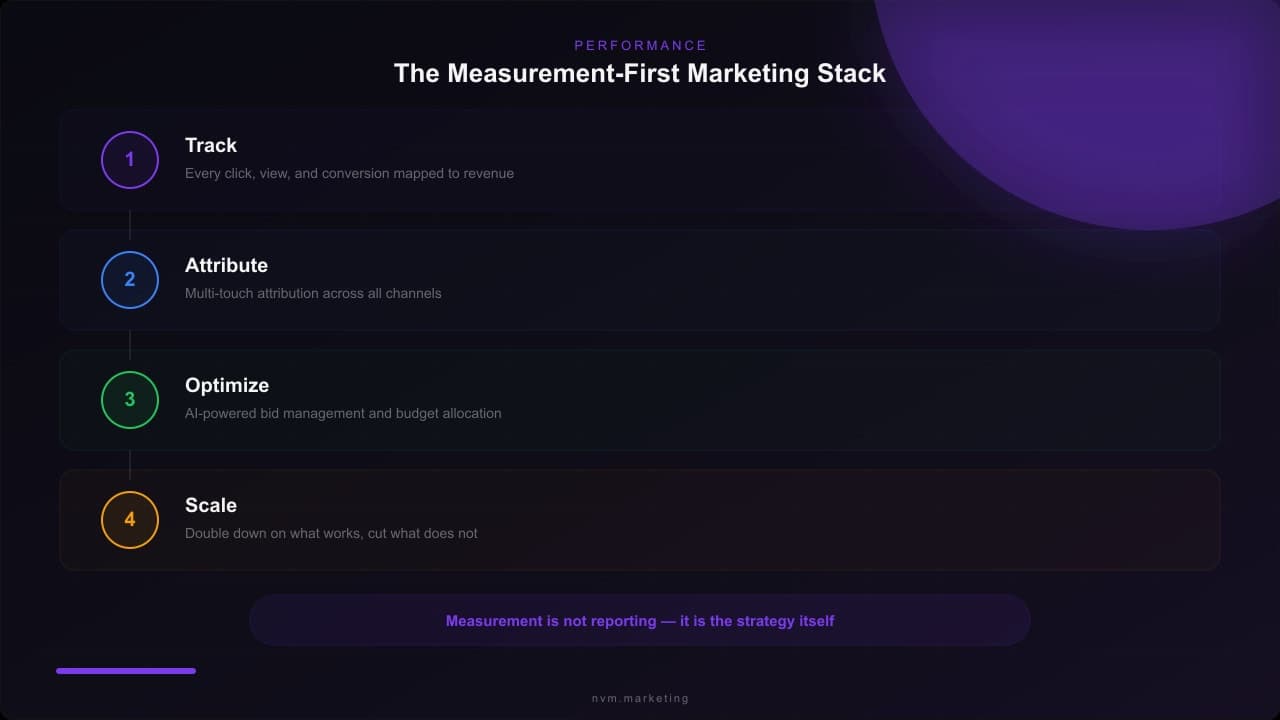
The fundamental shift in performance marketing over the past three years is the move from campaign-level thinking to system-level thinking. Individual campaigns come and go. A performance marketing system runs continuously, optimizing itself based on data feedback loops.
Beyond Vanity Metrics
Impressions, reach, and engagement rate are not performance metrics. They are activity metrics. They tell you something happened but not whether it mattered. Performance marketing measures what matters: how much it costs to acquire a customer (CPA), how much revenue that customer generates relative to ad spend (ROAS), and which variables — audience, creative, placement, timing — drive those outcomes.
The distinction is not semantic. A campaign that generates 500,000 impressions and 10,000 clicks but zero sales is not a successful awareness campaign — it is a failed conversion campaign wearing an awareness costume. Performance marketing strips away the costume and asks: did this spend produce revenue?
Building the Measurement Stack
Effective performance marketing requires a measurement infrastructure that tracks the complete journey from first touchpoint to final sale. This includes:
Pixel and conversion API setup: Platform pixels (Meta, Google, TikTok) installed correctly with server-side event tracking to maintain accuracy as browser-based tracking becomes less reliable. The iOS privacy changes and third-party cookie deprecation have made server-side tracking essential, not optional.
UTM discipline: Every paid link tagged with consistent UTM parameters (source, medium, campaign, content, term) so you can attribute revenue to specific ads, audiences, and creative variations in your analytics platform.
CRM integration: Closed-loop reporting that connects ad platform data to actual sales outcomes. Knowing that a Google Ads campaign generated 200 leads is useful. Knowing that 34 of those leads became paying customers worth 180,000 AED in lifetime value is actionable.
Attribution modeling: Understanding which touchpoints contribute to conversion. Last-click attribution is simple but misleading — it gives all credit to the final touchpoint and ignores everything that built awareness and consideration. Data-driven attribution models distribute credit across the full journey, giving you a more accurate picture of which channels actually drive growth.
Stop Buying Awareness, Start Buying Data
Many businesses still run "brand awareness" campaigns without clear measurement frameworks. They boost posts, run video views campaigns, and celebrate reach numbers without connecting those numbers to business outcomes.
Awareness matters, but awareness without measurement is hope marketing. Every awareness campaign should be structured to generate data that informs your performance campaigns.
The Data Acquisition Framework
Think of top-of-funnel campaigns not as awareness vehicles but as data acquisition tools. A video views campaign is not just building brand recall — it is building an audience segment of people who watched 75 percent of your video, which becomes a retargeting pool for your conversion campaigns. A traffic campaign is not just driving visits — it is populating your pixel with behavioral signals that improve your lookalike audiences.
When you frame awareness spending as data acquisition, the ROI calculation changes. The question is not "did this video ad generate sales?" but "did this video ad build an audience that my conversion campaign can profitably reach?"
Budget Allocation
The standard performance marketing budget split follows a 70/20/10 model:
- 70 percent on proven, high-ROAS campaigns that are already generating profitable returns. These are your money-makers and should receive the majority of budget.
- 20 percent on scaling experiments — new audiences, new placements, new creative formats — that have shown initial promise but need more data to validate.
- 10 percent on pure testing — entirely new approaches, untested audiences, and creative concepts that may or may not work. This is your innovation budget.
The mistake most businesses make is inverting this ratio, spending the majority of budget on untested campaigns while underfunding what is already working. Scale your winners first.
The Power of Retargeting
Most users do not convert on their first visit. Across industries, the first-visit conversion rate is typically between 1 and 3 percent. This means 97 to 99 percent of your paid traffic leaves without taking the desired action. Without retargeting, that traffic is lost.
Building Your Retargeting Architecture
Effective retargeting requires audience segmentation based on behavioral signals. Not all visitors are equal, and your retargeting should reflect where each user stopped in the journey:
Homepage visitors: Low intent. Retarget with educational content or social proof that builds credibility and brings them back for a deeper engagement.
Product or service page visitors: Medium intent. They explored a specific offering. Retarget with benefits, case studies, and comparison content related to what they viewed.
Cart abandoners or form starters: High intent. They began the conversion process and stopped. Retarget with urgency, incentives, or trust signals that address their likely objections.
Past customers: Highest value. Retarget with upsell, cross-sell, and loyalty offers. Acquiring a new customer costs five to seven times more than retaining an existing one.
Dynamic Creative Optimization
The most effective retargeting serves the specific products or services each user viewed, not generic brand messaging. Dynamic creative optimization (DCO) automatically assembles ad creative from a product catalog, showing each user the exact items they browsed along with related recommendations.
In the GCC market, dynamic retargeting with localized creative — Arabic language, local pricing in AED or SAR, and region-specific offers — consistently outperforms generic English-language retargeting by 40 to 60 percent in click-through and conversion rates.
Creative Testing at Scale
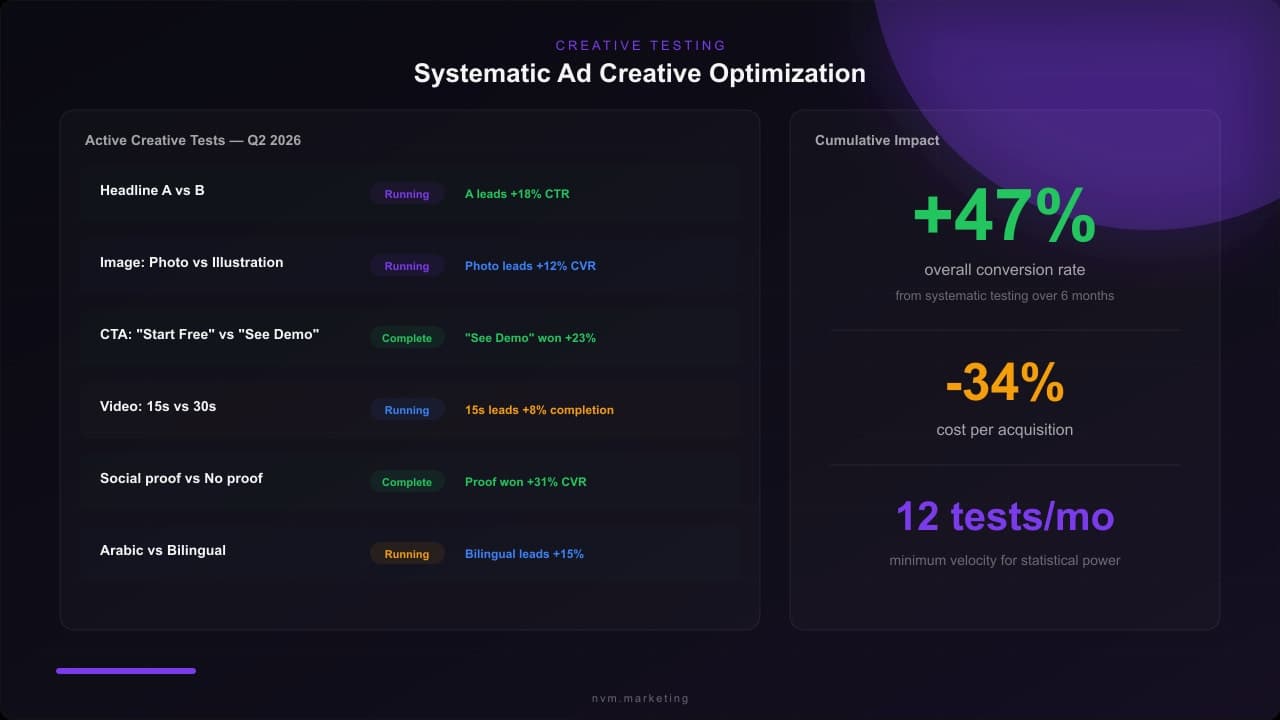
Ad fatigue is real and accelerating. The same creative asset will exhaust its audience within two to three weeks on most platforms. The half-life of ad creative is getting shorter as users become more adept at ignoring repetitive advertising. Success in performance marketing requires a systematic approach to creative testing.
The Testing Framework
Effective creative testing is not random. It follows a structured approach:
Variable isolation: Test one variable at a time — headline, image, video hook, call to action, offer — so you can attribute performance differences to specific changes. Testing multiple variables simultaneously makes it impossible to know what drove the result.
Statistical significance: Run tests long enough and with sufficient budget to reach statistical significance before declaring a winner. A creative that performs 20 percent better after 200 impressions might be noise. After 5,000 impressions, it is a signal.
Iteration cycles: Winning creative becomes the new control. The next test uses the winning headline with a new image, or the winning image with a new offer. This iterative approach compounds improvements over time rather than starting from scratch with each test.
Creative Formats That Work in 2026
The creative landscape has shifted dramatically. Static image ads still work for retargeting, but top-of-funnel campaigns increasingly require video content. Specifically:
Short-form vertical video (under 30 seconds) for TikTok, Reels, and Shorts. The hook — the first three seconds — determines whether the ad gets watched or skipped. Invest disproportionate effort in the opening frame.
User-generated content style ads that look like organic posts rather than polished advertisements. These consistently outperform studio-produced creative in both engagement and conversion metrics because they bypass the "this is an ad" mental filter.
Educational content that provides genuine value before asking for the conversion. A 60-second video explaining a concept, demonstrating a solution, or sharing a relevant insight builds trust in a way that a direct sales pitch cannot.
Landing Page Optimization
The best ad in the world cannot overcome a bad landing page. The post-click experience determines whether your ad spend converts to revenue or evaporates into bounce rates.
The Continuity Principle
The landing page must be a seamless continuation of the ad. If the ad promises a specific benefit, the landing page headline should echo that benefit immediately. If the ad features a specific product, the landing page should show that product above the fold. Any disconnect between ad promise and landing page delivery creates cognitive friction that kills conversions.
Speed and Mobile Performance
In the GCC market, landing page speed is a conversion variable with outsized impact. Every additional second of load time costs you 7 to 10 percent of conversions. Your landing pages need to load in under 2 seconds on mobile, which means minimal JavaScript, optimized images, and no unnecessary third-party scripts.
Social Proof Placement
For UAE and Saudi audiences specifically, social proof on landing pages follows a hierarchy: local client logos and case studies carry the most weight, followed by quantified results (percentages and numbers), followed by named testimonials with photos. Generic star ratings and unnamed quotes carry minimal persuasive weight in this market.
Building the Performance Machine
Performance marketing is not a set of campaigns. It is an operating system for growth. The businesses that win are not the ones with the biggest budgets but the ones with the best systems — measurement infrastructure that tracks every dollar from click to revenue, creative testing processes that continuously improve performance, and retargeting architectures that capture value from every visitor.
Build the system once, optimize it continuously, and let the data tell you where to invest next. That is how predictable, scalable growth works in 2026.
Keep the signal coming
Practical analysis on AI search, automation, and growth, straight to your inbox. No noise.
Related reading
E-E-A-T in the AI Era: A 46-Point Audit Guide
Experience, expertise, authority, and trust now influence more than Google rankings. Use this 46-point audit to make your brand, content, and authors easier for search engines and AI assistants to trust.
AI Search Visibility Checklist 2026: Be Answer-Ready
Google AI Overviews, ChatGPT, Perplexity — they all cite content differently. Seven areas that decide whether your brand shows up in AI answers.
Conversational Buying Shift: How AI Changed Search
Between 2023 and 2026, how consumers discover and buy changed more than in the previous decade of mobile. The data on what shifted and why.
Have a take on this?
Add a practitioner insight. Approved contributions appear inline with your name.
Comments
Sign in to join the conversation
Sign in