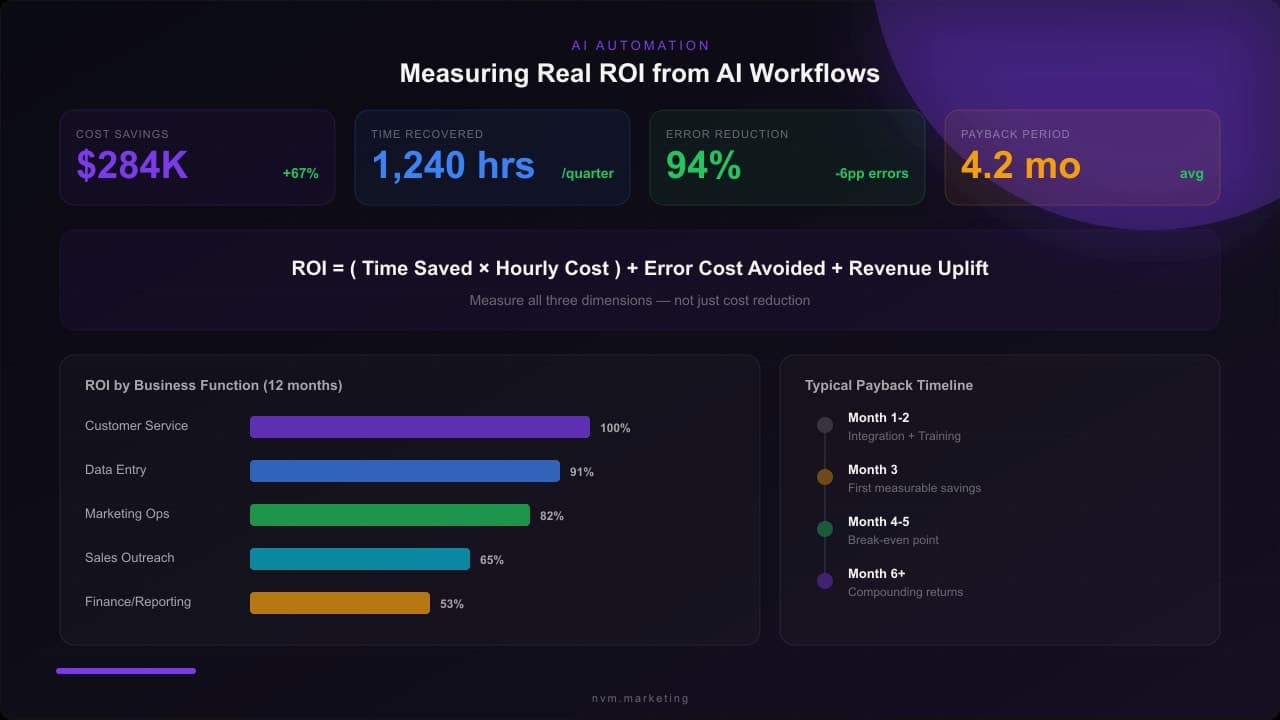
Maximizing ROI with AI Automation: Operator Framework
The gap between 'we implemented AI' and 'AI generated measurable ROI' is where most initiatives stall. An operator's framework for closing it.
Every business knows AI automation can save time. Few know how to measure whether it actually does. The gap between "we implemented AI" and "AI generated measurable ROI" is where most automation initiatives stall, not because the technology failed but because nobody defined what success looks like before deployment.
This is an operator's framework — not a vendor pitch. It starts with identifying where automation creates the most value, moves through implementation without organizational disruption, and ends with a measurement system that proves whether the investment is paying off.
Why Businesses Are Pivoting to AI Automation
The pressure is structural, not trendy. Across B2B services, e-commerce, real estate, and professional services, companies face the same equation: more competition, higher customer expectations, and the same or smaller teams to handle both. Hiring is not scaling fast enough. Manual processes that worked at 50 customers break at 500.
AI automation addresses this by handling the operational work that consumes human hours without requiring human judgment. The three primary value drivers are:
Reducing Operational Overhead
The average knowledge worker spends 60 percent of their day on "work about work" — status updates, data entry, searching for information, and routing requests. AI automation targets exactly this layer. When an invoice is processed automatically, when a customer inquiry is routed to the right team without human triage, when a report generates itself from live data — each of these removes a small friction cost that compounds across the organization.
The ROI calculation is straightforward: hours saved per week multiplied by the hourly cost of the person who was doing that work. A single automation that saves one team member two hours per day is worth approximately 50,000 AED per year in recovered capacity — and that person can now spend those hours on revenue-generating activities instead.
Enhancing Decision Making
Humans are excellent at making decisions with complete information and adequate time. They are poor at making decisions with incomplete information under time pressure, which describes most operational decisions in a fast-growing business.
AI systems process data from multiple sources simultaneously and surface patterns that humans miss. A predictive model that forecasts which leads are most likely to close, based on dozens of behavioral and firmographic signals, makes better prioritization decisions than a sales manager relying on intuition. Not because the manager lacks intelligence but because the data volume exceeds human processing capacity.
The ROI here is harder to measure directly but shows up in conversion rates, win rates, and revenue per employee. Teams that use AI-assisted decision-making typically see 15 to 25 percent improvements in these metrics within the first six months.
Scaling Personalization
Personalization at scale is the promise that AI finally delivers on. A human can write a thoughtful, personalized email to five prospects per day. An AI system can generate genuinely personalized outreach to 500 prospects per day, each message reflecting the recipient's industry, company size, recent news, and likely pain points.
The difference is not just speed — it is reach. Without AI, personalization is limited by team size. With AI, personalization is limited only by your contact database. This fundamentally changes the economics of outbound marketing and customer engagement.
The Functional Intelligence Framework
We do not believe in AI for the sake of AI. We believe in what we call Functional Intelligence — automation that solves a specific, measurable problem and proves its value through clear metrics.
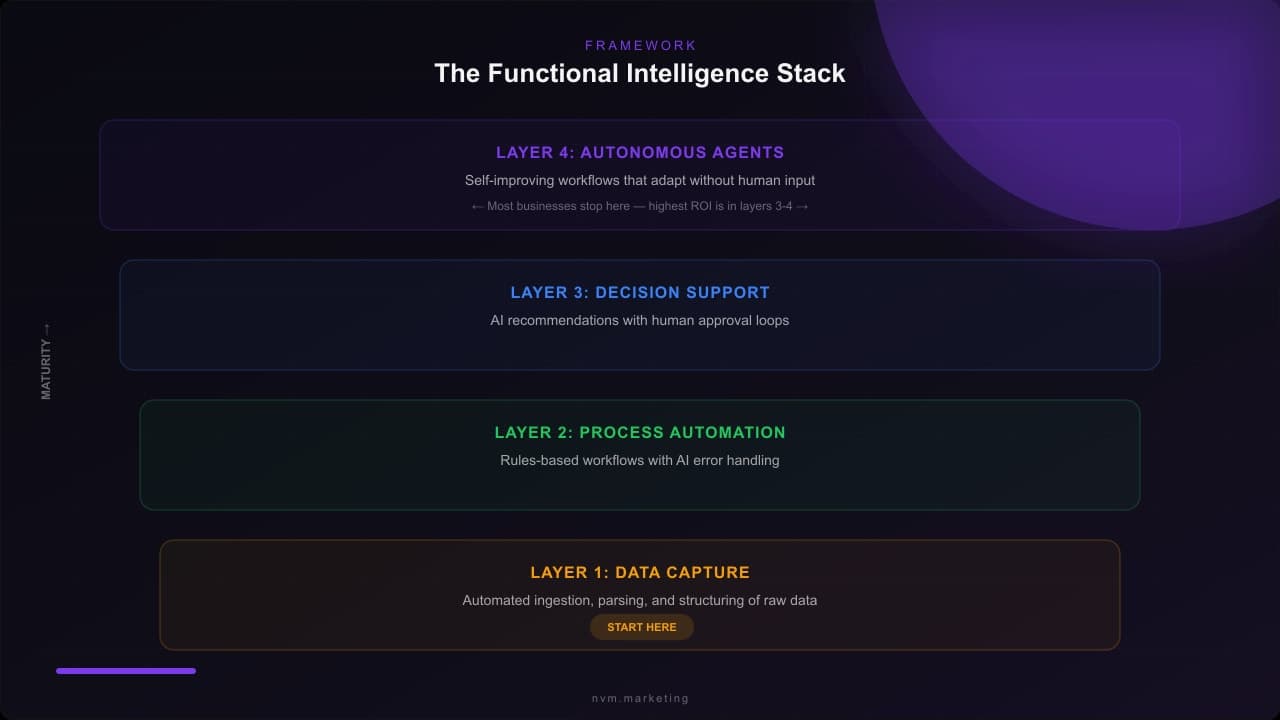
The framework has four principles:
Zero Bloat
Implement only the tools that move measurable needles. The AI automation market is flooded with solutions looking for problems. Every tool you add to your stack introduces complexity, maintenance cost, and potential points of failure. Before adding any automation, answer two questions: "What specific metric will this improve?" and "How will we measure the improvement?" If you cannot answer both questions concretely, do not implement.
Seamless Integration
AI automation fails when it creates its own silo. The most effective implementations plug directly into your existing CRM, email platform, project management tools, and communication channels. Your team should not need to learn a new interface or change their workflow to benefit from automation. The AI should work invisibly within the tools they already use.
ROI-First Mentality
Every automation should have a defined payback period. For most operational automations, payback should occur within 90 days. If an automation costs 5,000 AED per month to operate, it should demonstrably save or generate at least 15,000 AED per month by the end of the first quarter. If it does not, either the implementation needs refinement or the use case was not strong enough.
Human-in-the-Loop Design
The most reliable AI automations keep humans in the decision loop for high-stakes actions. An AI can draft an email, but a human should approve it before it goes to a strategic client. An AI can score a lead, but a human should validate the score before committing significant sales resources. This approach captures 90 percent of the efficiency gains while maintaining the quality control that pure automation cannot guarantee.
Practical Implementation Across Business Functions
Sales: Automated Lead Scoring and Routing
The highest-impact sales automation for most businesses is lead scoring. Instead of treating every form submission as equal, an AI model evaluates each lead against your historical conversion data and assigns a probability score.
The implementation process:
- Export your last 12 months of lead data with outcomes — which leads became customers, which did not, and what characteristics distinguished them
- Train a scoring model on these features — company size, industry, source channel, pages visited, engagement level
- Deploy the model to score incoming leads in real time
- Route high-score leads (top 20 percent) to immediate human outreach
- Route medium-score leads (middle 40 percent) to automated nurture sequences with periodic human check-ins
- Route low-score leads (bottom 40 percent) to long-term automated nurture
Teams implementing this approach typically see lead-to-opportunity conversion rates increase by 30 to 50 percent because sales effort concentrates on the leads most likely to close.
Support: Intelligent Triage and Resolution
Customer support automation starts with classification. An AI system reads incoming support tickets, categorizes them by type and severity, and either resolves common issues automatically or routes complex issues to the right specialist with full context.
The metrics that matter:
- First response time: Should drop below 2 minutes for automated resolution and below 15 minutes for human-required issues
- Resolution rate without human intervention: Target 30 to 40 percent for mature implementations
- Customer satisfaction scores: Must remain stable or improve — automation that resolves tickets faster but reduces satisfaction is net negative
- Cost per ticket: Should decrease by 40 to 60 percent as automation handles routine volume
Operations: Workflow Automation
Operational automation targets the repetitive, rule-based tasks that consume administrative hours. Common high-value targets include:
Invoice processing: Automatic extraction of data from incoming invoices, matching against purchase orders, flagging discrepancies, and routing approvals. Reduces processing time from 15 minutes per invoice to under 30 seconds.
Report generation: Automated dashboards that pull data from multiple sources and generate weekly or monthly reports without human assembly. Eliminates 4 to 8 hours per week of manual report building.
Onboarding workflows: Automated document collection, account provisioning, and welcome sequences for new clients or employees. Reduces onboarding time from days to hours while improving the experience.
Meeting scheduling and preparation: AI that handles calendar coordination, sends agendas, compiles relevant documents, and generates briefing notes before meetings. Saves 30 to 60 minutes of preparation time per meeting.
Measuring AI Automation ROI
The ROI Formula
AI automation ROI is calculated across four dimensions:
Time savings: Hours of manual work eliminated per week, multiplied by the hourly cost of the labor. This is the most straightforward measurement and the easiest to track.
Revenue impact: Additional revenue generated through faster response times, higher conversion rates, or expanded capacity. This requires attribution modeling to connect automation actions to revenue outcomes.
Error reduction: Cost of errors prevented by automation — incorrect data entry, missed follow-ups, compliance violations. Measure by comparing error rates before and after automation deployment.
Capacity creation: The value of work your team can now do because automation freed their time. This is the hardest to measure but often the largest long-term benefit. A salesperson who spends two fewer hours per day on data entry can spend that time closing deals, which generates revenue that exceeds the automation cost by multiples.
Setting Benchmarks
Before deploying any automation, establish baseline measurements:
- How many hours per week does this process currently consume?
- What is the error rate of the current manual process?
- What is the current response time or throughput?
- What is the current conversion rate at the stage being automated?
After deployment, measure the same metrics monthly and calculate the delta. If the automation is working, you should see improvement within the first 30 days and a clear ROI positive within 90 days.
The Compounding Effect
The most important aspect of AI automation ROI is that it compounds. A lead scoring model that improves conversion rates by 20 percent generates more revenue, which funds additional automation, which improves other metrics, which generates more revenue. The businesses that start early build compounding advantages that become increasingly difficult for competitors to replicate.
Common Mistakes That Kill ROI
Automating the Wrong Things
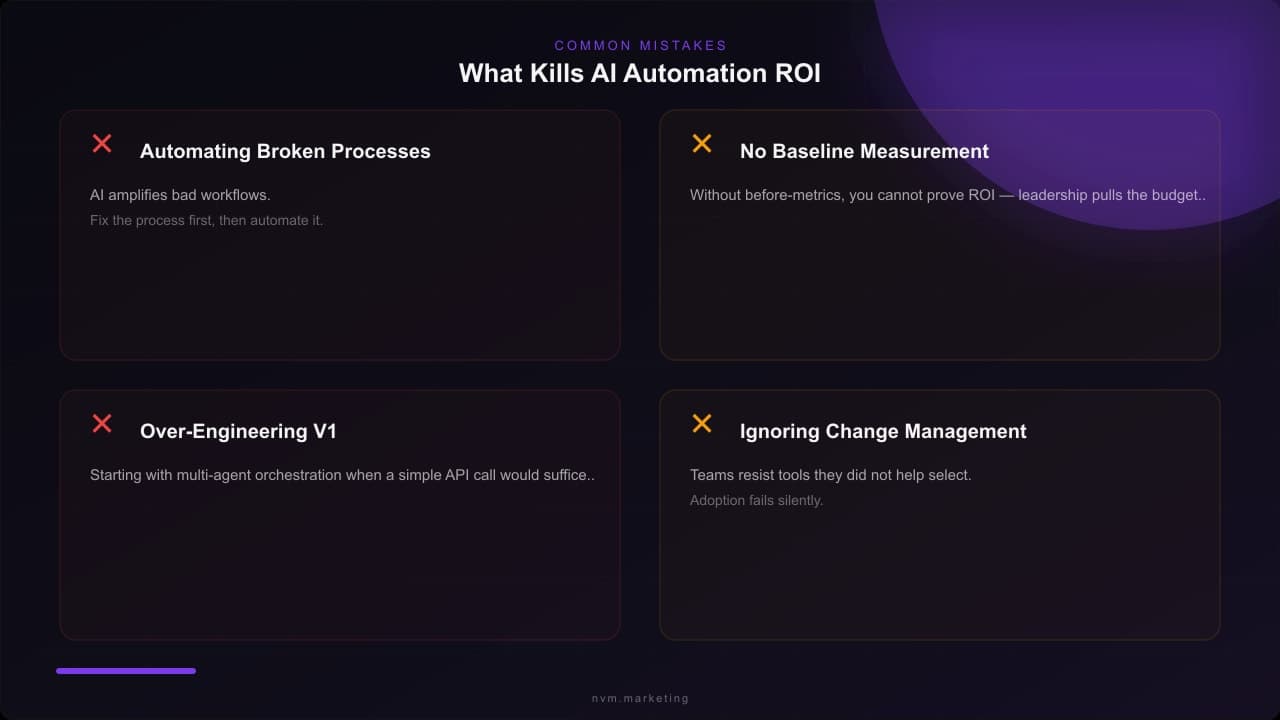
Not every process benefits from automation. Automating a broken process produces broken outputs faster. Before automating, fix the underlying workflow. If your lead follow-up process has no standard operating procedure, automating it will just send bad follow-ups faster.
Measuring Activity Instead of Outcomes
"We processed 10,000 leads through our AI system" is an activity metric. "Our AI system increased qualified pipeline by 35 percent while reducing cost per qualified lead by 40 percent" is an outcome metric. Always measure outcomes.
Ignoring the Change Management
Automation changes how people work, and people resist change. The most technically perfect automation will fail if the team does not adopt it. Invest in training, communicate the benefits clearly, and involve team members in the design process so they feel ownership rather than displacement.
Starting Your Automation Journey
If your team is still spending hours on data entry, manual client follow-ups, or report generation, start by mapping the handoffs that repeat every week. The best automation opportunities are usually the boring ones — the tasks nobody wants to do but everyone needs done.
Pick one. Measure the current state. Automate it. Measure the result. If the ROI is positive, move to the next one. This iterative approach builds confidence, proves value, and creates the organizational momentum for larger automation investments.
The future belongs to operators who treat AI not as a technology project but as an operational discipline — a continuous practice of finding friction, removing it with intelligent automation, and measuring the impact with precision.
Keep the signal coming
Practical analysis on AI search, automation, and growth, straight to your inbox. No noise.
Related reading
AI Automation for SMEs: Scaling Without Increasing Headcount
Every new hire brings capability — and coordination overhead. AI automation lets SMEs handle enterprise-level volume without the org chart.
AI Workflows for UAE Businesses: Multi-Agent Systems
ChatGPT for emails saves minutes. Autonomous multi-agent workflows save months. UAE businesses are closing that gap now.
How AI Is Transforming B2B Lead Generation
For every closed B2B deal, dozens of hours are wasted on prospects who were never going to buy. AI changes which parts of the pipeline need humans at all.
Have a take on this?
Add a practitioner insight. Approved contributions appear inline with your name.
Comments
Sign in to join the conversation
Sign in