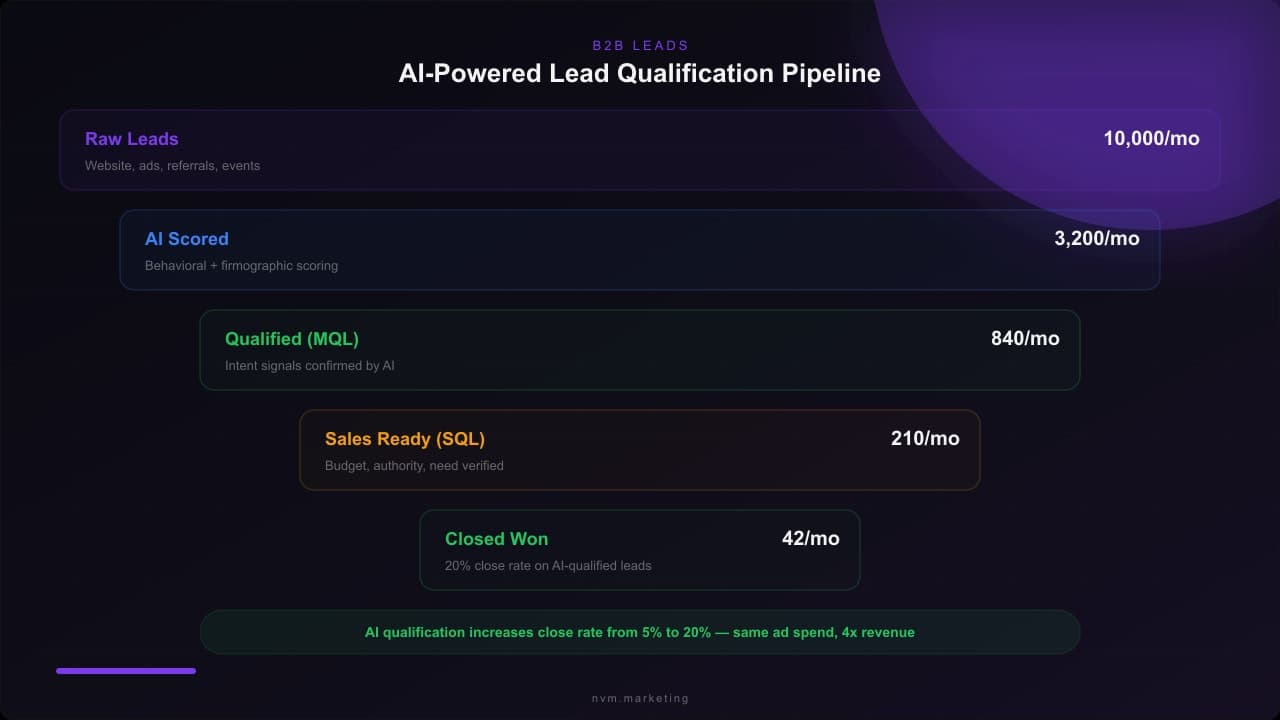
How AI Is Transforming B2B Lead Generation
For every closed B2B deal, dozens of hours are wasted on prospects who were never going to buy. AI changes which parts of the pipeline need humans at all.
B2B lead generation has always been a volume game with a quality problem. Marketing generates hundreds of leads, sales spends weeks qualifying them, and the conversion rate from lead to customer hovers between 2 and 5 percent. The wasted effort is staggering — for every closed deal, dozens of hours are spent on prospects who were never going to buy.
AI does not just make this process faster. It fundamentally changes which parts of the process require human involvement and which can be handled by machines that never sleep, never forget to follow up, and never let a high-value lead sit in an inbox overnight.
The shift is already happening. Saudi Arabia is a particularly visible example because digital transformation is accelerating across B2B services, real estate, education, and enterprise sales. But the pattern is global: teams that adopt AI-powered lead generation consistently outperform those that rely on manual qualification.
The Problem with Manual Lead Qualification
Traditional B2B lead qualification depends on human judgment at every stage. A marketing qualified lead (MQL) fills out a form, and someone on the team reviews it. They check the company size, look up the contact on LinkedIn, assess whether the inquiry matches an ideal customer profile, and decide whether to pass it to sales or add it to a nurture sequence.
This process has three structural problems:
Speed Decay
The probability of qualifying a lead drops by 80 percent after the first five minutes of response time. Yet the average B2B response time is over 42 hours. Every hour between form submission and first contact reduces the likelihood of conversion. Human teams cannot respond instantly to every inquiry, especially outside business hours, which in a global market means missing leads from different time zones entirely.
Inconsistent Scoring
Different team members evaluate leads differently. One representative might consider a 50-person company too small while another sees it as a perfect fit. Without standardized scoring criteria applied consistently, lead routing becomes subjective and unpredictable. High-value leads get buried in the same queue as unqualified inquiries.
Scaling Limitations
As lead volume increases, manual qualification does not scale linearly — it breaks. A team that handles 50 leads per week reasonably well becomes overwhelmed at 200. The response is usually to hire more people, which increases costs proportionally without improving the quality of qualification.
How AI Solves Each Problem
Instant Engagement and Qualification
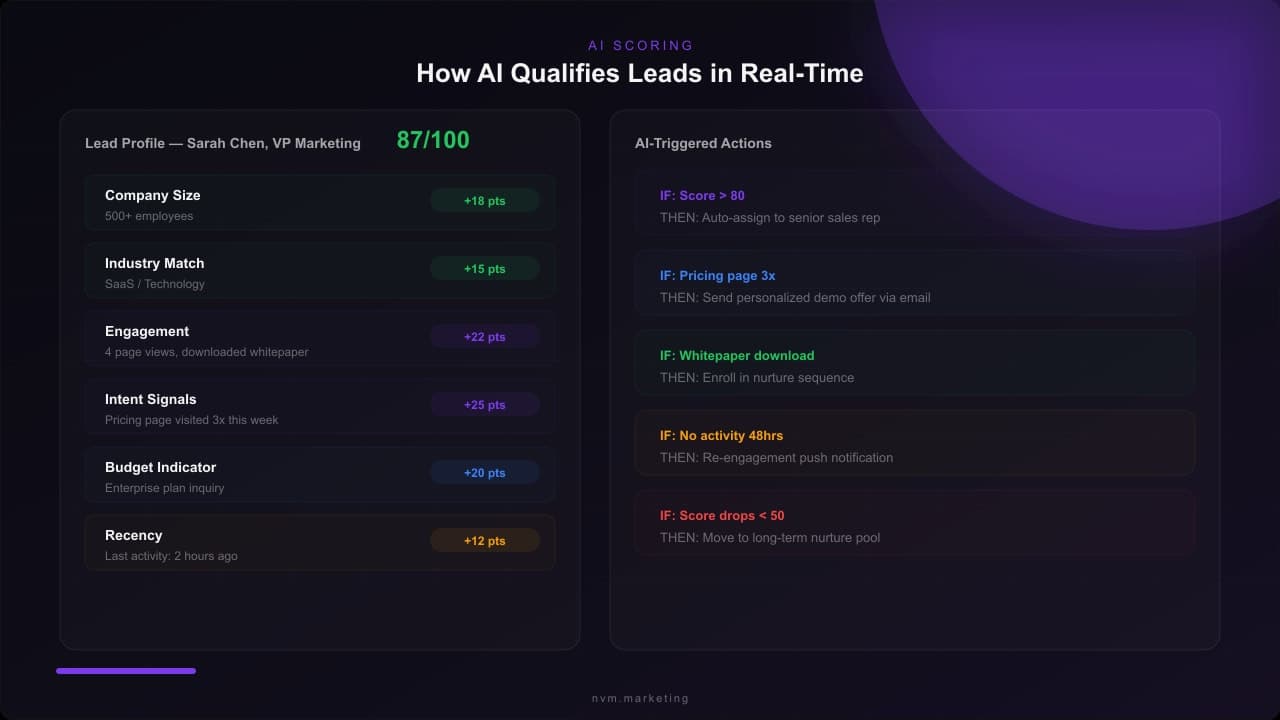
AI-powered systems engage every lead within seconds of form submission, regardless of time zone or business hours. But this is not the same as an auto-reply email that says "Thanks, we'll be in touch." Modern AI qualification agents conduct genuine conversations.
When a visitor fills out a contact form or engages with a chatbot, the AI agent can:
- Ask qualifying questions that determine budget range, timeline, decision-making authority, and specific needs — the BANT framework applied conversationally rather than through a rigid form
- Research the company in real-time, pulling firmographic data from databases to understand company size, industry, tech stack, and recent funding
- Assign a lead score from 1 to 100 based on a model trained on your historical conversion data — which characteristics of past leads predicted actual purchases
- Route instantly — high-scoring leads get a calendar link and a notification to your senior sales representative within minutes, while lower-scoring leads enter automated nurture sequences
The result is that your sales team only receives leads that meet your qualification criteria, pre-enriched with company data and scored by likelihood to close.
Standardized, Data-Driven Scoring
AI scoring models eliminate subjectivity by applying the same criteria to every lead. More importantly, they learn from outcomes. When a lead scores 85 and eventually closes, that reinforces the model. When a lead scores 90 but churns after three months, the model adjusts.
The scoring dimensions typically include:
Firmographic signals: Company size, industry, location, and revenue range. A B2B SaaS company targeting mid-market enterprises can automatically deprioritize leads from companies with fewer than 50 employees.
Behavioral signals: Which pages did the lead visit? How long did they spend on the pricing page? Did they download a case study in their industry? A lead that visited the pricing page three times and downloaded a competitor comparison guide is signaling high purchase intent.
Engagement signals: Email open rates, response times, and meeting attendance from previous interactions. A lead who opens every email but never replies has a different profile than one who responds within hours.
Intent signals: Third-party intent data from platforms that track which companies are researching topics related to your product. A company whose employees are actively searching for solutions in your category is a warmer lead than one who stumbled onto your site from a generic search.
Intelligent Lead Enrichment
One of the most time-consuming aspects of manual qualification is research. A sales representative might spend 15 minutes per lead looking up the company, finding the right contact, understanding their tech stack, and identifying potential pain points.
AI enrichment agents do this in seconds. They pull data from multiple sources — company databases, social media profiles, news feeds, job postings, and technology detection tools — and compile a comprehensive lead profile before the first human conversation happens.
This enrichment is not just data collection. The AI synthesizes the information into actionable context: "This is a 200-person fintech company in Riyadh that recently raised Series B funding. They are hiring for three marketing positions, which suggests they are scaling their go-to-market team. Their website currently uses WordPress with basic analytics — they likely need a more sophisticated marketing infrastructure."
That context transforms the first sales conversation from discovery ("Tell me about your company") to value demonstration ("Based on your growth stage, here's how we've helped similar fintech companies in KSA").
24/7 Multilingual Support
In markets like Saudi Arabia, the UAE, and the broader GCC, B2B conversations happen in both Arabic and English — sometimes switching mid-conversation. A buyer might submit an inquiry in English, receive a follow-up in Arabic, and then switch back to English for the technical discussion.
Why This Matters for Conversion
Offering support in the buyer's preferred language is not a premium feature — it is a conversion requirement. Prospects who interact in their native language are 72 percent more likely to complete a purchase. In the GCC specifically, Arabic-first engagement signals respect for local business culture and creates an immediate trust advantage over competitors who only operate in English.
How AI Handles Multilingual Engagement
Modern NLP systems handle Arabic-English code-switching seamlessly. A single AI agent can:
- Detect the language of an incoming message and respond in kind
- Maintain context when the conversation switches languages mid-thread
- Handle Arabic dialects (Gulf Arabic, Levantine, Egyptian) alongside Modern Standard Arabic
- Produce natural, culturally appropriate responses — not the stilted output of basic translation engines
This capability means your lead generation operates around the clock in every language your market requires, without the staffing cost of multilingual sales teams working in shifts.
Predictive Analytics and Pipeline Forecasting
Beyond handling individual leads, AI systems analyze your entire pipeline to identify patterns and predict outcomes.
Pipeline Velocity Analysis
AI models track how long leads typically take to move through each stage of your sales pipeline and flag anomalies. If a lead that matches your ideal customer profile has been sitting in the proposal stage for three weeks when similar leads typically close in ten days, the system alerts your sales team to re-engage before the opportunity goes cold.
Revenue Forecasting
By analyzing historical conversion rates at each pipeline stage, AI generates more accurate revenue forecasts than human estimation. A sales manager predicting quarterly revenue based on gut feel and pipeline value is typically off by 25 to 40 percent. AI models that factor in deal stage, engagement signals, competitive activity, and seasonal patterns reduce that error margin to under 15 percent.
Ad Spend Optimization
Predictive models identify which lead sources, campaigns, and keywords produce the highest-value customers — not just the most leads. A Google Ads campaign might generate 100 leads at 50 AED per lead while a LinkedIn campaign generates 30 leads at 200 AED per lead. If the LinkedIn leads close at 3x the rate and have 2x the lifetime value, the LinkedIn campaign is actually more efficient despite the higher CPA.
AI systems surface these insights automatically, allowing marketing teams to reallocate budget from high-volume, low-value channels to lower-volume, high-value ones.
Implementation: Where to Start
The most effective approach to AI-powered lead generation is incremental. Do not attempt to automate your entire sales process at once.
Phase One: Automated Lead Response
Start with a system that responds to every inquiry within 60 seconds with an intelligent conversation rather than a template email. This alone typically increases qualification rates by 30 to 50 percent because you catch leads while their intent is highest.
Phase Two: Scoring and Routing
Add lead scoring based on your historical data and route leads to different sequences based on their score. High-score leads get immediate human attention. Medium-score leads get automated nurture with periodic human check-ins. Low-score leads get long-term nurture content.
Phase Three: Enrichment and Personalization
Integrate data enrichment to give your sales team complete context before every conversation. Personalize outreach based on the enriched data — industry-specific case studies, relevant pain points, and tailored value propositions.
Phase Four: Predictive Optimization
Once you have enough data, deploy predictive models to forecast pipeline outcomes, optimize ad spend, and identify at-risk deals before they stall.
The Competitive Advantage
AI-powered lead generation is not a future capability — it is a current competitive differentiator. The B2B companies that adopt these systems now are building compounding advantages: faster response times, better qualification, richer data, and more accurate forecasting. Each improvement feeds the next, creating a flywheel that manual processes cannot match.
The question is not whether to adopt AI for lead generation but how quickly you can implement it before your competitors do. In fast-moving markets like Saudi Arabia and the UAE, the window for early-mover advantage is measured in months, not years.
Keep the signal coming
Practical analysis on AI search, automation, and growth, straight to your inbox. No noise.
Related reading
Maximizing ROI with AI Automation: Operator Framework
The gap between 'we implemented AI' and 'AI generated measurable ROI' is where most initiatives stall. An operator's framework for closing it.
AI Automation for SMEs: Scaling Without Increasing Headcount
Every new hire brings capability — and coordination overhead. AI automation lets SMEs handle enterprise-level volume without the org chart.
AI Workflows for UAE Businesses: Multi-Agent Systems
ChatGPT for emails saves minutes. Autonomous multi-agent workflows save months. UAE businesses are closing that gap now.
Have a take on this?
Add a practitioner insight. Approved contributions appear inline with your name.
Comments
Sign in to join the conversation
Sign in