AI Workflows for UAE Businesses: Multi-Agent Systems
ChatGPT for emails saves minutes. Autonomous multi-agent workflows save months. UAE businesses are closing that gap now.
The common mistake business owners make in 2026 is thinking AI means "ChatGPT for emails." That saves minutes. Autonomous multi-agent workflows save months. The gap between these two levels of AI adoption is where competitive advantage lives, and UAE businesses are uniquely positioned to close it faster than most.
This is not about replacing your team with bots. It is about eliminating the invisible work — the data transfers, the copy-pasting between systems, the follow-up emails that nobody wants to write but everyone needs to send — so your team can focus on the decisions and relationships that actually grow the business.
What Multi-Agent Systems Actually Are
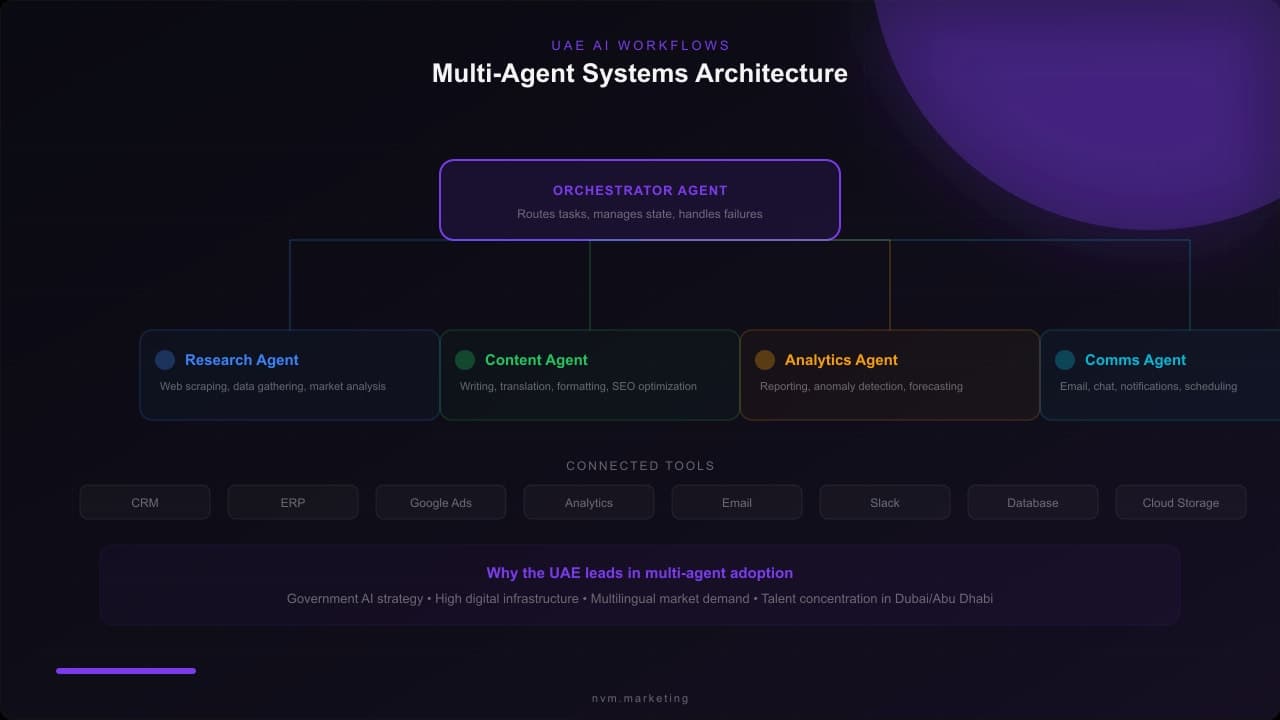
A single AI assistant is useful but limited. It waits for input, processes one task, and returns a result. A multi-agent system is fundamentally different: it is a network of specialized AI agents that coordinate with each other autonomously, each handling one piece of a larger workflow.
Think of it like a well-organized team where every member has a specific role:
- Agent A monitors for new client leads from your CRM, website forms, and social media channels
- Agent B receives the lead and researches the company — their industry, existing digital presence, recent news, and likely pain points
- Agent C takes that research and drafts a personalized proposal or outreach message tailored to the specific prospect
- Agent D schedules the initial consultation, sends calendar invites, and sets up the meeting agenda
In a traditional setup, this workflow requires a sales development representative spending 30 to 45 minutes per lead. With a multi-agent system, it happens in under two minutes with no human intervention until the actual meeting.
The Difference from Simple Automation
This is not the same as a Zapier workflow or a basic if-then automation. Traditional automation follows rigid, predefined paths: if this happens, do that. Multi-agent systems reason about their inputs. Agent B does not just pull data from a database — it evaluates what information is relevant, identifies gaps, and adjusts its research strategy based on what it finds. Agent C does not fill in a template — it writes a genuinely personalized message that reflects the prospect's specific situation.
The reasoning capability is what separates multi-agent systems from the automation tools businesses have been using for the past decade. Rules-based automation handles repetitive, predictable tasks. Agent-based systems handle tasks that previously required human judgment.
Why the UAE Is Uniquely Suited for AI Workflows
Several structural factors make the UAE one of the best markets in the world for AI workflow adoption.
Government-Backed Digital Infrastructure
The UAE has invested heavily in AI at the national level. The Ministry of Artificial Intelligence, the UAE Strategy for Artificial Intelligence 2031, and dedicated free zones for AI companies create an ecosystem where AI adoption is actively supported rather than passively tolerated. This means faster regulatory clarity, better access to technical talent, and a business environment that rewards digital innovation.
For practical purposes, this translates to shorter sales cycles when pitching AI solutions to UAE businesses. The awareness and willingness to adopt is already there — what most businesses need is implementation guidance, not persuasion.
High Mobile and Digital Adoption
The UAE has one of the highest smartphone penetration rates in the world, and its population is comfortable with digital-first interactions. This creates the data infrastructure that multi-agent systems need to operate effectively. When your customers interact with you primarily through digital channels — website, WhatsApp, social media, email — every interaction generates structured data that agents can process.
In markets where significant business still happens through phone calls and in-person meetings, the data capture problem is a major barrier to AI workflow adoption. In the UAE, this barrier is substantially lower.
Operational Speed Pressure
Dubai's business culture rewards speed above almost everything else. A proposal that arrives within hours beats one that arrives in two days, regardless of quality differences. Multi-agent systems excel in exactly this environment because their primary advantage is speed without sacrificing personalization. The same quality of research and outreach that might take a human team half a day is delivered in minutes.
Practical Applications Across Business Functions
Multi-agent workflows are not limited to sales. Every function with repetitive, data-dependent processes benefits from this approach.
Sales and Lead Management
The sales application described above is the most immediate opportunity for most UAE businesses. The workflow covers lead capture, enrichment, scoring, personalized outreach, and meeting scheduling. Businesses implementing this type of system typically see lead response times drop from hours or days to minutes, which in the UAE market directly correlates with win rates.
Beyond initial outreach, agents can manage the follow-up sequence: sending relevant case studies based on the prospect's industry, scheduling check-in emails at optimal intervals, and alerting the sales team when engagement signals suggest the prospect is ready to move forward.
Client Onboarding
Onboarding new clients involves a predictable sequence of document collection, account setup, welcome communications, and kickoff scheduling. Each step depends on the previous one, and delays at any point create a poor first impression.
A multi-agent onboarding system assigns each phase to a specialized agent. One agent manages document collection and verification, following up automatically when items are missing. Another configures the client's accounts and access. A third generates personalized welcome materials and training resources. A fourth coordinates the kickoff meeting and pre-populates the agenda with relevant context.
The result is an onboarding experience that feels premium and attentive without requiring a dedicated onboarding specialist for each new client.
Financial Operations
Invoice processing, expense categorization, payment follow-up, and financial reporting all contain manual steps that multi-agent systems can handle. An agent can monitor incoming invoices, match them against purchase orders, flag discrepancies, and route approvals to the right person. Another can track payment timelines and send graduated follow-up communications — a friendly reminder at 30 days, a firmer notice at 45 days, and an escalation at 60 days.
For UAE businesses dealing with international clients across multiple currencies and payment methods, agents that handle currency conversion, VAT calculations, and regulatory compliance documentation reduce both errors and processing time.
Customer Service and Support
Customer service in the UAE has particular demands. Customers expect rapid responses, often through WhatsApp, and they expect the person (or system) responding to have full context about their account and history. Multi-agent customer service systems meet both requirements simultaneously.
A front-line agent handles initial triage — understanding the issue, checking account status, and resolving common problems instantly. If the issue requires human intervention, the agent compiles a complete briefing: the customer's history, the nature of the problem, what has already been tried, and recommended solutions. The human agent walks into the conversation fully prepared instead of starting from scratch.
The Implementation Roadmap
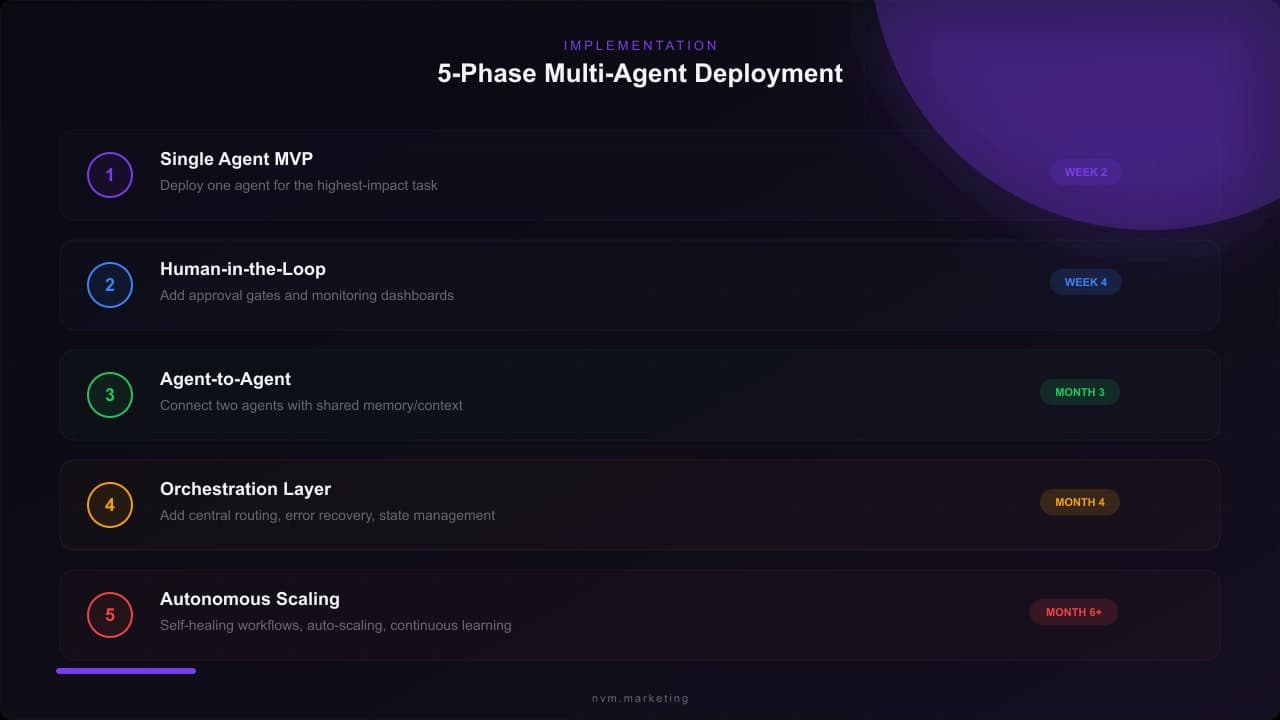
Moving from traditional operations to multi-agent workflows does not happen overnight. The businesses that succeed follow a specific sequence.
Step One: Identify the Bottlenecks
Start by mapping where humans currently act as data bridges between systems. Every time a person copies information from one tool to another, looks something up to make a simple decision, or sends a follow-up message that follows a predictable pattern, you have identified a candidate for agent automation.
Focus on bottlenecks that create visible business impact. A slow lead response time that costs you deals is a higher priority than automating an internal report that nobody reads urgently.
Step Two: Standardize Your Inputs
AI agents perform best with structured, consistent data. Before building agent workflows, clean up your data inputs. Standardize how leads are captured in your CRM. Ensure contact forms collect the fields agents need to personalize outreach. Structure your proposal templates so agents can populate them with variable data.
This data hygiene step is unsexy but essential. An agent working with messy, inconsistent data produces messy, inconsistent outputs. The quality of your inputs defines the ceiling of your automation.
Step Three: Build Feedback Loops
The systems that improve are the ones that learn. Every agent workflow should include a feedback mechanism: did the personalized outreach result in a meeting? Did the automated follow-up sequence convert? Did the onboarding system flag the right documents?
This feedback loop does not need to be complex. A simple tracking system that measures outcome rates for each agent's outputs provides enough signal to identify underperforming steps and refine them. Monthly reviews of agent performance, comparing results against human-managed equivalents, keep the system calibrated.
Step Four: Expand Incrementally
Start with one workflow, prove it works, measure the impact, then expand to the next. Businesses that try to automate everything at once create complexity that overwhelms their team's ability to manage and refine the systems. The companies that get the most value from multi-agent systems are the ones that master one application before moving to the next.
Common Mistakes to Avoid
Over-Automating Human Relationships
Not every interaction should be automated. High-stakes negotiations, sensitive customer complaints, and strategic partnership discussions benefit from human presence. The role of agents is to handle the preparation and follow-up that surrounds these interactions, not to replace the interactions themselves.
Ignoring the Handoff
The transition point between agent and human is where most systems fail. If an agent schedules a meeting but does not brief the human on the context, the human walks in unprepared and the automation created a worse experience than no automation at all. Design your handoffs with the same care you design the automation itself.
Choosing Tools Before Defining Workflows
Too many businesses start by selecting an AI platform and then look for problems it can solve. The effective approach is the reverse: map your workflows first, identify where agents add value, define the requirements, and then select the tools that meet them.
The Competitive Window
AI workflow adoption in the UAE is still in its early stages. The businesses that implement multi-agent systems now are building operational advantages that will be difficult for competitors to replicate once they become table stakes. The window for early-mover advantage is open, but it will not stay open indefinitely.
The transition from manual operations to multi-agent workflows is not a technology project. It is an operational transformation that happens to use technology. The businesses that approach it with that mindset — focused on workflow outcomes rather than tool features — are the ones that will see the most impact.
If your team is still moving information manually between tools, the highest-leverage move is to pick your most painful bottleneck, map the workflow, and automate the highest-friction step first. One successful automation creates the organizational confidence to do the next one, and the compounding effect builds from there.
Keep the signal coming
Practical analysis on AI search, automation, and growth, straight to your inbox. No noise.
Related reading
Maximizing ROI with AI Automation: Operator Framework
The gap between 'we implemented AI' and 'AI generated measurable ROI' is where most initiatives stall. An operator's framework for closing it.
AI Automation for SMEs: Scaling Without Increasing Headcount
Every new hire brings capability — and coordination overhead. AI automation lets SMEs handle enterprise-level volume without the org chart.
How AI Is Transforming B2B Lead Generation
For every closed B2B deal, dozens of hours are wasted on prospects who were never going to buy. AI changes which parts of the pipeline need humans at all.
Have a take on this?
Add a practitioner insight. Approved contributions appear inline with your name.
Comments
Sign in to join the conversation
Sign in