AI Automation for SMEs: Scaling Without Increasing Headcount
Every new hire brings capability — and coordination overhead. AI automation lets SMEs handle enterprise-level volume without the org chart.
For small and medium enterprises, efficiency is one of the few sustainable advantages. The challenge is not whether to grow — it is scaling operations without increasing costs, meetings, tools, and handoffs at the same pace. Every new hire brings capability but also coordination overhead: more Slack channels, more status meetings, more approval chains. At some point, the organizational cost of managing people exceeds the output those people produce.
AI automation breaks this equation. It allows SMEs to handle operational volume that would traditionally require additional headcount, without the management complexity that headcount creates. But the opportunity is narrower and more specific than the industry narrative suggests. Not every process benefits from automation, and the SMEs that generate real ROI from AI are the ones that target the right bottlenecks with the right level of automation.
The Efficiency Gap in SMEs
The efficiency gap in SMEs is structural, not behavioral. It is not that small teams work inefficiently — it is that small teams are forced to handle the same operational complexity as large organizations with a fraction of the resources. A five-person marketing agency handles client onboarding, content production, campaign management, reporting, invoicing, and client communication — the same functions that a 50-person agency distributes across specialized departments.
The result is predictable: team members spend their most productive hours on administrative tasks. A senior strategist who should be developing campaign architectures spends two hours per day updating spreadsheets, formatting reports, and chasing invoice approvals. A sales lead who should be closing deals spends 40 percent of their time on data entry and follow-up scheduling.
Why Hiring Does Not Solve It
The instinctive response to operational overload is hiring. But for SMEs, hiring introduces problems that compound faster than the problems it solves:
Coordination costs scale non-linearly: Adding one person to a five-person team does not increase capacity by 20 percent. It increases communication paths from 10 to 15 — a 50 percent increase in coordination overhead. By the time a team reaches 10 people, there are 45 communication paths, and a significant portion of each person's day is spent keeping everyone aligned rather than producing output.
Onboarding absorbs existing capacity: Training a new hire requires the existing team's time and attention during a period when they are already overloaded. The productivity dip during onboarding can take three to six months to recover, and for specialized roles in the UAE market, finding the right hire can take months before onboarding even begins.
Fixed costs reduce flexibility: Salaries, visa costs, office space, and benefits in the UAE create fixed cost structures that reduce the business's ability to adapt to market changes. AI automation converts fixed operational costs into variable costs that scale with actual usage.
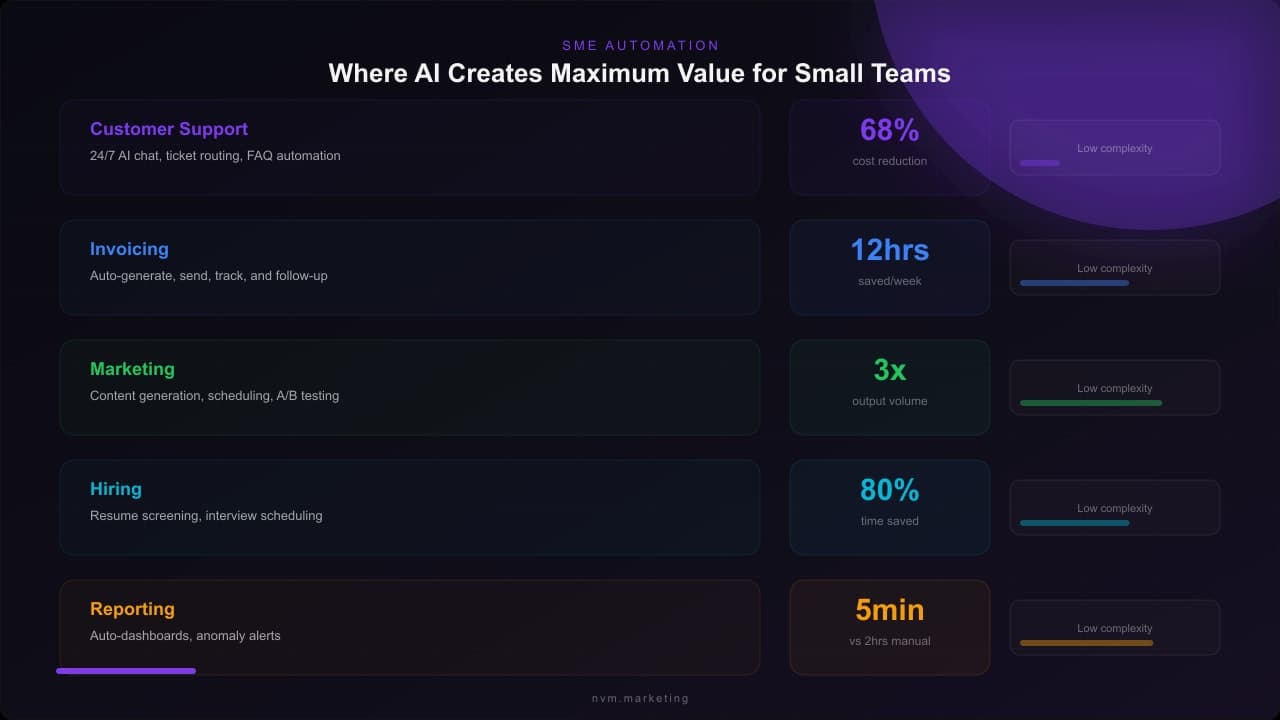
Where AI Automation Creates Maximum Value for SMEs
The highest-value automation targets for SMEs share three characteristics: they are repetitive, they follow predictable patterns, and they currently consume skilled human time that could be spent on higher-value work.
Lead Qualification and Routing
For most SMEs, lead qualification is the single highest-impact automation opportunity. Without automation, every form submission, email inquiry, and WhatsApp message receives the same treatment — a sales team member reads it, evaluates it subjectively, and decides whether to follow up. This creates three problems: response delays during busy periods, inconsistent qualification standards depending on who handles the lead, and wasted time on leads that were never going to convert.
AI-driven lead qualification solves all three simultaneously:
Instant response: An AI agent engages every incoming lead within seconds, asks qualifying questions, and captures the information your sales team needs — budget range, timeline, specific requirements, decision-making authority. This happens at 2 AM on a Friday as reliably as at 10 AM on a Tuesday.
Data enrichment: The AI system pulls company information from LinkedIn, website data, and public databases to build a lead profile before a human ever touches it. A lead from a 200-person company in DIFC with an active job posting for a marketing manager tells a very different story than a lead from an unidentifiable email address.
Intelligent routing: High-score leads route to immediate human outreach with full context. Medium-score leads enter automated nurture sequences with periodic human check-ins. Low-score leads receive long-term automated engagement that costs nothing in human time but keeps the relationship alive for future conversion.
Teams implementing this approach typically see lead-to-opportunity conversion rates increase by 30 to 50 percent because sales effort concentrates on the leads most likely to close.
Document and Invoice Processing
Manual data entry is not just slow — it is error-prone in ways that create cascading problems. A single incorrect digit on an invoice can trigger payment disputes, accounting mismatches, and hours of reconciliation work. For logistics, distribution, and service businesses that process dozens or hundreds of invoices weekly, the cumulative cost is substantial.
AI document processing extracts data from invoices, contracts, receipts, and purchase orders with accuracy that matches or exceeds human data entry. The system reads the document, identifies relevant fields, validates the extracted data against existing records, and flags discrepancies for human review. Processing time drops from 15 minutes per document to under 30 seconds, and error rates typically decrease by 70 to 90 percent.
For UAE businesses specifically, AI document processing handles the complexity of multilingual documents — invoices that mix Arabic and English, contracts with both Hijri and Gregorian dates, receipts in different currencies — without the manual effort of context-switching between languages and formats.
Customer Support at Scale
In a city like Dubai where customers communicate in English, Arabic, Hindi, Urdu, Russian, and Mandarin, providing multilingual support is an operational challenge that scales directly with headcount in a traditional model. Every additional language requires either multilingual staff or dedicated language-specific support agents.
AI-integrated support systems change this equation fundamentally:
Instant multilingual support: An AI support agent handles customer inquiries in any language without requiring separate language-specific teams. For common queries — order status, appointment scheduling, pricing information, return policies — the AI resolves the issue completely without human intervention. Mature implementations handle 30 to 40 percent of total support volume autonomously.
Intelligent escalation: When a query requires human expertise, the AI does not simply transfer the customer — it provides the human agent with full context: the customer's history, the nature of the issue, attempted resolutions, and the customer's sentiment. This reduces the human agent's handling time by 40 to 60 percent because they start with complete information instead of asking the customer to repeat everything.
Sentiment monitoring: AI systems detect customer frustration in real time — through word choice, response patterns, and interaction history — and escalate proactively before a minor issue becomes a complaint. This early intervention reduces negative reviews and customer churn.
Marketing Workflow Automation
Marketing operations in SMEs typically involve multiple disconnected tools: a CRM for contacts, a social media scheduler for posts, an email platform for campaigns, a spreadsheet for reporting, and a project management tool for task tracking. Each tool requires manual input, and the gaps between tools require human bridges — copying data from one system to another, reformatting reports, and manually triggering follow-up actions.
AI marketing automation connects these systems and eliminates the manual bridges:
Content operations: AI systems that learn your brand voice generate social media copy, email drafts, and blog outlines that require human editing rather than human creation. This shifts the content team's role from production to curation — reviewing and refining AI-generated content rather than creating everything from scratch. For an SME with a two-person marketing team, this effectively triples content output without additional headcount.
Campaign analytics: Automated dashboards pull data from advertising platforms, website analytics, CRM, and social media into unified reports that update in real time. The weekly reporting meeting that previously required four hours of manual data assembly now requires 30 minutes of analysis and decision-making.
Triggered workflows: When a prospect downloads a whitepaper, the AI system automatically adds them to the appropriate nurture sequence, notifies the sales team if they match ideal customer profile criteria, updates the CRM record, and schedules a follow-up task. This chain of actions that would take a human 15 minutes happens instantly and without error.
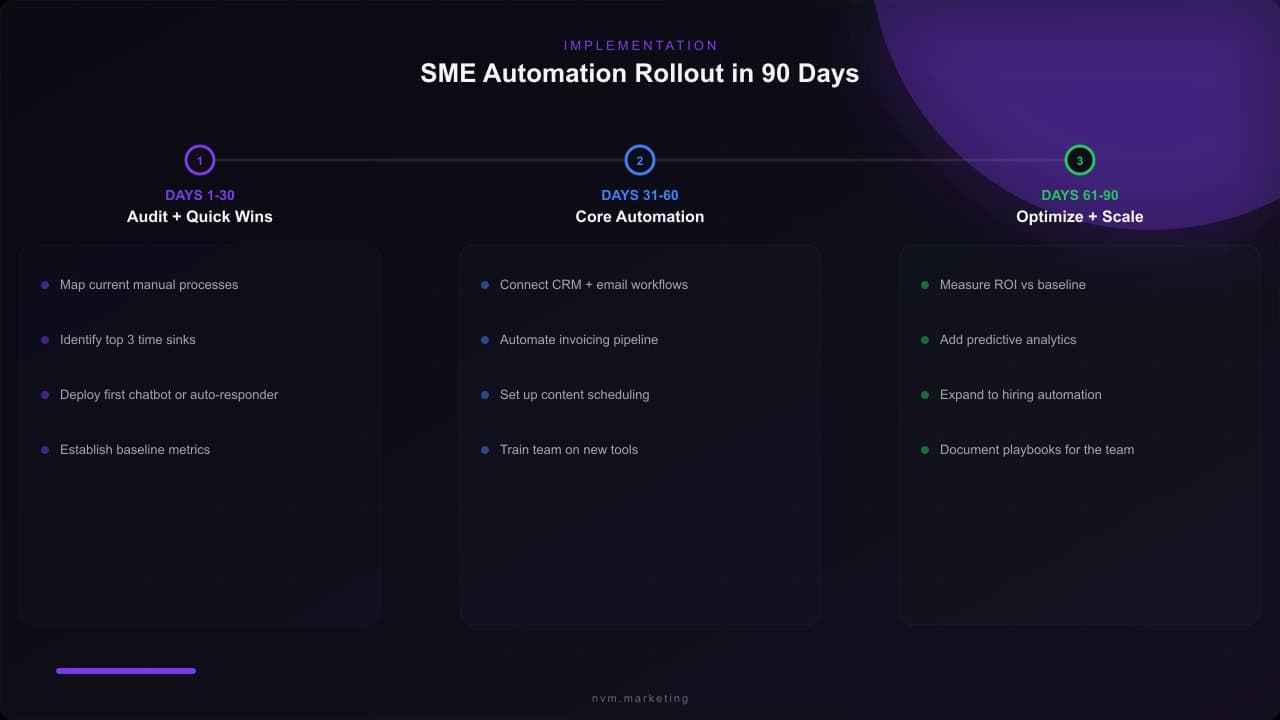
Implementation Framework for SMEs
Phase 1: Audit and Prioritize (Week 1-2)
Do not start with technology. Start with a process audit that identifies where your team's time goes:
Map every recurring task that takes more than 30 minutes per week. For each task, document: who does it, how long it takes, what inputs it requires, what outputs it produces, and what happens when it is done late or incorrectly. This audit typically reveals that 25 to 40 percent of total team hours are spent on tasks that AI can handle.
Prioritize by impact: focus first on automations where the time saved multiplied by the hourly cost of the person doing the work produces the highest monthly value. A task that saves your highest-paid team member two hours per day is worth more than a task that saves an intern one hour per day, even if the intern's task is technically easier to automate.
Phase 2: Build the First Automation (Week 3-6)
Pick one high-impact automation and build it properly. The most common mistake SMEs make is trying to automate five things at once, doing all of them poorly, and concluding that AI automation does not work.
Use established platforms — Make, Zapier, or n8n for workflow orchestration, combined with AI APIs for the intelligence layer. Custom Python agents are appropriate for complex logic but add maintenance overhead that may not be justified for simpler workflows.
Build with human-in-the-loop design: the AI handles the repetitive processing, but a human reviews and approves high-stakes outputs. An AI that drafts client proposals is valuable. An AI that sends client proposals without review is a liability.
Phase 3: Measure and Expand (Month 2-3)
Measure the first automation against the baseline you established in the audit. If it saves the expected time, reduces the expected errors, and maintains or improves quality — expand to the next automation on your priority list. If it does not, diagnose why before moving forward: the process may need redesign before automation can improve it.
Each successful automation funds the next one — not just financially, but in organizational confidence. The team sees that automation removes tedious work rather than threatening jobs, and adoption resistance decreases with each proven implementation.
Common Mistakes That Kill SME Automation ROI
Automating Broken Processes
A broken process automated is a broken process that fails faster. If your lead follow-up process has no standard operating procedure — no defined response times, no qualification criteria, no escalation paths — automating it produces inconsistent outputs at higher speed. Fix the process first, then automate it.
Over-Engineering the First Implementation
The first automation should be simple, reliable, and demonstrably valuable. An AI system that handles 80 percent of cases perfectly is more valuable than one that attempts to handle 100 percent of cases and fails on edge cases. Build for the common path first, handle exceptions manually, and add complexity only when the data justifies it.
Ignoring Change Management
Automation changes how people work. The sales lead who has been qualifying leads manually for three years may resist an AI system that does it differently — not because the AI is wrong, but because the change threatens their sense of competence. Involve team members in the design process, communicate how automation makes their work more valuable rather than less relevant, and celebrate the time recovered rather than the tasks eliminated.
The Compounding Advantage
AI automation ROI compounds. The first automation saves time. The saved time allows the team to focus on higher-value work that generates more revenue. The additional revenue funds more automation. Each cycle widens the gap between automated SMEs and their manually-operated competitors.
The businesses that start building automation infrastructure now — even with a single workflow — are establishing the operational discipline and technical foundation for a compounding advantage that becomes increasingly expensive for competitors to replicate. The cost of delay is not standing still. It is falling behind competitors who are already building.
Keep the signal coming
Practical analysis on AI search, automation, and growth, straight to your inbox. No noise.
Related reading
Maximizing ROI with AI Automation: Operator Framework
The gap between 'we implemented AI' and 'AI generated measurable ROI' is where most initiatives stall. An operator's framework for closing it.
AI Workflows for UAE Businesses: Multi-Agent Systems
ChatGPT for emails saves minutes. Autonomous multi-agent workflows save months. UAE businesses are closing that gap now.
How AI Is Transforming B2B Lead Generation
For every closed B2B deal, dozens of hours are wasted on prospects who were never going to buy. AI changes which parts of the pipeline need humans at all.
Have a take on this?
Add a practitioner insight. Approved contributions appear inline with your name.
Comments
Sign in to join the conversation
Sign in